
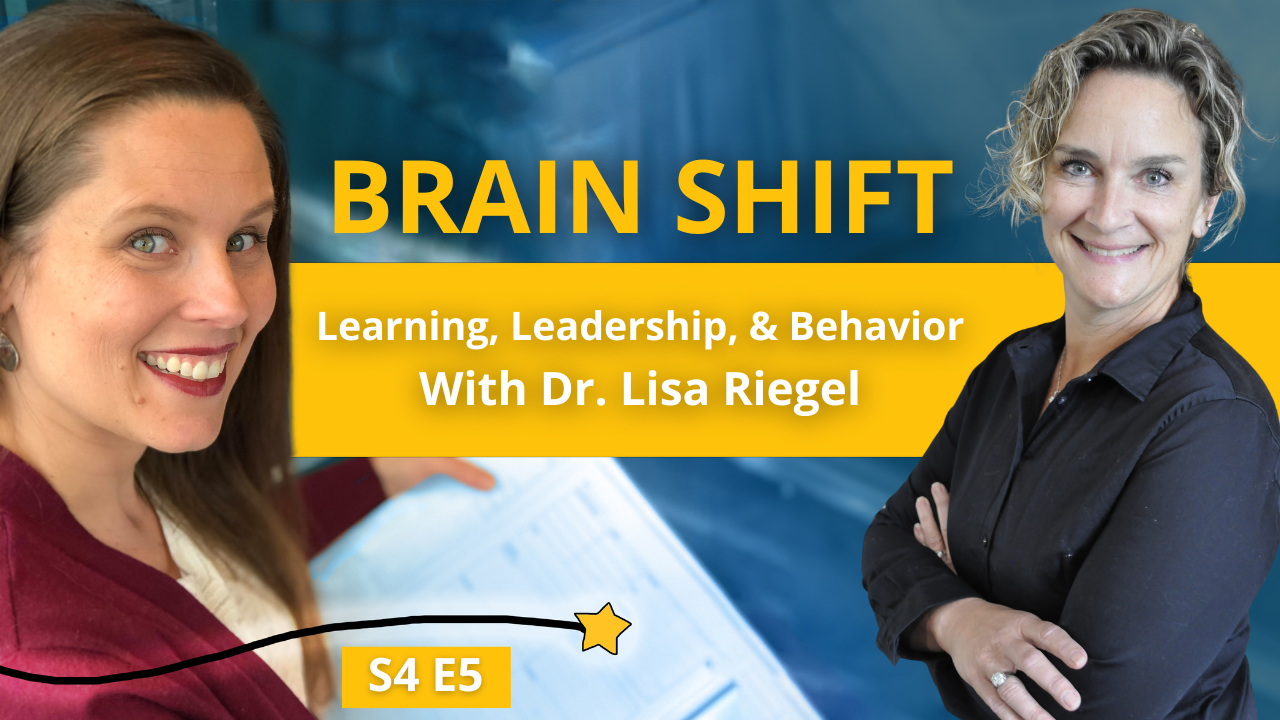


What if the key to better behavior, stronger leadership, and healthier relationships isn’t found in stricter rules, but in understanding how the brain works?
In this episode of Diary of a Dreamer, Tasha Eizinger sits down with educator, author, and leadership expert Dr. Lisa Riegel to explore how brain science influences behavior, learning, anxiety, self-regulation, and personal growth.
Drawing from decades of experience in education, leadership development, and neuroscience research, Dr. Riegel explains why many of our reactions happen long before we’re consciously aware of them. She shares practical strategies for managing stress, developing self-awareness, building healthier habits, and creating environments where people can thrive in and out of the classroom.
Whether you’re a parent, educator, leader, entrepreneur, or someone interested in personal growth, this conversation offers practical tools you can start using immediately.
Connect with Dr. Lisa Riegel
Website: LisaRiegel.com
Website: EPInstitute.com
LinkedIn: Dr. Lisa Riegel
Read Transcript
[00:00] Tasha Eizinger:
Welcome to Diary of a Dreamer, where resilience unlocks your potential.
I’m Tasha Eizinger, and each week I’ll bring you powerful stories and practical insights from my own experiences and inspiring guests. Whether you’re facing challenges or chasing dreams, this podcast is your go-to source for motivation, confidence-building, and practical tips for transforming obstacles into opportunities.
Be sure to check out my website, TashaEizinger.com.
Let’s dive into today’s episode and start turning your dreams into reality.
[00:35] Tasha:
Today we are here with Dr. Lisa Riegel, and I’m super excited. She’s actually going to be a repeat guest, which makes me even more excited because we’re really just warming up for another conversation we’ll have as well.
For everyone listening, Dr. Lisa Riegel has spent more than two decades helping schools, leaders, parents, and organizations align brain science with human systems. She began her career as an educator, wanting to help children reach their potential, and that passion has evolved into the work she does today.
She has authored five books—two of which we’re going to talk about today—and her work has been featured in peer-reviewed journals. I’m incredibly excited about the wealth of information, experience, and research she brings to this conversation.
Thank you for being here today.
[01:30] Dr. Lisa Riegel:
Thank you so much for having me.
[01:32] Tasha:
How did you go from being a classroom teacher to deciding, “I’m going to become a neuroscientist”?
[01:41] Dr. Lisa:
Well, I started out as a teacher and spent nine years in the classroom. During my first few years, I had an incredible administrator. Then she left, and I experienced a series of ineffective leaders. That really started me down the leadership path because I became interested in understanding how people lead.
Eventually, I had the opportunity to become a leader myself. I served as an administrator at a career center for a couple of years and, unfortunately, experienced another ineffective leader. That led me to pursue doctoral work at Ohio State, where I focused on leadership.
What interested me most wasn’t policy or organizational theory—it was the human side of leadership. I felt there was a significant gap in how we prepare leaders. Even in MBA programs, we often prepare people to be executives, but not necessarily leaders. I wanted to understand how we teach the human side of leadership.
At the same time, I had always worked with at-risk students. I wanted to know how to help kids become excited about learning and how to help them feel confident and secure in themselves.
So I had one foot in understanding children and another in understanding adults. I started digging into social science research around motivation, engagement, and learning. Eventually, I realized that real change starts in the brain, so I should probably understand how the brain works, too.
Around that time, the Science of Reading movement was gaining momentum. I remember thinking, “We’re finally aligning the way we teach reading with the way the brain actually learns to read. That’s amazing.”
Then I started wondering, “Behavior happens in the brain, too. What if we studied behavior, motivation, engagement, and relationships through the lens of neuroscience rather than through the lens of character, morality, or choice?”
[03:35] Tasha:
So it was basically one domino knocking over the next domino.
[03:40] Dr. Lisa:
Exactly.
If there’s one thing I can say about my life, it’s that it has not been a straight path. I’ve zigged and zagged all over the place. But I’ve always been a curious person.
Looking back, every place I’ve landed was exactly where I needed to be at that moment.
[03:56] Tasha:
And isn’t it invigorating to be at a point in your life where you can provide so much value because it’s the accumulation of years of learning, experience, and curiosity?
I also love people like you who see a problem and, instead of complaining about it, decide to do something about it.
We need more people who think that way.
[04:26] Dr. Lisa:
One thing I bring to my clients is that I spent many years as a classroom teacher. I also worked as an academic researcher at Ohio State, but I never became disconnected from the classroom.
I understand what it’s like to teach. I spend a lot of time coaching teachers in classrooms, leaders in offices, and leadership teams in meetings.
I also bring the perspective of being a parent. Both of my children have ADHD. In fact, I’m the only person in my household who doesn’t.
I navigated special education, twice-exceptional learners, and all of those challenges. My son was particularly difficult to teach when he was younger. He’s doing great now, but as a child he was constantly moving, rolling around, and needing activity. School simply wasn’t designed for him.
At one point, I even pulled him out and homeschooled him for a year.
Those experiences have given me multiple perspectives that I bring to the table.
One of my books is called Aspirations to Operations. I think many people live in the aspirations phase. They say, “I wish we could do something about this.”
The reality is that we can. We just have to operationalize it.
We can’t stay stuck in concepts. We have to move into action.
That’s what I try to provide—knowledge combined with practical implementation. I don’t want people walking away thinking, “This sounds great, but I have no idea where to start.”
[06:01] Tasha:
So where do people start?
Obviously, getting your book would be one way.
[06:03] Dr. Lisa:
Yes, absolutely.
But the first step is understanding the “why.”
There is some learning involved. People need to understand how the brain creates perceptions, how it functions, and what I call the biology of behavior.
I describe behavior as the intersection of biology and context.
Whether you’re a parent, educator, or leader, if you start viewing behavior through the lens of biology, you begin to realize that much of what drives behavior happens beneath conscious awareness.
About 80% of our thinking is unconscious.
There is a tremendous amount of processing happening below the surface that influences how we behave, react, respond, and feel before we’re even aware of it.
Understanding that biology helps us develop empathy. It also helps us reframe problems and develop solutions that actually work.
In schools, I often see students who simply don’t fit neatly into the system we’ve created. We try all kinds of interventions that don’t work because we’re operating under the assumption that the student knows how to behave and is choosing not to.
We treat it as a character issue, a morality issue, or a choice issue.
But when we understand the biology behind behavior, we realize that assumption isn’t always accurate.
The other side of the equation is context.
Many students develop negative worldviews and negative beliefs about themselves. Over time, those patterns become embedded in the brain itself.
I often say that the solution to pollution is dilution.
If a brain is filled with negativity, it affects how reality is perceived. The antidote is positivity.
As educators, leaders, and parents, we have tremendous influence over the environments we create. We can intentionally create contexts that help people become healthier, happier, and more successful.
[08:18] Tasha:
So is this what neuroplasticity is? Are we essentially rewiring people’s brains?
Diary of a Dreamer Podcast
Featuring Dr. Lisa Riegel
Cleaned Transcript – Part 2
[08:18] Tasha:
So is this what neuroplasticity is? Are we essentially rewiring people’s brains?
[08:24] Dr. Lisa:
Yes, some of it is rewiring.
When we create perceptions, our brains function almost like a giant company. We tend to think our brain is completely under our conscious control, but the reality is that about 80% of what happens in the brain occurs outside of our awareness.
I like to describe one part of the brain as the “data department.” It’s located in the thalamus, which sits within the limbic system. This part of the brain doesn’t understand time and can’t tell a story. Its job is simply to take in information from the environment and determine whether something is similar to a previous experience.
I call my data manager Harold.
Harold’s job is to look at incoming information and say, “This is like that.”
If every experience felt completely new, our brains would be overwhelmed. We rely on patterns to make sense of the world.
[09:13] Tasha:
And our brains are masters at finding patterns.
[09:18] Dr. Lisa:
Absolutely.
[09:19] Tasha:
And that’s really about survival, right? Our brains look for patterns to keep us safe.
That was incredibly useful thousands of years ago when we were surrounded by predators. Now our brains try to keep us safe in situations where we’re actually okay.
Is that accurate?
[09:35] Dr. Lisa:
Yes.
Our brains are amazing machines for the world humans lived in thousands of years ago. The problem is that we still have those same mechanisms operating today.
The limbic brain exists to keep us alive and keep us safe.
Many people think behavior is simply a series of conscious decisions. While that’s partly true, your brain is constantly feeding you information designed to protect you before your conscious mind even has a chance to weigh in.
Fear keeps us alive.
The brain is constantly comparing what’s happening now to what happened in the past, and our bodies often react as if those situations are identical—even when they’re not.
For example, if you grew up with a hypercritical parent who constantly put you down, you might learn to associate feedback with danger.
Later in life, someone may offer you constructive feedback, but before the thinking part of your brain has a chance to process it, Harold is already generating a report that says, “This is bad. This is dangerous. The last time this happened, we felt terrible.”
That report gets sent to the amygdala, which I call Bob.
Bob is your security officer.
Bob immediately hits the panic button because all of this happens before the rational, thinking part of your brain has a chance to participate.
[11:23] Tasha:
I don’t get the impression that you’re saying consequences shouldn’t exist.
You seem incredibly compassionate and empathetic, but you also recognize that consequences are part of life.
[11:40] Dr. Lisa:
Absolutely.
When we understand how the brain works, we gain the ability to ask a different question.
Instead of saying, “What’s wrong with this child?” we can ask, “What’s happening here?”
Sometimes a child isn’t choosing the behavior at all.
That’s very different from a child making a poor decision while fully regulated and fully in control.
When children are living in chronic stress, their stress systems can become dysregulated. At that point, Harold and Bob essentially take over.
When they determine you’re not safe, Bob sends a message to the executive center of your brain—the part that represents your conscious self—and says:
“We’ve got this. You can leave now.”
I often joke that Bob tells the rational part of the brain to go grab a coffee and wait until things are safe again.
When I observe classrooms, I frequently see situations where the Harold and Bob of the student are arguing with the Harold and Bob of the teacher.
Neither person is actually functioning as their best self.
That’s why people often calm down later and think, “Why did I say that? I don’t even believe that.”
It’s because the rational part of the brain wasn’t running the show at that moment.
[13:02] Tasha:
So now I can just blame everything on Harold and Bob.
[13:05] Dr. Lisa:
You can blame them, but you’ll still have to deal with the consequences.
One of my goals for humanity is helping people develop self-awareness, self-regulation, and self-control.
You can’t have self-control without the first two.
You have to understand how your brain works and learn how to calm your body.
Another important piece of this conversation is the vagus nerve.
The vagus nerve runs through the neck and around the heart. I often describe it as the systems manager of the body.
It’s constantly monitoring whether your heart is beating properly, whether your stomach is functioning correctly, and whether your body is operating as it should.
But it also tracks where your body is in space. This process is called proprioception.
Think about standing near the edge of a cliff. Your brain needs to know where your body is so it can determine whether you’re safe.
The vagus nerve constantly provides that information.
The challenge is that modern life doesn’t provide the kind of movement our bodies were designed for.
Proprioceptive development comes from rolling down hills, hanging upside down, doing somersaults, climbing, balancing, and moving through space.
Children don’t spend nearly as much time doing those things anymore.
Many adults don’t either.
As a result, the vagus nerve is often overstimulated and uncertain. It’s continually sending messages that something feels off, which contributes to elevated stress levels.
[14:54] Tasha:
I heard something fascinating recently.
If a deer is being chased in the wild, its stress hormones spike as it runs for safety. But once it escapes, one of the first things it does is shake.
I’ve heard that the shaking helps release the stress response so it doesn’t stay trapped in the body.
That’s why people sometimes recommend humming, movement, or other activities that stimulate the vagus nerve.
Is there any truth to that?
[15:31] Dr. Lisa:
One hundred percent.
It’s funny that you mention humming because I naturally hum when I cook.
Not necessarily songs—sometimes it’s just random sounds.
My husband always knows when I’m cooking because I’m humming in the kitchen.
When I started learning more about neuroscience, I realized that part of the reason cooking feels relaxing is because humming stimulates the vagus nerve.
It’s essentially self-regulation happening automatically.
Another incredibly simple exercise people can use is setting a timer on their phone.
Start with every 30 minutes.
When the timer goes off, take two or three deep breaths.
And remember: when in doubt, blow out.
Exhaling longer than you inhale activates the relaxation response.
After taking a few breaths, gently rotate your wrists and ankles. Stretch your neck. Move a little.
Do this for 15 seconds.
Then place your feet firmly on the ground.
You’ll notice that you’re suddenly more aware of where your body is.
That awareness sends a message through the vagus nerve that says:
“We know where we are. We’re safe.”
The same thing happens when you squeeze your fingertips together and intentionally notice the sensation.
The nervous system begins mapping the rest of the body based on that awareness.
You’re essentially reminding your brain that you’re grounded and secure.
When people repeat this process throughout the day, the body begins to develop a habit of relaxing.
Over time, your baseline stress level decreases, making it easier to stay regulated when challenges arise.
[17:27] Tasha:
Its own. And why 30 minutes? Why is that important? Why not 90 minutes?
[17:32] Dr. Lisa Riegel:
You could do it every 90 minutes. I think it’s really about getting some frequency in there. Fit it into whatever works in your day.
The point is that you want the baseline of your body to remain calm. When your body is calm, your executive functioning—the executive of your brain—is much more likely to stay engaged when stressors come your way.
If you’re already elevated and Harold and Bob encounter a stressor, they may decide, “Okay, this is enough. We don’t even know where we are anymore. We’ve got stress happening. You get out of here and go be safe. We’ll take care of it.”
[18:17] Tasha:
Right. That’s interesting—and such a simple thing for us to do.
[18:21] Dr. Lisa:
So simple.
Many of these things are incredibly simple. Whether I’m talking to business leaders, educators, teachers, or parents, the focus is always on understanding the human system.
You don’t need a dissertation in brain science. You just need a basic understanding of what’s happening in there. I summarized most of it in about 40 pages with diagrams in my book.
You learn a little about how the brain works. You practice some relaxation techniques. Then you gain more self-control.
The goal is for you to decide how you want to proceed instead of letting Harold and Bob decide for you.
[19:03] Tasha:
I like to tell myself, “Hey, I’m the boss. Not all this other stuff. I’m the boss.”
[19:10] Dr. Lisa:
Exactly.
Let me give you an example.
When I was little, my parents were divorced. My dad would come pick me up on his nights, and he was always late. Always.
Divorce is already disruptive, and there were a lot of negative emotions attached to it. I spent a huge portion of my childhood sitting on the front step waiting for him.
[19:32] Tasha:
My little eight-year-old heart hurts for little Lisa.
[19:35] Dr. Lisa:
Mine does too.
What happened was that my brain made an association between time and love, worth, respect, and importance.
For years—even into my twenties and thirties—if my husband was running late or if I was running late, I would feel anxiety and anger. It didn’t matter what I logically knew. I could tell myself, “This is silly. Everything is fine.”
But my body didn’t agree.
[20:03] Tasha:
Right.
[20:04] Dr. Lisa:
Once I understood what was happening, I could intervene.
If I noticed we weren’t going to arrive on time, before I started escalating emotionally, I could say:
“Harold, this is not that. We are fine. This is an open house. We don’t have to be there at the beginning.”
The second thing I did was build systems that worked for me. I leave early for everything.
My clients laugh because if I’m not there 10–15 minutes early, they assume I’m in a ditch somewhere. That’s just who I am now.
By leaving early, I remove the trigger entirely.
When we teach ourselves how our brains work—and when we teach kids how their brains work—we can create routines and systems that give us a greater sense of control.
And anxiety is often the result of feeling out of control.
The more control we feel we have, the less anxiety we tend to experience.
[21:45] Tasha:
A hundred percent.
Something else I do is get curious when I have a strong emotional reaction to something.
If something really bothers me, I ask:
“Why did that bother me so much?”
“Where did that come from?”
I try not to be judgmental. I genuinely want to understand myself better.
Once I connect those dots, the next time it happens, it doesn’t have the same power over me.
[22:23] Dr. Lisa:
Exactly.
When you understand Harold and Bob, it removes a lot of shame and guilt.
Instead of saying, “There’s something wrong with me,” you can say:
“For whatever reason, this part of my brain created a negative association.”
Then you become the leader of the organization.
You investigate.
You ask questions.
You figure out why that process exists.
One exercise I use with both kids and adults is to make a list of things that upset you.
Do you dislike crowded places?
Certain smells?
Certain fabrics?
Being told no?
Receiving feedback?
Feeling misunderstood?
Write them all down.
Then ask yourself why.
Try to uncover the underlying fear.
Because most of the time, it’s not the event itself. It’s the fear connected to it.
In my example, it wasn’t actually about time.
It was about a fear of being unloved.
A fear of not being important to someone I cared about.
Once you identify that fear, you begin seeing it show up in other areas of your life.
Then you can step in and say:
“No, Harold. That’s faulty thinking. We’re not doing that.”
[24:00] Tasha:
That’s funny because I talk directly to my amygdala sometimes.
I’m like, “Listen, Amygdala, you need to settle down. We’re fine.”
[24:08] Dr. Lisa:
Exactly.
We need to simmer down here, buddy.
[24:10] Tasha:
That’s hilarious.
One thing I’m thinking about is the person listening right now who says:
“Okay, Dr. Riegel, that’s great for you. Love this for you. But this is just who I am. This is how I’ve always been.”
What would you say to that person?
[24:31] Dr. Lisa:
I would say that if that’s your belief, then you’re choosing to believe that the filters and systems currently operating in your brain are producing exactly the results you want.
If that’s true, then you should be happy, healthy, and successful.
But if you’re not happy, healthy, or successful, then the good news is that you have the power to change.
This brings us back to neuroplasticity.
There are seven conditions required to build new neural connections.
Think of your brain like a giant field.
When we’re born, it’s just grass.
Over time, repeated experiences create pathways. Those pathways become easier and easier to travel.
It’s like seeing a dirt path across a college campus and thinking, “They should have put a sidewalk there.”
The path exists because people kept using it.
The same thing happens in the brain.
The more we use a pathway, the stronger and more automatic it becomes.
[25:39] Dr. Lisa:
So when we’re trying to build a new habit, seven things need to happen.
1. Know Where to Go Instead
The first condition is knowing where to go.
We often assume people know the right behavior and are choosing not to do it.
That’s not always true.
Imagine you and I decide we’re going to get healthy.
We agree to stop eating unhealthy food and start making better choices.
Then we say, “Great. Let’s go to the Cheesecake Factory.”
We both know that’s probably not the healthiest choice.
We need a clear alternative.
We need to know where to go instead.
[26:33] Tasha:
What about people who say, “It’s common sense. They should know.”
[26:44] Dr. Lisa:
A lot of things should happen.
But they don’t.
I hear this all the time in schools.
“Well, they should know better.”
Maybe.
But they don’t.
So we can either teach the behavior, or we can keep punishing people for something they don’t yet know how to do.
[26:59] Dr. Lisa:
2. Self-Awareness
The second condition is self-awareness.
You have to recognize when you’re about to take the familiar path instead of the new one.
That’s where reminders, accountability, goal-setting, and support systems become important.
If you’re trying to change an emotional response, understanding the underlying fear can help tremendously.
3. Willingness to Be Uncomfortable
Our brains love certainty.
They love patterns.
Even unhealthy patterns feel comfortable because they’re familiar.
We know drinking six beers when we’re stressed isn’t healthy.
But it’s familiar.
Replacing that habit with a healthier one feels uncomfortable.
And discomfort is part of growth.
That’s why support systems matter so much.
Sometimes you need someone beside you saying:
“You can do this. You’re going to be okay.”
4. Energy
Change requires energy.
Think about paving a road.
That takes effort.
In the brain, energy often comes through positivity, encouragement, recognition, and dopamine.
When people notice your progress, it reinforces the behavior.
Unfortunately, many schools focus more attention on mistakes than on effort.
[29:03] Tasha:
How many positives does it take to counter one negative?
I’ve heard numbers ranging from seven to twenty.
[29:16] Dr. Lisa:
I’ve heard those numbers too.
I think it depends somewhat on a person’s self-image.
If that negative comment reinforces an existing belief, it may take even more positives to overcome it.
5. Persistence
You have to keep paving the road.
Again and again.
Consistency matters.
6. Tenacity and Self-Forgiveness
This is where many people fail.
You’re going to make mistakes.
You’re going to have setbacks.
Maybe you skip the gym.
Maybe you eat the fast food.
The question is:
Do you say, “Okay, that wasn’t ideal. I’ll get back on track tomorrow”?
Or do you say:
“See? I always fail.”
That’s the difference.
[30:23] Tasha:
I hear that all the time.
“I always mess up.”
“I always fail.”
It reinforces the negative belief.
[30:34] Dr. Lisa:
Exactly.
That’s why self-forgiveness is so important.
You need the tenacity to keep going.
To remind yourself:
“I have a goal. I can do this. I deserve this.”
7. Support
Support helps bridge the gap until the new behavior becomes natural.
At first, external rewards can be very effective.
If your goal is to work out three times this week, maybe your reward is a new pair of shoes or workout clothes.
Those rewards help get you started.
Eventually, though, the behavior itself becomes rewarding.
At that point, external rewards become less important.
The goal is to transition from external motivation to internal motivation.
Diary of a Dreamer Podcast
Featuring Dr. Lisa Riegel
Cleaned Transcript – Part 4
[31:39] Dr. Lisa Riegel:
Using external rewards can be helpful when you’re first establishing a new behavior. But over time, those rewards should fade as the behavior itself becomes rewarding.
The real goal is to build a support system around you that provides encouragement, positivity, and accountability.
This is one area where I think many schools miss the mark.
A lot of schools use positive behavior intervention systems with points, tokens, tickets, and rewards. While those systems are built on some good brain science, they’re often implemented in a way that doesn’t produce the intended results.
They’re time-consuming, expensive, and frequently fail because they don’t incorporate all seven conditions needed for lasting behavior change.
Instead of focusing on a few meaningful behaviors, they often try to change everything at once.
And when you try to boil the ocean, nobody succeeds.
[32:19] Tasha:
I’m so glad to hear you say that because I’ve never really liked those systems.
What bothers me is that the kids who consistently do the right thing often don’t receive recognition because it’s simply expected of them.
Meanwhile, the student who behaves appropriately one time—right in front of the teacher—gets the star, token, or reward.
There are just so many layers to those systems that don’t sit right with me.
[33:03] Dr. Lisa:
There are a lot of problems with how we implement them.
The sad part is that many of these systems were built on good intentions and good science. But because we didn’t fully understand the “why,” they’ve often been applied in ways that don’t work.
The result is exhausted teachers and frustrated students.
[33:19] Tasha:
And then the kids who consistently behave well start thinking:
“I thought I was a good kid.”
“I guess I’m not.”
[33:27] Dr. Lisa:
Exactly.
It creates a transactional culture.
And that’s not what we want.
[33:34] Tasha:
So what’s the right system?
[33:35] Dr. Lisa:
I always start with belonging.
Teachers should create classrooms where every child feels like they belong and is a valued part of the community.
Unfortunately, many classrooms are still built around control and compliance.
The message becomes:
“I’m the king or queen.”
“You’re my subjects.”
“Sit down.”
“Do it my way.”
Instead, we need to shift toward the idea that we are a learning community.
Our mission is learning.
We’re going to have fun.
We’re going to make mistakes.
We’re going to have bad days.
But we’re all here to learn.
You absolutely have the right to choose not to learn on a given day.
You can put your head down.
You can disengage.
But if that becomes a consistent pattern, then we’re going to have a conversation because learning is the purpose of being here.
What you don’t have the right to do is take learning away from someone else.
When a student’s behavior disrupts another student’s opportunity to learn, now we have a community issue.
And that’s a very different conversation than a power struggle between teacher and student.
[34:41] Dr. Lisa:
Then we define what it means to be a good learner and a good community member.
We create specific behaviors.
For example:
- Let people finish speaking before interrupting.
- Respect personal space.
- Use kind words.
- Listen actively.
- Support others.
Now we’ve identified where we want students to go.
Then we ask each student to choose one behavior they want to improve.
Just one.
If a student is struggling significantly, the teacher may help choose the goal.
Once students have selected a goal, they can be grouped with others working on similar skills.
Maybe one group is working on organization.
Another group is working on kindness.
Another group is working on impulse control.
Now students aren’t being compared to each other.
They’re working on personal growth.
[35:36] Dr. Lisa:
Throughout the day, students check in with themselves.
If they’re elementary students, this might happen several times a day.
If they’re older students, it might happen at the end of class.
They pull out their goal sheet.
They ask themselves:
“Did I practice my goal today?”
If the answer is yes, they give themselves a star and write down what they did.
The teacher can walk around and provide additional affirmation.
Then, perhaps once a week, students meet with others working on the same goal and discuss what’s helping them succeed.
I once worked with a high school student who constantly forgot things at home.
He tried lists.
He tried reminders.
Nothing worked.
Finally, he put a sticky note on his steering wheel.
Every morning, before leaving, he saw the note and remembered to check for what he needed.
Another student immediately said:
“That’s genius. I’m going to try that.”
Now students are learning from one another.
They’re empathizing with one another.
And they’re solving problems together.
[37:13] Dr. Lisa:
The key is that everyone is working on one goal at a time.
If I handed you a list of twelve things to improve tomorrow, you wouldn’t do any of them well.
But one goal?
That’s manageable.
This system also creates a more objective process.
Students are evaluating themselves.
They’re receiving feedback from peers and teachers.
And every student experiences regular moments of success and dopamine throughout the day.
[37:54] Tasha:
One thing I love about this is that it removes shame.
Shame says:
“I am bad.”
Guilt says:
“I did something bad.”
What you’re describing isn’t about labeling students as good or bad.
It’s about growth.
It’s asking:
“Where can I improve as a member of this community?”
And:
“What am I already doing well?”
[38:18] Dr. Lisa:
Exactly.
I tell students all the time:
“You’re not the main character in every scene.”
Sometimes you’re a supporting character.
You’re part of a community.
And communities thrive when people support one another.
[38:30] Tasha:
They’re probably thinking:
“Listen, researcher lady, I think you’re wrong.”
[38:34] Dr. Lisa:
(Laughing)
Sometimes.
[38:40] Tasha:
Another thing I love is that teachers often say:
“I don’t have time.”
But if they invested time in building these systems at the beginning of the year, they would gain so much instructional time later.
Students would become more self-aware.
More self-regulated.
More responsible.
And teachers would spend less time managing behavior.
[39:18] Dr. Lisa:
Absolutely.
Which brings me to another strategy that works incredibly well.
It’s called learning sprints.
Honestly, if teachers try only one thing, I’d recommend this.
It works every time once students understand the process.
Think about interval training at the gym.
Instead of running nonstop, you alternate periods of focused effort with short recovery periods.
Learning sprints work the same way.
[39:46] Dr. Lisa:
Imagine a 50-minute class period.
You might tell students:
“Today we’re going to have three learning sprints.”
You explain what will happen during each sprint.
You set clear expectations.
Then you put a visible timer on the board.
That’s important.
Students need to see the countdown.
Now they know:
- What they’re doing.
- How long they’re doing it.
- What success looks like.
When the timer goes off, you stop.
Even if you’re in the middle of a sentence.
Then students get a two- or three-minute break.
[40:50] Dr. Lisa:
These breaks teach students how to focus and recover.
You can use them for movement.
Breathing exercises.
Conversation.
Reflection.
Or simply letting students reset.
The brain can only sustain passive attention for about ten minutes before it starts wandering.
So instead of fighting biology, we work with it.
I used this strategy with a teacher whose curriculum was entirely computer-based.
Within three weeks, student productivity increased by 30 percent.
[41:45] Tasha:
That’s incredible.
[41:47] Dr. Lisa:
It really is.
Learning sprints teach students:
“This is a time to focus.”
They begin understanding what they can accomplish in ten minutes when they’re fully engaged.
And teachers often worry that if they give students breaks, they’ll never get them back.
But my response is always:
If you don’t give them breaks, you don’t really have them in the first place.
They’re already mentally gone.
[42:53] Tasha:
And honestly, adults could benefit from this too.
We’re working with the same brain.
[43:06] Dr. Lisa:
Absolutely.
Adult brains operate under the same principles.
We simply have more experiences stored inside them.
[43:17] Tasha:
I’ve always said adults are just kids walking around in bigger bodies.
[43:24] Dr. Lisa:
There’s definitely some truth to that.
One thing I hear frequently from teachers working with at-risk students is:
“These kids don’t know how to have fun.”
And it’s sad.
Kids today often live in structured environments.
They’re either following rules in organized activities or playing video games that tell them exactly what to do.
Many don’t know how to simply play anymore.
[44:07] Dr. Lisa:
That’s why even a short brain break matters.
Give students two or three minutes of unstructured time.
Or have them listen to music and imagine a story.
Ask them:
Who was the main character?
What happened?
What did you see?
Creative thinking requires mental space.
And many students don’t get enough of it.
[44:45] Tasha:
To clarify, when you say “do whatever you want,” you’re not suggesting students run around screaming or climbing on desks.
[44:54] Dr. Lisa:
No.
The adult still creates the environment and the boundaries.
There is freedom and choice within structure.
That’s the difference.
[45:48] Tasha:
I think we often expect children to do things that adults wouldn’t tolerate.
We expect them to sit quietly for long periods, stay completely focused, and never get distracted.
Meanwhile, adults struggle to do the same thing.
[46:43] Dr. Lisa:
Exactly.
We often criticize students for behaviors we exhibit ourselves.
The real question is:
How do we make learning meaningful enough that students want to engage?
Because relevance drives motivation.
And a sense of accomplishment creates momentum.
[47:48] Tasha:
I also think teachers feel pressured to be performers and entertainers.
What you’re describing allows them to get back to what they love: teaching.
These aren’t complicated systems.
They’re simple strategies with tremendous impact.
And all of this is in your books, right?
[48:12] Dr. Lisa:
It is.
The book for educators is called NeuroWell.
The first section explains how the brain works and how biology and context shape behavior.
Then it explores how technology, media, parenting, sports culture, and other factors influence brain development.
From there, it provides practical strategies for creating a NeuroWell classroom and supporting positive change at home.
My other book, Aspirations to Operations, focuses on leadership and implementation.
It gives leaders a framework for creating sustainable change and engaging people through brain science.
[49:25] Tasha:
So the moral of the story is:
You need both books.
[49:38] Dr. Lisa:
I certainly wouldn’t argue with that.
And for schools, I also offer book studies and professional development opportunities.
Teams can work through the material together, earn professional development hours, and create action plans for implementation.
Diary of a Dreamer Podcast
Featuring Dr. Lisa Riegel
Cleaned Transcript – Part 5 (Final)
[49:38] Dr. Lisa Riegel:
I also offer book studies for schools and leadership teams. If educators need continuing education hours, we can design a book study around either book and meet multiple times throughout the process.
The goal isn’t just to read the material. It’s to discuss it, apply it, and determine how to create meaningful change within a school system.
Because the reality is that we’re at a pivotal moment in education.
With the rapid rise of artificial intelligence, education is about to experience one of the most disruptive changes we’ve ever seen.
If we don’t begin adapting quickly, we’re going to become obsolete.
[50:24] Tasha:
It needs to happen fast.
[50:26] Dr. Lisa:
Fast and effectively.
For a long time, education has focused primarily on content transmission.
The problem is that content is no longer scarce.
Students can access information instantly.
And when it comes to careers, many industries don’t even know what jobs will exist ten years from now.
New roles are emerging all the time.
The two purposes we’ve traditionally built education around—content delivery and career preparation—are shifting dramatically.
We’re seeing students vote with their feet.
Many are asking:
“Why am I here?”
“Why does this matter?”
“What am I actually learning that will help me in the future?”
[50:55] Dr. Lisa:
I believe the future of education must focus on teaching people how to think.
We need to teach:
- Critical thinking
- Self-regulation
- Self-control
- Problem-solving
- Collaboration
- Social engagement
- Executive functioning
Those are the skills that will remain valuable regardless of how technology changes.
And honestly, that creates a perfect bridge into our next conversation, where we’ll be talking specifically about ADHD and executive functioning.
To me, that’s the future.
Teaching people how to think, how to manage themselves, and how to engage meaningfully with others.
Those are the skills that make us human.
[51:13] Tasha:
Absolutely.
We need people who know how to use their brains.
And I want to emphasize something you just said:
We need to change quickly, but we also need to change effectively.
Rushing into solutions without understanding the problem won’t help anyone.
So how can people connect with you, Dr. Riegel?
Especially educators, school leaders, or anyone interested in coaching, consulting, book studies, or professional development opportunities.
[51:36] Dr. Lisa:
The easiest way is through my websites:
- LisaRiegel.com
- EPInstitute.com
I’m also very active on LinkedIn.
People can connect with me there, send me a message, and reach out directly.
My contact information is available, and I’m always happy to schedule a conversation about how I might support schools, leadership teams, educators, or organizations.
I also offer one-on-one coaching, so if someone is interested in individual support, that’s available as well.
[52:07] Tasha:
I feel incredibly inspired by everything you’ve shared today.
My encouragement to everyone listening is simple:
Try something.
Take one idea from this conversation and implement it.
Try a learning sprint.
Practice a few breathing exercises.
Get curious about your own Harold and Bob.
Experiment with one strategy and see what happens.
Because I know it can make a difference.
And if you’d like to learn more, definitely connect with Dr. Riegel.
Thank you so much for being here today.
I cannot wait for our next conversation.
[52:31] Dr. Lisa:
Thank you for having me.
[52:40] Tasha:
Thank you for tuning in to this episode of Diary of a Dreamer.
I hope the stories, insights, and practical strategies shared today have encouraged you and given you something meaningful to think about.
Remember, every challenge you face is an opportunity to grow, learn, and move one step closer to your dreams.
If you enjoyed today’s episode, please subscribe, leave a review, and share it with someone who could benefit from this conversation.
You can learn more about me, my books, speaking engagements, and other resources at TashaEizinger.com.
Until next time, keep dreaming, keep growing, and keep moving forward.