
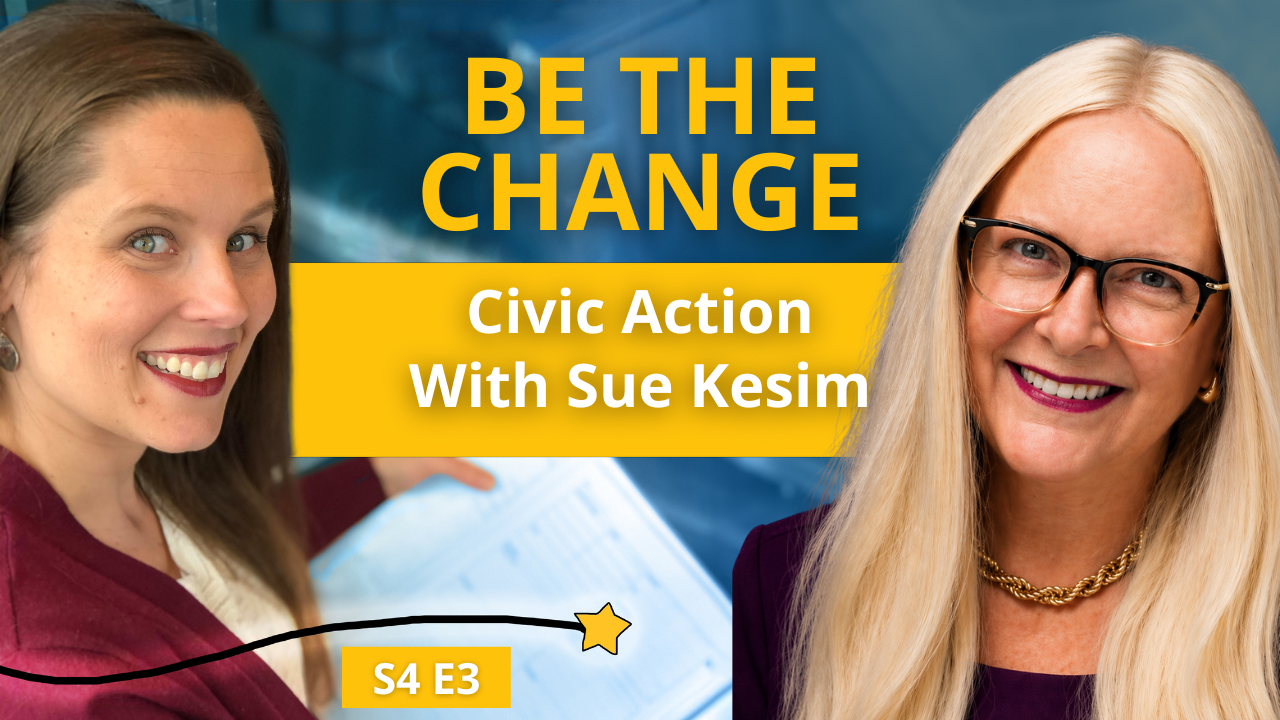


In this episode, Tasha Eizinger sits down with civic advocate Sue Kesim to explore what real civic action looks like in everyday life and how ordinary people can create meaningful change in their communities.
From city meetings and budgeting decisions to sidewalk repairs and legislation, Sue breaks down how local government actually works and how you can engage with it in practical, doable ways.
She also shares her 3-3-3 Advocacy Framework, a simple method for focusing your message, taking action, and following through until change happens.
In this episode:
- What civic action means in real life
- How to navigate local government and meetings (email Tasha: tashaeizinger@gmail.com for this document)
- The 3-3-3 Advocacy Framework explained (email Tasha: tashaeizinger@gmail.com for this document)
- Why follow-up is key to creating change
- Simple ways to take action in your community
Key takeaway:
You don’t need a platform to create change. You need consistency and a willingness to show up.
Learn more at TashaEizinger.com
Sites Referenced:
Read Transcript
Introduction
[00:00]
Welcome to a special mini-series of Diary of a Dreamer called Be the Change, where resilience, critical thinking, and everyday courage come together.
I’m Tasha Eizinger, and in this series, we’re exploring how ordinary people can create meaningful change. We’ll talk about how to think clearly, engage responsibly, and take action in ways that truly make a difference.
If you’ve ever wondered how to stay level-headed, raise resilient kids, participate in your community, and be a force for positive change, this series is for you.
You can learn more about my work at TashaEizinger.com.
Let’s dive into today’s conversation.
Meet Today’s Guest: Sue Kesim
[00:47]
Today’s guest is Sue Kesim, a longtime community advocate and civic leader in South Bend.
She has spent years showing up in many ways for her community—from attending city council meetings and budget hearings to volunteering with hospice care, senior programs, Unity Gardens, and Junior Achievement.
Professionally, she brings experience as a corporate trainer, analyst, and IT professional.
Personally, she is known for her grassroots efforts to empower everyday citizens to understand local government, engage in advocacy, and have their voices heard.
That is why she is part of this Be the Change mini-series—especially after introducing her 3-3-3 Advocacy Plan, a framework designed to help people channel civic energy into actionable impact.
The 3-3-3 Advocacy Plan
[02:01]
Sue: Thank you for having me. I appreciate it.
[02:05]
I came up with the 3-3-3 plan when I was running for city council in 2019.
I lost in the primaries, but I had been attending government meetings for about 20 years. I used to write about them—almost like early blogging—so people could understand what was happening.
People would ask me, “What happened at the meeting?” and I would share my notes.
Eventually, people said, “If you have all these ideas, why don’t you run?”
So I did.
The 3-3-3 framework came out of that experience.
You focus on:
- Three key issues you care about
- Three actions you take (call, write, share facts, invest time or money)
- And then the most important part: follow up
Because change doesn’t happen once. It happens through persistence.
Five Years for Sidewalks
[03:51]
For example, I worked on getting sidewalks repaired around a school and park.
It took me five years.
[04:04]
Tasha: Five years for sidewalks?
Sue: Yes—five years.
I worked with one district representative for two years, then another for two more years, and nothing happened.
Eventually, I brought photos, documentation, and testimony to the school board and redevelopment commission.
That’s when things finally moved.
Where Do People Even Start?
[05:10]
Tasha: A lot of people feel overwhelmed by how much needs to change. How do you even know where to go or who to talk to?
Sue: Start with the clerk’s office—city, county, or state.
They manage agendas, meetings, and public notices.
Now it’s easier because so much is online, but that office is still a great entry point.
For example, when I wanted to change a county animal ordinance, I literally walked into the clerk’s office and asked how to change a law.
That experience eventually led me to create WriteMyLaw.com to help people understand the process step by step.
Make It Easy for Decision-Makers
[08:34]
One of the biggest lessons I’ve learned is this: make it easy for them.
When I wanted a change in an ordinance, I rewrote the section myself.
Will they use it exactly? Probably not—but it gives them a starting point.
If they don’t have to start from scratch, they are far more likely to act.
Why Small Actions Matter
[09:28]
Local laws shape our daily lives.
We live under them every day, yet most people don’t realize how accessible the process actually is.
Even small community issues—like sidewalks or safety concerns—matter deeply.
I once dealt with an intersection that was causing frequent accidents near a school. After gathering information and speaking at a meeting, I pushed for a simple but effective solution.
Sometimes change is not about reinventing systems—it’s about improving what already exists.
How to Find the Right Meetings
[11:37]
Many people ask how to even find meetings or know what’s happening.
A simple step is to look up city, county, and school board calendars online.
But you can also attend clerk-managed meetings or public sessions where agendas are posted in advance.
If people don’t show up, decisions still get made—but without community input.
Potholes, Railroad Tracks, and Everyday Advocacy
[11:58]
Sometimes advocacy is as simple as reporting a pothole.
If you see a problem, call it in. Don’t assume someone else will.
Because “someone” is often nobody.
I’ve even called about dangerous railroad crossings. Within weeks, repairs were made.
One phone call can make a difference.
Frustration vs. Action
[14:14]
Tasha: I think people get overwhelmed and angry, but that doesn’t always lead to change.
Sue: Exactly.
You can complain on social media—or you can take action.
I choose to focus on what actually changes things.
Calls to Action Matter
[17:19]
Protests and rallies can be powerful, but they need direction.
Afterward, people should know:
- who to call
- where to go next
- what meeting to attend
Otherwise, energy fades without impact.
Real Advocacy Work: Rape Kit Legislation
[18:38]
One issue I’ve worked on involves unprocessed rape kits in Indiana.
Thousands remain untested, which delays justice.
I worked with a state representative to introduce bills and am continuing efforts through panels and community conversations.
Progress is slow—but conversations matter.
How to Get Decision-Makers in the Room
[20:22]
Sometimes it’s about showing up where leaders are speaking.
I introduce myself, follow up, and ask for meetings or connections.
Advocacy is often about persistence and relationship-building.
Working in Small Teams
[22:07]
A small group of three to five people is often most effective.
Too large, and things stall.
Each person can focus on strengths:
- research
- organizing
- outreach or speaking
Shared effort makes action sustainable.
Speaking at Public Meetings
[23:46]
Public meetings often allow “privilege of the floor,” where citizens can speak.
You usually have about three minutes.
I prepare carefully:
- start with a personal story
- present three key points
- end with a strong closing message
Preparation matters.
I also provide handouts and research so officials have everything they need.
The Power of Consistency
[26:34]
Over time, people begin to recognize your voice.
Consistency builds awareness—and sometimes influence.
Even when change is slow, persistence matters.
Transparency and Accountability
[28:00]
I publish meeting notes, crime statistics, and budget summaries on my blog so people can stay informed.
Many people don’t have time to attend meetings, so I bring the information to them.
That’s part of civic accountability.
Big Conversations About Money and Priorities
[30:13]
Sometimes budget decisions are difficult to understand.
For example, funding decisions between development projects and community services can raise important questions about priorities and equity.
This is why transparency matters.
Stay Curious, Not Reactive
[32:01]
It’s important to stay curious rather than reactive.
Ask questions. Look at the data. Understand context before forming strong opinions.
That’s how thoughtful civic engagement happens.
Seventh Generation Thinking
[43:13]
I learned from a Cherokee teaching circle about “seventh generation thinking.”
When we make decisions, we should consider how they affect future generations.
What we do today shapes the world they inherit.
Ripple Effect of Change
[49:19]
Even small actions create ripple effects.
One phone call can lead to change.
One blog post can help others take action.
One person can teach many.
Final Reflection
[52:05]
Never doubt that a small group of thoughtful, committed citizens can change the world. Indeed, it is the only thing that ever has.
Closing
[53:08]
Thank you for listening to this episode of Be the Change, a mini-series on Diary of a Dreamer.
My hope is that these conversations leave you more informed, more confident in your ability to think critically, and more empowered to contribute positively in your community.
Real change doesn’t come from reacting quickly—it comes from thoughtful people willing to stay curious, ask good questions, and take meaningful action.
If this episode encouraged you, please subscribe, leave a review, and share this podcast with someone who values thoughtful conversation and positive change.
You can learn more at TashaEizinger.com.
Until next time—keep dreaming, keep learning, and remember: each of us has the power to be the change.