


What if being a good parent has less to do with being perfect and more to do with being present?
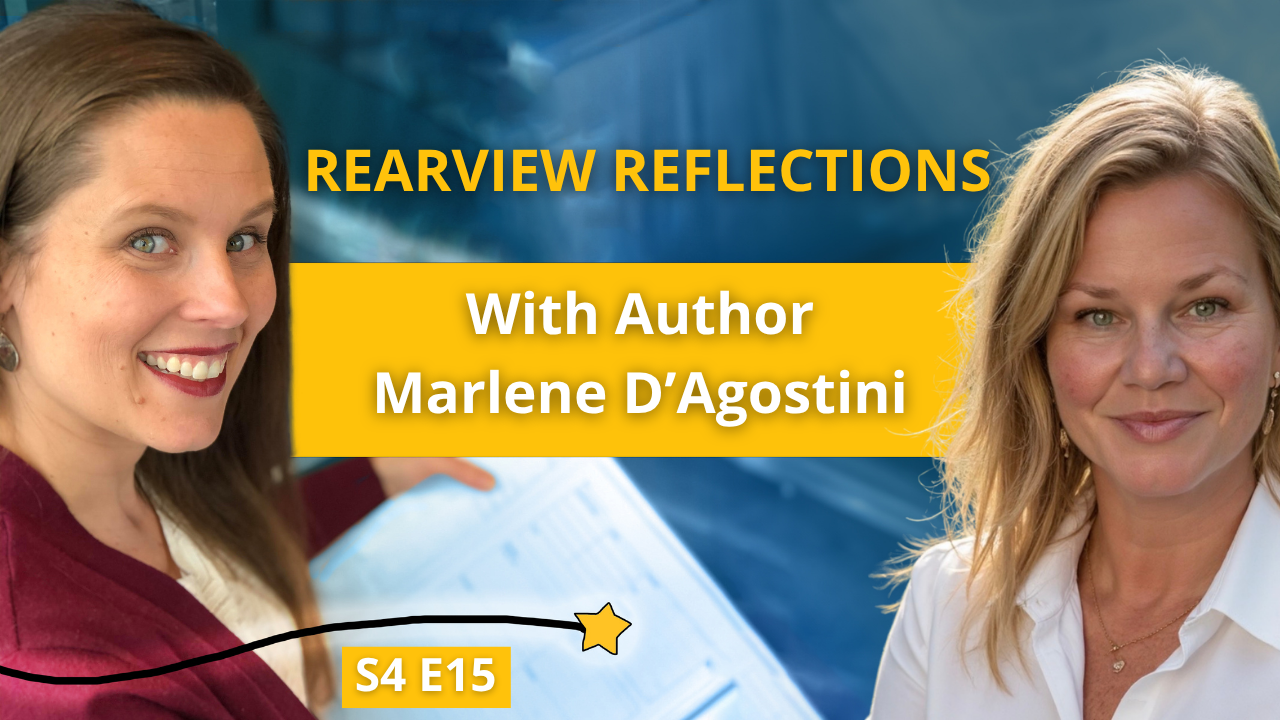
In this episode of Diary of a Dreamer, I sit down with author, storyteller, and speaker Marlene D’Agostini to talk about her debut book, Rearview Reflections, and the unexpected detours that shaped her journey through motherhood.
Marlene began writing the stories that eventually became her book when her sons were still young. What started as a collection of funny and meaningful stories about raising two boys who were close in age but completely different eventually became a reflection on motherhood, single parenting, co-parenting, trust, boundaries, resilience, and the changing relationship between parents and their children.
Now that her sons are adults, Marlene can look back at those years from a different perspective, and she shares what she has learned along the way.
About Marlene D’Agostini
Marlene D’Agostini is an author, storyteller, and speaker whose work centers around faith, resilience, motherhood, intentional living, legacy, and meaningful connection.
Her debut book, Rearview Reflections, explores motherhood through stories from raising her children, navigating life’s unexpected turns, and learning to look backward with greater perspective.
She is also the creator of Roots and Crowns Collective, a brand rooted in purpose, growth, and authentic storytelling.
Marlene is currently working on a future book exploring her Italian-American family heritage, including family history, traditional recipes, gardening, beekeeping, and the story of her grandparents’ journey to America.
Connect With Marlene
Instagram: Marlene D’Agostini
Facebook: Roots and Crowns Collective
Website: https://authorwebservices-gem2.net/WestBowPress/868680/
If this episode resonated with you, subscribe to Diary of a Dreamer, leave a review, and share it with a parent who might need the reminder that they don’t have to be perfect; they just need to be present.
Read Transcript
00:00
Welcome to Diary of a Dreamer, where resilience unlocks your potential. I’m Tasha Eizinger, and each week I’ll bring you powerful stories and practical insights from my own experiences and inspiring guests. Whether you’re facing challenges or chasing dreams, this podcast is your go-to for motivation, building confidence, and practical tips for transforming obstacles into opportunities.
Be sure to check out my website, TashaEizinger.com. Let’s dive into today’s episode and start turning your dreams into reality.
00:32
Today, we are with Marlene D’Agostini. She is an author, storyteller, and speaker whose work centers around faith, resilience, motherhood, and the beauty found in life’s unexpected detours, which will segue great into her book, her debut book, Rearview Reflection.
So we’ll be talking about that today and how that came to be. In addition to her writing, though, Marlene is passionate about intentional living, legacy building, and meaningful connection through creative ventures connected to Roots and Crowns Collective, which is a brand rooted in purpose, growth, and authentic storytelling.
Thank you so much for being here today, Marlene. I’m so excited to learn more about your book and everything that you’re doing.
01:24
Yeah, of course. It’s my pleasure. I was super excited to join you today and be offered this opportunity. So I am super excited about it. Everything to do with the book and all of the things that are future-oriented.
01:41
So today’s an exciting day. We’re recording this several months before it actually will go live. But you get to do your book signing and a meet and greet, right?
01:52
Yeah. So I’m super excited about that as well. I will be doing that for the first time. So the book was actually just formally published, and I will be having an author site and things like that. People can visit later.
I will be meeting several of the people who pre-ordered the book in advance. This will be the first time, and so I don’t even know what to expect yet. There’s all the excitement and a little bit of anxiousness or anxiety that goes with that, because the first time you do anything can be a little bit turbulent in your mind because you don’t really know what to expect.
But I expect that it will be a great turnout and a beautiful event. A lovely woman is hosting it at her boutique store, and so I know that the people there will be gracious and welcoming.
02:44
Make sure you show your excitement, right?
You know, I write different books than what you’ve written, but there’s something really special and almost magical about this idea swirling around in your head, and you finally get it on paper. Then you get to hold it in your hands and see other people holding it in their hands. It’s so magical.
03:10
And today I’ll get to sign them. So that’s even more interesting, right? More exciting, I should say. And it’ll be the first time I do that.
My husband ordered the book, or pre-ordered the book, for me. It’s interesting because as an author, they told me that I couldn’t get my case of books for three weeks. It was actually in print and ready to go before Mother’s Day, and so he actually ordered it from Amazon and we got it in two days.
He’s like, “That’s so backwards. The author cannot get her own book for three weeks, but he could order it in two days.” So he did that just to be funny and as a surprise for me.
03:48
Very special surprise.
Also, for people that don’t know, we’re authors, so we know that you can get author copies, right? You are published through WestBow Press, so we’re using your author copies through them.
04:01
Correct. Yes. Yes. I’ll be getting my author copies through WestBow Press specifically.
It is also available at Barnes & Noble and Amazon, and you can get an e-book and download it that way, too.
04:16
So what you were probably waiting on was the author copies.
04:16
Correct. Yes. I think sometimes people don’t realize that authors a lot of times will order their author copies to have their own supply. Yours comes through your publisher.
04:32
I do some finagling as well to make it happen.
So what started you on writing this book in particular?
04:46
It started a really long time ago because, like I said, it’s Rearview Reflection. It’s a period of time when I was a young mom.
Now my boys are older. They’re adults. They have their own kids. One of them will be getting married soon, and the other one’s already married.
It’s interesting because I started writing it probably when they were in middle school, thinking that it was going to be just stories about sharing their childhood and the journey of being a young mom of two boys who are very close in age but are polar opposites.
The stories that I had to tell people about what happens when you have that in your household, and at one point in time I was a single mom, so doing that and kind of navigating that, navigating the co-parenting, all of those kinds of things.
For the most part, I feel like we had done that successfully, and that isn’t the case for a lot of people who were sharing their troubles or their concerns with me about navigating the same waters. They were asking me, “How do you do it?”
To be honest, other people suggested I should write a book first. And then I was kind of like, “Well, maybe they’re onto something.”
Not that I did anything perfectly because none of us do, right? But some of the stories and the connections and things like that that were made along the way are funny, but also helpful, I think, to people.
In the middle of it all, when you feel like you could be failing or that you’re not doing something right, that’s really when the connections were all human. Your kids can see the humanity and the human side of you, and you extend them grace and they extend you grace at the same time.
And so I think that’s super important.
06:34
I think it’s a big shift in parenting, too, that parents are very aware of. Like, if we’ve messed up, we should say sorry because we’re teaching our kids how to say sorry, or that we set the example.
I know that was my mom’s number one parenting philosophy. She’s like, “Your dad and I have to set the example first.”
And that’s what I’m hearing from you. When you set the example, your kids reciprocate it.
07:01
And with my children, it’s always, “Mom’s always going to tell you the truth.”
And it might not always be easy to tell you the truth. One of those things very early on when I separated from their dad was, “I will never lie to you.”
And that statement a couple of times kind of got me in trouble because they will remind you, like, “Mom, remember when you said you’d never lie?”
And then I kind of braced myself like, “Oh, what kind of question are you about to ask?” They have to preface it: “Remember you said you’d never lie, right?”
So that’s in the book a couple times.
But I feel as though I never really got to the finish line with the book when they were younger. And I think that that was because there was still more story to tell.
Not that there still isn’t, because navigating parenting for adult children—and maybe that’ll be another book because it’s definitely the biggest challenge right now—is like the biggest challenge of your life after you navigate those waters.
They’re constant for so long, and then now all of a sudden they’re adults and you’re not. And so there’s that part, too.
But I feel like for this book, I was at a closing point. Like, the childhood—we can kind of tuck that away. We can look in the rearview mirror and see the whole thing all together.
So the stories of them at a younger age were written a very long time ago, and then as the book goes on, the end of the story and the last few chapters were written more recently.
08:29
Which I love that you are saying how long it takes to write a book. All books are different, of course, but that’s one of the top questions people ask: How long does it take?
And it’s like, well…
08:42
That’s a loaded…
08:44
Question.
Of course, it’s based on the book. And if it’s somebody who’s, you know, like the Harry Potter series, it was released during a specific timeframe, right? But for most people, especially when it’s your first book, you can take as long as you want.
09:02
Well, then once I started working with my publisher, actually last summer, thinking, “Oh, great. I’ll have this all bundled together and packaged out by October because October is my birthday.”
It was last summer that I started working on it, in 2025, with the actual publisher.
And then you have to go through and do the manuscript part, and you have to do it the way that they specifically want you to break it down and send it into them, which…
09:28
Wasn’t the way that I had originally written it.
09:31
And so then you have to kind of put it together and format it in the way that they want.
And then there’s several different renditions of editing, obviously, and things like that. And then, you know, everybody says you don’t judge a book by a cover, but let’s face it, we all do.
You have to work on that part, too, like the cover art.
And originally the title was not Rearview Reflection, either.
Most of the stories, especially when the children were younger, the vehicle or the car—in my case, it was a Jeep—became kind of like the stage where all these stories had happened and transpired.
Because when you’re riding in the car together and there’s this open space—this is before children were entertained with tablets and phones and things like that—there were actual conversations that we had in the car that were very pertinent to life that I took those stories away from.
So the original title was going to be Riding in Cars with Boys.
But then it was pointed out to me that that is a 2000-something movie.
10:39
Yeah, that it may not be…
10:49
And so when I looked that up…
10:52
I even announced it to my social media that I’m writing this book and this is what I’m going to title it. I’m super excited about it. I’m working with the publisher.
So even when I first started working with the publisher, the title was not what it is now.
11:04
Yeah, I love the title.
And I think my favorite part about the concept of your book, the overarching theme of being in the car, is I hear parents who will complain about, “Oh, I’m just a taxi. I’m just a taxi.”
And it’s like, well, try to maximize that time. And that’s what you did. You maximized the time that you shared instead of thinking—I mean, not that you didn’t ever think, like, “Oh, I feel like a taxi driver.” That is fair at the same time.
You took that as a beautiful opportunity to connect with your boys and now turn it into a book that can impact so many moms in particular.
11:44
Absolutely.
And I think that, you know, even now the conversations that I have with them, they’re not riding in the car with me, but they’re on the phone with me in the car, like while I’m driving from work to home or home to work or wherever we’re going.
So that part is interesting, too.
My youngest will call and he’ll say, “Mom, do you have a moment?”
And I’m like, “Well, I’m driving in the car. So why not?” Right?
Same thing, only…
12:11
Different.
That’s like the sweetest thing, though. Isn’t that the parents’ dream? That your kids want to contact you when they’re adults and say, “Hey, do you have a moment?” Or, “I want to talk to you,” or text you.
12:24
I mean, it is absolutely. I mean, when you’re the mom of boys and the saying goes, you know, “Daddy’s girl, mama’s boy.” And it’s kind of true.
And then you get to a certain point where—and all through high school, even into the later years, just like the first year or so after they had graduated, still they were living with me. And it was great.
And then all of a sudden, they meet the love of their life and they have these relationships, and you’re like, “Oh, wait a minute.”
And to be honest, the first time I had an emergency—one of my boys had an emergency—the first time I realized, “Wait a second, that’s not my role.”
I don’t have to take the day off of work. I don’t have to go to the hospital. I don’t have to sit there.
I mean, and it’s not that it was ever a chore. It’s just that…
13:15
Wow, this is different.
13:18
It takes a lot to retrain your brain and also accept the fact that it’s okay.
Yeah. It’s just different, you know?
And I think that’s where a lot of the struggle happens in that transition period, because we kind of just don’t know our place anymore.
13:36
You know what? That’s so interesting. You said “retrain your brain” because our brain seeks patterns. Patterns are safe. And when something’s different, it does alert our brain to be like, “Hey, this is different.”
Or, “Is it dangerous different?”
And you’re right. Like, it’s okay. That means that you raised your sons well, right? That they are capable adults and they have another capable adult in their life.
14:08
And at the end of the book, I talk about that because if we really, truly do our jobs as parents, doesn’t matter if you’re a mom or a dad, but you do the job as a parent, your job is for them to live a successful life without you.
14:22
Like, that’s the…
14:23
Ultimate goal.
So if we do that successfully, we’re kind of setting ourselves up for that end game, right?
It doesn’t end there necessarily, but like you said, it changes. And then that alerts our brain that, like, “This is different. And how do we navigate this now?”
So it also helps me, though, extend my parents a lot of grace because when you were a kid, you thought, “Oh, my parents have it all figured out.”
14:50
I tell my kids that now. I’m like, “Listen, I’m doing my best. No parent exactly knows what they’re doing. We’re just all doing our best.”
15:00
But I felt like when I was a kid, my parents had it all together. They were navigating this and they knew all the rules.
And then you get to be an adult and you’re like, “Hold on. This is what my parents felt like, too.”
You kind of get a little…
15:17
Empathy there, I feel like.
Absolutely.
Well, and the goal is that your adult kids—I mean, my kids are a lot younger than yours, so correct me if I’m wrong—but I feel like on top of you wanting them to be independent, capable, successful members of society, right? And that they have all these values, but…
15:36
Also that…
15:36
They are your friends now. They can still come to you if they need their mom. That’s always there because you’re a mom for life.
But it’s positioning into, “I’m not your caretaker necessarily. Now we are more on an even playing field. We’re friends.”
15:55
To…
15:56
Be parenting you the same way.
15:58
And the whole circle of life is, someday, ideally, they will be your caretaker, right?
It kind of transitions into this whole full-circle thing.
And I think sometimes parents have a hard time transitioning from caretaker parenting role to, “Oh, now we can be friends.”
16:19
I do think that, but I also think that some parents may want to shift into that friend role a little too early as well.
And I think that it’s very important—I do talk about this in the book as well—but I think it’s very important to lay out from the beginning with your children: We can be friends later, but yet I’m still your parent. I’m still your mom. I still have a lot more experience than you do to navigate these things.
And it’s not that I don’t want to be friends with you. I do. But I also don’t want it to seem like we’re not going to be drinking buddies. We’re not going to be, you know, like some…
And I think some parents navigate into that gray area of friendship versus parenting a little too soon.
17:08
So when do you think—I know in my head what I think, because my mom did it with me. She was always my mom. We were very close. Right? Now she’s 100% my best friend.
But…
17:19
She didn’t.
17:19
I’m curious what age you think is appropriate to start shifting into that.
17:24
Yeah, I started shifting into it a little bit in high school with my kids. But at the end of the day, it’s like, Mom is still Mom, right?
And I would let—and there are certain areas where I would let them drive me places, right? Because they’re learning how to drive, and not even just when they’re having their learner’s permit.
But there is a chapter in the book called “Navigating One-Way Streets,” and it talks about when my son and I were going to see the Christmas lights in Detroit and things like that.
What happened is our roles kind of reversed a little bit. He was 17, almost 18 at the time, and Mom was having kind of like a panic attack.
So he had to—he was driving already—but then he had to navigate the streets and fully step in.
And so I think that the early years leading up to that allowed that to be like, “Oh my goodness, my mom needs my help, and it’s okay for me to step in and be that person in that role.”
But she’s still my mom, you know?
At the end of the day, it doesn’t mean that tomorrow I get to be the parent and she gets…
You know what I mean? Our roles didn’t reverse forever.
But there are times when you have to trust your kids, too.
18:34
And I talked a lot about that with them. Trust is one of those things that, if it’s broken, everything from that point forward is questionable.
And so that’s why I had made the promise to them to always tell the truth, no matter what.
And it was very funny sometimes because they would use it against me, you know? Like, “Mommy said, ‘You tell the truth.’ So what about this?”
And it would just be basic questions.
“Where do babies come from?”
“Is Santa Claus real?”
Or, “Because you said you’d never lie. So now what?”
19:11
So I have a confession, Marlene. One of the lies I say sometimes when we’re at the park with my younger one is, “Oh, the park is closing.”
19:23
And the other moms are like, “Yep, it is closing. We have to leave, too.”
They’re playing along with you.
Am I that terrible?
I mean, I would say it’s not. You mentioned that you have younger kids, and just to be fair and honest, I actually have a seven-year-old as well.
So I’m navigating life again, and she’s a girl this time.
So this one is about my boys and things like that and being a younger mom.
And I have to say that I think things aligned for me perfectly to where I was younger. I had more energy and I had more discipline in me when I had the boys, because I feel like being a mom of boys can take those qualities.
And now that I’m older, I have a little bit more freedom in my job. I have a little bit more money in the bank, and let’s just face it: girls are more expensive than boys.
They have to have the ballet and the gymnastics and the dance and the costumes and all the things.
I mean, they don’t technically have to have that, but you know, this is one of the things I feel.
I had my children in the perfect times of my life. And I enjoy that.
But she’s seven, and I haven’t made that promise to her yet that I’ll never lie to you.
So I have—I mean, I try not to—but like that, right?
“Okay, well, they’re closed now, so we can’t go there.”
20:45
Now I will say, whenever it comes to the things that truly matter, right, I’m also very honest.
So then when they do have apprehension or even fear about something, I can look them in the eyes and say, “Hey, I’m honest with you. This is going to be hard. Or you can do this. I know you can.”
And you know I tell you the truth. And if I didn’t think you could, for whatever reason, I would help you.
21:13
And sometimes you have to step in and say, “I don’t think this is a good idea, and these are the reasons why.”
And a lot of times, especially the teenage years and things like that, it’s like, “Well, you’re going to make your own decisions anyway. My job is to raise you to know which direction to take…”
21:28
When you are faced with that…
21:30
Choice on your own.
21:31
You know, back to me…
21:33
Yes, absolutely.
And they always have. They’ve had several times, and I’ve had to have, you know, in high school years and teenage years, the difficult conversations of navigating things with the teens, especially when it comes to illicit drug use or alcohol use or gender identity now or relationship status, things of that nature.
And right now my seven-year-old tries to say, “Well, so-and-so is my boyfriend.”
And I’m like, “He’s not.”
22:02
He’s your boy, but we’re not doing that.
22:07
Not at seven, you know. And she’s like, “Well, so-and-so at school says that this person’s her boyfriend.”
And I’m like, “You guys are seven. You can have your favorite friends, and it doesn’t matter, you know, the gender at this point. If that’s your friend and that’s who you like to spend time with, that’s fine.”
But we’re not going to be labeling like boyfriend and girlfriend at seven years old.
22:28
I completely agree with you.
22:33
No, no, no. We don’t need to do that.
And with my boys, you know, I saw their friends allow their parents’ friends—allow people to stay the night that they were courting or dating, even in a high school situation.
And I laid the framework down with my boys that you won’t be having overnight guests that you’re in a relationship with at my house until you’re officially adults.
22:58
Yes. So you can officially take responsibility for any choices you make.
23:02
Yes. I mean, and that’s not to say there were some times that bonfires were to happen in our backyard and things like that, and people needed to stay the night and their parents didn’t want them driving home late.
You know, that’s kind of like a different situation.
But we’re not going to be cohabitating in your bedroom and having these overnight visits with a boyfriend or girlfriend or anything of that nature.
And I’m planning to have that same discussion and conversation with my daughter as well, and what those relationships are for and the timing of things like that in life.
And it’s not about being strict. It’s about setting my child up for a successful relationship in the future.
And I don’t think the need to, “Oh, I have to stay the night with this person,” I don’t think that’s setting healthy boundaries or healthy relationship status.
23:50
No, because they could get themselves in a situation that would throw them into adulthood before they are ready for adulthood.
24:00
Right.
24:01
And so when people would argue, “Well, they’re going to do that anyway on a back road or this or that or the other,” I was like, “Yeah, but I’m not going to make it easier for them.”
24:09
Exactly. Make them work.
24:13
And I completely agree.
But also when you are saying, “I support this behavior,” then the probability of it is going to increase as well.
24:24
And besides that, I don’t want that particular person feeling like they’re going to be coming to live in my house.
You guys have to, if we’re setting ourselves up to be successful adults, we’re going to be having our own jobs, our own careers, our own life ahead of us before that type of situation is forced into existence.
And I think that allowing it too soon is not…
I mean, no.
That’s not to say there have been a couple of times, like when my boys went to prom and things like that. And I was a single mom at the time.
I come downstairs from my room to make the coffee, and I’m like, “Oh, there’s someone sleeping on my couch.”
It was my son’s friend, and he’s like, “Well, you know, he said it was okay to stay the night because I didn’t want to go home and it was too late and this and that.”
And I was like…
My house was always open.
25:15
Yes.
25:18
I always provided food for their friends. I always made sure there was Gatorade and water and snacks and all of those things.
We kind of lived in the country. There was some acreage, so we had some four-wheelers, ATVs and things.
And so, you know, they found that fun and exhilarating.
And so I always wanted to create a welcoming space because I would rather my children be there and their friends be there versus the other, where they felt like they needed to get away from me or away from the space.
I mean, I think that started, you know, riding in cars with boys at a very young age when I did tell them, “You can talk to me about anything. You can ask me anything. I’m going to be honest with you. I’m going to be open with you.”
And approaching those conversations created a safe space for them.
And I think it navigated away from a lot of things that could have been problematic in the future.
26:12
With you—and I’m glad to hear you say that because I’m earlier than where your boys are in the parenting cycle—and that’s one of my core philosophies.
I want you to come to me about anything. Not the internet, not your friends. Come to me and I will be truthful.
Of course, trying to keep it age-appropriate and keeping my face very calm and neutral.
26:41
Yeah. No, that is the hard part.
Like, you might say something, but your face is saying something totally different. And they know that because they’re your kids.
So they know.
My younger one, he’s very much into animation and comic books and things like that.
And so sometimes we’ll, even now as an adult, he’ll be like, “Mom, you’re turning green,” which means like I’m about to be the Incredible Hulk.
So, like, calm down, you know, situation.
But he can tell before it’s…
27:03
It’s happening.
27:06
I love it.
27:06
Yeah. Or he’ll send me little memes, like Hades from Hercules, you know, when his head gets on fire and then he quickly calms himself down.
He’s like, “It’s okay. I’m fine. I’m fine. I’m fine.”
He’ll send me that.
27:18
That is so cute.
I think your next book needs to be, since you have a daughter who’s seven and you have these older boys, the similarities and differences of raising a daughter versus a son.
27:55
Yeah.
27:55
We do want sons who can have emotions and are empathetic and loving and nurturing, right?
And we also need daughters who are competitive and driven and use their voice and feel confident.
27:55
But they are still different in so many ways, I’m sure.
27:55
No, and I think that’s generally true.
And also, having a daughter who has a 12-year-old stepbrother at home that’s with us every other week, and having a daughter who has three brothers—and her mother, myself, also had three brothers.
28:11
We’re different women, aren’t we?
28:15
Absolutely.
28:15
And on that note, like, I was the first girl in my dad’s family in five generations.
28:23
Oh my gosh. So you were like the princess.
28:25
I was treated like one, but then at the same time, I still have to get like slap-shot in the leg by hockey pucks and ride four-wheelers and accidentally flip over the handlebars or fall into creeks and, like, you know, swim out of them.
So, yes, I was treated as the princess, but also there’s this—I mean, and then there’s this movement right now where I feel like the idea or the concept of just an overall general tomboy has been lost.
And I think that it’s okay to get your nails done and also ride four-wheelers or target practice or do all of the things.
And there’s positive femininity and there’s positive masculinity.
And I think that unfortunately the lines have been crossed in regard to—you hear so much about toxic masculinity, and it’s just like, well, if it’s driven in the right direction and used intentionally, like what it was created for and why we have that…
29:30
Testosterone, I guess you’d say.
29:32
We have testosterone, too. We just don’t have much…
29:35
I’m using it.
29:38
Well, it’s like my daughter, you know, on her report card, she gets things like, you know, she’s bossy or she’s this or she’s that.
And I’m like, well, if she was a boy, you would be saying she had leadership skills.
So let’s just…
29:49
Be honest.
Exactly what I’m talking about right there. A hundred percent.
It’s the dynamic of how both genders are perceived.
Yes, naturally there can be some differences.
But I do think it’s interesting, like the number of women—when they say that they have all sisters—versus when I’m around women who say, “Oh, I grew up with brothers.”
And even my daughters, they just have sisters. And sometimes they’ll come home and say, “Well, the boys said this.”
I’m like, “This is what you say back. You’ve got to dish it back.”
30:22
I respect you.
Well, and I think that that’s taught me, especially being out in the world and having a nine-to-five and being in the corporate world, then, yes, I’m more so in the medical field.
But it’s like, you have to have a little bit of tougher skin, I guess, and you can’t be overly sensitive about every little thing.
I’ll never forget, like, I go—I touch on it a little bit in the book, but this book isn’t completely about that.
But, you know, I had a marriage at one point in time where I was the caregiver for four girls for six years. They called me Mom.
And that was treading new waters for me because when one of the girls came up to me and said, “So-and-so said she doesn’t want to be my sister anymore. That hurt my feelings.”
I was literally like, “So she’s always going to be…”
And I had to break it down a little bit because then she was tattling on me next. She was like, “Dad, she said so to me.”
31:24
Well, I’m confused because boys, it’s just…
31:24
Different.
31:30
And I told her, I was like, “Just because she says she’s not going to be your sister anymore, or that she doesn’t want to be your sister anymore, guess what? The facts are the facts.”
She’s your sister forever, like that.
The biological DNA concept of that doesn’t change just because she’s mad at you.
So I was really trying to teach her it’s okay to say, “So?” Like, and I said, you probably should have said that to her because she would have been upset that you didn’t care that she doesn’t want to be your sister.
The whole goal was to make you hurt your feelings or make you mad.
And if you know the facts are the facts and she’ll always be your sister, she can be mad at you, and that’s okay.
The biology of that doesn’t change.
You can say, “So,” and you can just move on and keep playing or keep doing what you’re doing. It doesn’t have to bother you.
I got this sign for the house at one point in time that said, “Drama auditions are over for today.”
32:20
I didn’t need that so much with the boys, but with the girls I felt like everything had to be this big ordeal.
And it’s like, some things just aren’t a big ordeal.
32:28
That’s okay.
32:28
Yes. And it is interesting, the sister dynamic, too.
I think it’s interesting that when they, let’s say, are really upset with each other, they can recover pretty quick.
And then they go back to like nothing even happened.
And I’m like, if my brothers or I got upset with each other, like, there was good reason.
And we, you know, I would maybe call them out or they would call me out. We would deal with it, and then we could move on.
But it was so rare.
And then the bickering, you know, that’s just like…
33:06
Yeah. My brother used to always tell my parents that I was like stretching out his shirt in the female boob area, and he would be mad.
I’m like, “It’s a sweatshirt.”
33:21
Oh my goodness.
One question I want to make sure I ask because we do have to wrap it up is, you have chosen to use a pen name.
Did that come from WestBow Press? Was that your idea? And why did you use that?
33:34
Well, at any point in time, in the author industry or the book world, they suggest that if it’s a memoir-type book or if any characters or stories are almost or could be true to life, that—at least at WestBow Press anyway—they suggest that people use a pen name.
So the names have also been changed in the book. None of the names that are in the book are actually the names of the people unless they gave me explicit permission to use their real name.
But with all the other names altered, it’s hard to navigate which ones are real and which ones aren’t.
But yes, my pen name, Marlene, is actually my grandmother’s middle name, on my dad’s side.
And then D’Agostini would be my grandfather, who’s still alive today, 89 years old, bless his heart.
He is 100% Italian from Italy, and his mother’s maiden name was D’Agostini.
And so I chose that because I thought it was so pretty.
35:01
It is beautiful.
35:06
And my maiden name is obviously Italian, and so I kind of just wanted to keep the Italian-ness going there.
Italian-ness—I don’t even know if that’s a word, but I just made it up.
And then honestly, the next book that I’m actually working on currently is my grandfather’s parents’ coming-to-America story.
35:01
Oh, wow.
35:01
But it’s also an Italian-American cookbook at the same time.
35:01
Nice. Oh my goodness.
So where in Italy does your family originate?
35:06
So that’s the interesting part, right?
My grandfather’s mother and my grandfather’s father are from two completely different regions of Italy. One’s from the north, one’s from the south.
And they actually didn’t meet each other until both families were kind of hunkered down here in Detroit.
Part of the interesting story is that, through my research and things like that, they actually spoke two completely different dialects of Italian.
So when they met each other, they kind of weren’t even speaking the same language.
They were, but they weren’t.
There was probably most likely a lot of bickering about, “That’s not how you say it. You say it like this.”
And then my grandfather, growing up in an Italian-American household, they didn’t speak English until my grandfather was already an adult.
So that’s part of it, too.
36:03
He had to learn two different dialects, right, and then blend them together?
36:05
Literally how the household…
36:08
Talked.
36:10
Trilingual, pretty much, because the kids—he had brothers as well. He had three brothers, and they all went to Catholic school and things like that.
So they all learned how to speak English, and then they would come home and speak English, and then their parents would tell them, like, “What are you even saying? Because we can’t understand you.”
They kind of taught their parents broken English a little bit.
So it’ll be an interesting book, and it’s kind of like an honor to write about my grandfather and his heritage that he’s very, very, very much proud of.
Him being Italian makes, you know, my dad is like half and then I’m like a quarter. So I’m like, it’s dwindling down.
But growing up, where he came from and things like that were so important to him that we just kind of were driven home that, “You’re Italian. You’re Italian,” and all these other things.
I had my 23andMe done and I’m more German than anything, but in my mind, I know I’m not.
37:30
Yeah.
37:32
My other grandfather is German. His family’s from Germany.
And so my grandfathers would, like, old men, bicker back and forth, and then they would send us kids on missions to offend the other one, and we had no idea what we were saying.
37:49
Right. And it was kind of…
37:51
You know, very derogatory.
37:58
And they didn’t know that it was until the grandfather we spoke it to or said it to was like, “Don’t—why are you saying that? Don’t you say that word.”
And we were like, “Why? My grandpa so-and-so said to do it.”
37:49
Right.
37:51
But they loved each other. They just did it.
37:51
It was very much funny banter. Nothing was truly, like, unfriendly about it, really.
38:12
Yeah. It wasn’t to be mean. It was to…
38:12
Write another…
Yes, absolutely.
Well, I also think it’d be interesting because it’s going to be an Italian-American cookbook. Northern Italy and Southern Italy have different recipes, correct?
38:12
Yes. And how they blended them together in their household and then how those traditional recipes were changed and kind of passed on to us, you know, at the dinner table and things like that, too.
38:23
That’ll just be such a fun exploration, I think, for you as a writer.
38:31
Yeah. And as a human.
38:31
It already has been, for sure.
38:31
Yes. And I kind of have the whole table of contents laid out.
And so I think this one will be a little faster in terms of writing it because I’m not waiting for the stories to transpire. It’s kind of like we already have our family recipes and we have the things that are important and we want to write about.
My grandfather was a very, very big gardener while we were kids growing up, and he had to have specific types of tomatoes and specific types of peppers because that’s what was the best for the recipes that he wanted.
And then he was also a beekeeper. So we had always had honey and things like that.
So there were a lot of things like that that are going to be in the next book.
39:14
That’ll be so special. I definitely can’t wait to check that book out as well.
How can people get in touch with you?
39:22
So there will be an author website. That’s going to be coming out through WestBow Press.
I am also on social media. I have an Instagram account, Marlene D’Agostini.
And then my Facebook is the Roots and Crowns Collective. So that’s kind of because I also do public speaking, and it’s kind of a way for all of those things to transpire and come together.
So Roots and Crowns Collective is the Facebook page, and the social media for Instagram is under Marlene D’Agostini.
39:52
Wonderful. I’ll make sure I put everything in the show notes so people can follow your author page and see whatever projects you’re doing or where you’re speaking as well, and they can keep in touch with you.
Thank you so much, Marlene, for being here today and sharing more about yourself so that people can be inspired.
And hopefully there were parents listening that are like, “Okay, maybe I’m on the right track.”
40:16
Yeah, absolutely. And that’s kind of like the whole point.
And some of it, you know, I do share my failures because I think that we can learn from each other’s failures. And there’s always learning in that, too.
40:26
I love that. So we don’t have to be perfect.
40:29
I think that the book’s major message is you don’t have to be perfect. You know, it’s more about being present than it is about being perfect.
40:38
That is fantastic.
Well, thank you again for being here today.
40:38
Yeah. Thanks for having me.
Thank you for tuning into this episode of Diary of a Dreamer. I hope you found the stories and tips shared today to be a source of motivation and strength.
Remember, every challenge you face is a chance to grow and move closer to your dreams.
Don’t forget to subscribe, leave a review, and share this podcast with anyone who could use a boost of encouragement.
Please check out my website, TashaEizinger.com.