
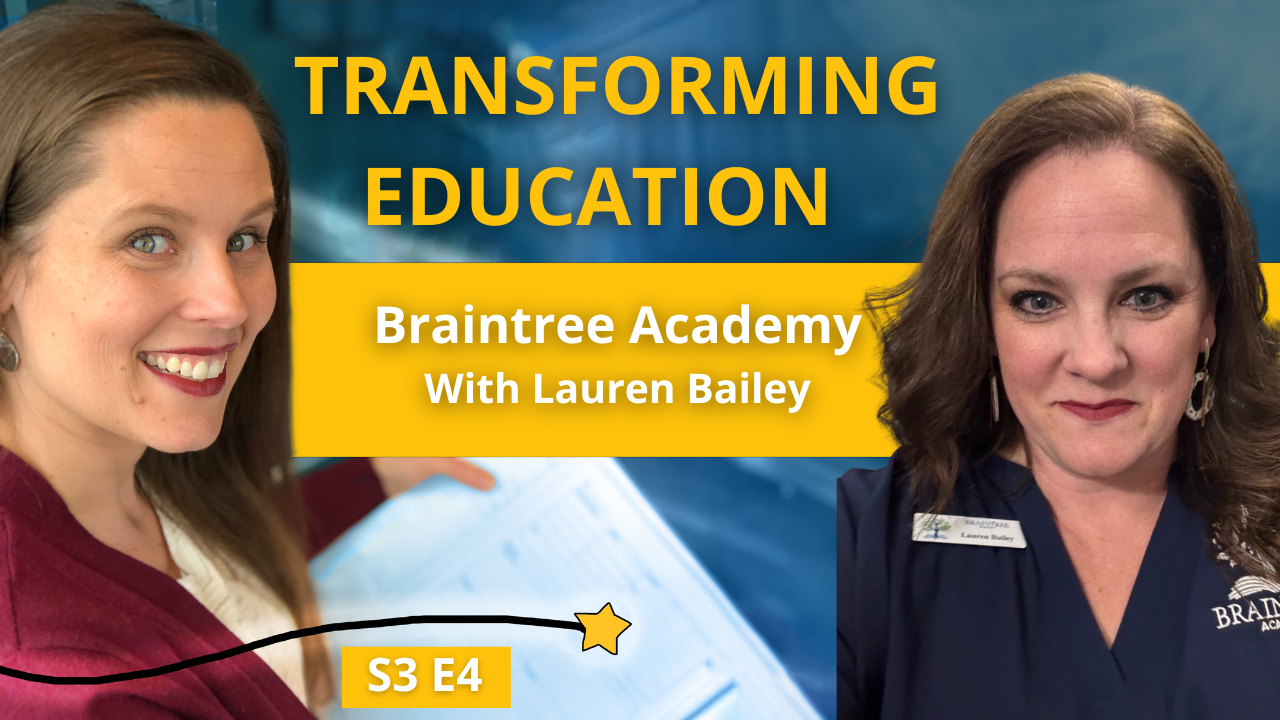


In today’s episode, I’m joined by Lauren Bailey, a passionate and experienced special educator and administrator with 20 years in the field. Lauren has built innovative special education and virtual learning programs, all while raising six children in rural Indiana. She’s a Purdue Ph.D. student, Ball State master’s graduate, and now the Director at Braintree Academy, where she leads special education, RTI, and policy work.
Together, we discuss:
- The importance of healthy communication between educators and parents
- How to build trust and collaboration in special education
- The flexibility and intentionality behind Braintree Academy’s virtual learning model
- Why family advocacy and educational choice matter now more than ever
Lauren shares real stories of working with students, families, and educators to find solutions that support both academic and emotional growth. From field trips to flexible curriculums, she reminds us that education can be both structured and compassionate.
We also talk about the Midwest Homeschool Expo in Indianapolis which is a powerful gathering that connects families with resources, curriculum options, and community. Get tickets!
If you’re a parent, educator, or lifelong learner looking for more flexibility and family-centered education, this conversation is for you.
Connect with Braintree Academy
🌐 Website: Braintree4Me.com
📧 Email: Indiana@BraintreeEd.com
📞 Phone: 574-218-3812
About Braintree Academy:
Braintree Academy offers flexible, family-driven education across six states, supporting students from preschool through high school with customizable programs and community engagement.
Read Transcript
00:00 Welcome to Diary of a Dreamer, where resilience unlocks your potential. I’m Tasha Eizinger, and each week I’ll bring you powerful stories and practical insights from my own experiences and inspiring guests. Whether you’re facing challenges or chasing dreams, this podcast is your go-to for motivation, building confidence, and practical tips for transforming obstacles into opportunities. Be sure to check out my website, TashaEizinger.com.
00:34 Let’s dive into today’s episode and start turning your dreams into reality. Today, we have Lauren Bailey. She is a passionate, experienced special educator and administrator with nearly 20 years in the field, which is way more than I have in education. I have four.
00:54 um she’s built innovative special ed and virtual programs from the ground up all raising six farm kids in rural Indiana she is a Purdue phd student i’m noticing too because i’m a Purdue grad that i’m getting some Purdue people which makes me really happy that’s right pull her up and she has a ball state master’s grad
01:17 or Ball State’s master’s degree. Lauren now serves as director at Braintree Academy. She’s leading the special ed, RTI, and policy work. She’s a fierce advocate for educational choice and thinking outside the box. So I am excited to have you here today, Lauren. I think we’re very similar. We’re kindred spirits. I love it. Even beyond the Purdue degree. So how did you…
01:46 get involved with Braintree? Was that early on in your experience with education or did it come after? Oh, that’s a good question. I used to started out teaching kids with severe disabilities in the classroom. And what was really special about that was that I would have those students for sometimes six, seven years in my classroom. They would be in that classroom and I would have a team of adults that I would get to know deeply and I’d get to know their families very passionately. And when I got an opportunity then to switch to an online program,
02:22 it too in the public space was going to be very family focused i i can remember them asking me about it and i was like you want me to work with general ed kids like what’s that but it ended up being this opportunity to work with students that were depressed or suicidal or anxiety stricken and needed something different and so i continued to fall in love with the space of
02:46 um supporting families even you know when you’re an educator you have their kids eight hours of the day and then i started popping out all these babies and i missed being with them you know that was a big chunk of time that they were away from me so um then i morphed into the brain tree world which continues to be in that virtual education space as well as supporting families with what they need to
03:12 to raise their kids and educate their kids the way they want to. So it’s gone from one end of the spectrum to the other. But that’s kind of how I landed where I’m at right now. I think that’s really cool. And I guess, what would you like people to know about kids in special ed programs? What do people need to understand? And I think that special education has become this space of a lot of contention.
03:39 but i think so often parents and whatever educational partner they’re working with whether it’s a therapist or a teacher typically they want the same thing they want what’s best for the kid but i think the ability to have a healthy conversation and get to what feels like what’s best for the kids together i think it just gets
04:06 bogged down with red tape and politics and rules. And so finding a way for as a parent, if I were advising a parent right now, I would say you get to be their biggest advocate, you get to ask questions, you get to tell them what you want. And then on the educator side, I think they have so many expectations put on them in their day to day that it’s easy to not hear what the family needs and wants, but it’s so critical.
04:35 to the bigger success. I mean, you’re going to have more successful test scores. You’re going to have happier kids. All things will improve if that bridge between families and that educational support are a solid, strong relationship and partnership. And we just run out of time, right? So making that a priority, I think, is easier said than done. But I think that it could be a less contentious and
05:04 I don’t know what the right word is. Yes, yes, place, like that place of, you hear special education and everybody’s on their toes. The stress rises, the anxiety rises, everybody’s bringing out their lawsuits and the big guns, but it doesn’t have to be that way. And I’ve just seen so many great success stories of where once you get people to see eye to eye and have healthy conversation, even hard healthy conversation, which I love, it doesn’t need to be that place.
05:34 I could not agree more with you. I feel like when I was teaching and I taught in an inner city parochial school and it was the parents who worked with me who saw like, I really do care about your child. Not the same way they do because that’s their baby and their whole world. Right. But I do care and love about my, my students. And if we could work together, like the success for the child was significantly greater. So could you share an example of like maybe a.
06:03 hard, productive conversation? Because you had referenced that, like, what does it look like? Because obviously we’re trying to see eye to eye. Everybody’s advocating for the child. Of course, the teacher has to consider the whole classroom too, which is hard. So they’re advocating for all the children and the parents are advocating for their child. So what does a…
06:24 hard, productive conversation look like? Well, OK, for start, I can think of a million. So let me try to give you one from my time in the brick and mortar space and then one from my time in the virtual space. But in the brick and mortar space, I think.
06:39 One time I had, I was supporting a family through a divorce situation where, you know, one parent could only hear from their child’s kid through these emails and phone calls with me, the teacher, and the other parent, you know, had very different opinions and he could talk to me every time he was dropping the kid off to school. But so those parents, I was right in the middle of a lot of words on paper. Tell me about my kid’s day. Tell me about the schedule.
07:08 as they asked me really hard questions well why is he sitting in the desk in this portion of the room and why like well why would you put him in an art class instead of a gym class or they just asked me so many hard questions and i could have chose to be offended right offense That’s that’s the beast that gets to all of us. I could have just curled up in a ball and cried. It was stressful in my administrative team. They were stressed and they wanted me to forward every email to them. But ultimately, by choosing to just always take a step back and say, OK, why am I doing that? And being able to then just voice it’s because.
07:46 this is what i think is best for your kid i love your kid i this is where they’re going to succeed this is where they’re going to make new friends this is where they’re going to learn them by being able to just rein in the emotions i i’m an educator i’m an expert and i know i have the best of intentions because i love this kid but if i would have let all the other things get in the way of muddying my ability to just talk
08:08 and put that in writing. We really did get to the bottom and man, I got to go to that kid’s graduation not long ago. You know, he was so much taller than me and he used to be just this little tiniest little booger. But so that, not being offended and just being able to speak to why we’re doing things the way we are or why I think this might be best for your kid, but let’s talk it out. You probably have some really good insight too.
08:36 That was an example in the brick and mortar space. You know what, Lauren, that what I love about what you’re saying is something I think we forget as people, because like you said, you know, remove the emotion, feeling offended, all of that. Trust is built in any relationship. And just because you’re an educator, just because you have a degree does not mean that that parent is ready to trust you yet.
09:06 Because they might have had, like I had a student who was a selective mute, and his teacher the year before made it so much worse. Like he was making progress the year before that, and then he had a new teacher. So he had to learn to trust me. His parents had to learn to trust me. And that takes time and consistency and saying that, hey, I’m here for your kid. Thank you for caring about your child and asking questions, right? So I hope everybody heard that in what you were saying.
09:35 Yeah, I love that. And I think that’s so hard. That’s such a good example of how people could choose to trust you based on those decisions, or they can choose to interpret it, what you’re doing in a completely different way. And so if you don’t have those open lines of communication, it is so hard to build that trust. I love that. So what was your virtual example? Okay, well, I…
10:02 I can’t even think of one, but I said I could think of a million. I put you on the spot. No, I love being put on the spot. I think just in the virtual space, something that’s been tricky with Braintree in particular and special education is that we’re still playing by the rules of public education, even though your child is in your living room and you’re the one that’s home with them. So we have to bridge.
10:30 this process of meeting the needs of the IEP which is a you know a federally compliant document with what’s happening in your living room and so Figuring out how to have our special ed team document student successes in a way that it’s not, well, mom says this and mom says that and mom says this, because that isn’t what educators and psychologists have been trained to do in their education. But at the same time, do we value what mom says? Yes, she’s the one that’s home with them. And dad, aunts, grandparents, they have all this great support at home. We have to figure out how to get on.
11:10 Zoom with the kid and record and document, have the parents submit videos of their observations. So it’s not a he said, she said. And it’s been really fun to watch how. us getting the support of the parent like we want to believe you and we do believe you we just need one more way in the public school eyes to be compliant of having our teachers spend a little bit of time on zoom with them having you send us a video recording of those observations so it’s been tricky to learn how to communicate we just talked about communication and trust in a space where we don’t get to lay eyes on these beautiful kids every day and and that mama does so i guess that’s kind of a broad example in the virtual space of how we’re
11:50 building trust with that special ed team and finding ways to still play the games of public school requirements and still give the family that’s at home a lot of authority and support in what that looks like in their home. You know I think it’s interesting I didn’t think about the fact that with special ed in the virtual aspect you do want videos
12:14 Because so much is revealed when you can see and not revealed in a way of like the parents are doing it wrong, right? But in the behaviors and the nuances that an outsider of the family can probably pick up on, that the mom who’s in the trenches and the dads who’s in the trenches every day and they’re tired and they’re doing the best they can, they can’t see it the same way. So we should all want as many advocates for our children as possible. And I feel like that’s another way that you can advocate.
12:43 for them is by being another set of eyes to help the family. I love that. I have six kids and right now they’re ages six to 16. And I was just trying to explain to someone how there, there is some blur in my memory and my mind from when they were like ages one, two, three, six, seven.
13:02 And it was so exhausting and you’re so busy and you want to do so much right. I can’t remember what I was doing, but I was doing it. And how fun to be able to choose an educational model where you have a teacher at your disposal that you can pick up the phone and call her personally and say, I am struggling. I have been trying double digit multiplication and I can’t get there. And in our model, the teacher is paid hourly. They’re all part time to love on and support that mama.
13:31 say, I get it. I know that you have all these little people at home with you. I am excited to give you some of the ideas that have worked for me in the past or that I learned about or have seen other students submit to me. That is one of my favorite things about the Braintree model is that homeroom teacher support that you just are compassionate and empathetic to what families have in their home while they’re trying to do the best they can to get as much learning into their kid as they can.
14:00 the way they want to. I feel like, yeah, I feel like brain training is almost like, so yes, it’s virtual learning, which I love. It sounds like. advocacy for the children, which I love. And it’s almost like you’re a search engine in person. Like, don’t go to Google, go to Braintree. I have used that exact line. Do not go down the rabbit hole of Google and spend four hours looking for one fun way to play with math manipulatives because you will. You’ll be there for days if you want. Call up your teacher and let them do some of the legwork. Yeah, that is a fun way to look at it. That’s so cool. And I do love that we live in a time period where
14:40 parents can have a choice of what’s best for their family. You know, I grew up in public school. Obviously, we both graduated from big university. And, you know, my children go to a private school because we love that one in our area. I love the homeschooling model, virtual learning, like there’s so many options. So what makes Braintree a good option for families?
15:07 Well, I think you hit the nail on the head that you have options. And I would say that it might be a good option for families for periods of time. And that might not be forever. But it feels really good to be that solution. So I had my boys and my daughter, too, for junior high. Junior high was hard in my community, for my kids, for my family values. That was a time when I had them home doing Braintree. And then also in Indiana, we don’t have public school preschool. So for my kindergartner.
15:37 when um he was itty bitty and he was um he would have been a young kinder i had him do braintree his first year of kindergarten and then i chose to retain him because he was a boy and they typically need a little more um a little extra time to mature. And then I put him in a retained kindergarten then the following year as a six-year-old for that extra boost. So those are some ways that I’ve used Braintree intermittently. If families are traditional homeschoolers, I think that Braintree complements the work they’re doing, doesn’t get in the way. And I think that just being able to have the choice of what’s right for you and when it’s right for you and, you know.
16:18 Maybe 20 years ago, families just didn’t know all the educational options that were available, but now with technology at our fingertips, it’s a quick Google search. So just knowing that you have choices and options, I think Braintree could complement and support so many students, probably not the ones that don’t have some support at home.
16:40 this model just feeds on opportunities for someone at home to be supporting the child and us to be the ones that are not only supporting the child, but supporting the parent or the guardian, whoever’s supporting that child at home. I think that is where we just really help families soar. I love that you mentioned
17:02 who it’s not for, because I think that’s important too. There’s so many curriculum options available and learning modalities available that it’s important to know what’s required. So supporting the learning in the home is important. And I like that it’s flexible. Yeah, super flexible. That’s a great model that you can kind of pick and choose. So what kind of, is it like K through 12? Is it all subjects? What all does it encompass?
17:32 So we’re in six states, and it’s a little different in every state. We did get to take off with preschool for the first time in the state of Oklahoma. And in Idaho, it’s our only state where we’ve made it to K-12. So we have graduating seniors every year. In Indiana, where I live, I live up on the Michigan line in Elkhart County in northern Indiana. We have added…
17:55 cohorts slowly so we started as a k-6 school eventually we added seventh and eighth now we’ve added a ninth grade cohort and starting this coming year there will be a 10th grade cohort that will so eventually that first cohort will graduate with the Cloverdale Community Schools accredited diploma which is a fun win for us we worked really hard to build that high school model out but it’s been a slow burn and we want to make sure it’s a good fit for our family’s needs and our state’s rules and policies which change all the time so yeah
18:24 Yeah, it’s the grownups that get in the way of the kids so often. So often. That’s a great way to put it. We could make that a whole other series. It could be a series. I love that. Oh, my. So what I like about what you’re saying with this model in its entirety is it sounds like whoever is who has created it.
18:51 is being really intentional and purposeful to ensure it really is what’s best for the kids. And it makes sense instead of just coming in and saying, oh, it’s K through 12 everywhere. It’s a piece of cake. We got it. And making a messy program, it sounds like it’s a really intentional one. I love that you’re picking up on that because you’re making me step back and think through our decision making as a leadership team often. And very often the decisions we’re making are is, well, that’s kind of a pain in the butt for our team to do, but is it the right thing for the students and the families? Does it give and provide more to them? Yes. Do we need to do field trips all over the state every month? No. Is it awesome for the families? Absolutely. Another thing we do that’s kind of just for the families is
19:37 we have all of these curriculums that we have negotiated and i like to use the word hustle we’ve hustled um discounted pricing for all these curriculums because we we have the clout right we we have 10 000 students in six states so then if a homeschool mama wants to purchase a curriculum it might be $100 for her to do that independently. But it’s something she wants. We’ve hustled and haggled those prices down to $15 a year. It’s a huge lift for our team, but we only do it to put more resources in the hands of families. And I do think we are intentional about what do our families need and how can we support them best. That’s the heart of educators that I think a lot of people miss.
20:23 And yes, there’s good and bad in every profession. I’ve definitely seen bad teachers. You have seen bad teachers. They do exist and they are terrible and they should not be teachers, but they are right. But the vast majority of people who are educators are willing to go above and beyond and inconvenience themselves for the betterment of the children. And that’s what I’m hearing from your leadership team. Yeah, I absolutely agree with that. Absolutely.
20:52 Can you tell me more about the field trips? Because that sounds fun. Of course. That is one of our pride and joys. Whenever we have a pocket of families in a part of the state, we add a field trip coordinator there. We call them our events coordinators. And they often are mamas in our program. And then we get to pay them, hire them to plan field trips in their community for their own children and other children. Like, how fun is that to get paid to plan field trips for your children and the other?
21:22 Braintree students in that part of the state. And we always make sure they’re free for the students and their parent. We just want education to not be in front of a screen all the time. We’re pretty fierce believers in virtual learning is not sitting at a computer all day. And so in addition to providing opportunities for families to do hands-on learning and offline curriculums.
21:47 field trips are instrumental in opportunities to learn within your community so we we probably do i don’t know maybe 10 um per month across the state that’s a guess but it’s not it’s not an exaggeration um and they’re they’re just brilliant. Some of them are small, you know, going to your local fire station, that’s something a kid would have the opportunity to do maybe in a brick and mortar setting. And some are just really exceptional. We do the Children’s Museum. We have a school membership there. So every single month, multiple times a month, our families have access to go to the Children’s Museum in Indy. That’s one of the favorites. I almost applauded you when you said virtual education does not mean sitting in front of a screen all day.
22:33 no that’s not good for anyone no yeah no i i shouldn’t say that because there’s probably families that that works really well for but i mean it gets excessive when some of the virtual models are just requiring minutes of engaging with the computer and the computer times out or off or it can just get so excessive. I’m sure there’s good models where students are using digital curriculum exclusively, but in this model where parents are home supporting their kids, you’re going to balance that with offline opportunities just in life and day-today learning. I think we all know that’s best for kids. I think you should have Braintree for adults.
23:16 It sounds like fun. I say to people at least once a week, can you believe I get paid to do this? I get paid to just listen to families, talk about what they need and how we can support them. And it is the coolest thing in the world. And I think all of my colleagues feel the same way that we get to just pour into and love on families who are trying to figure out what’s best for their family at home. You’re a professional problem solver. Ooh, I love that. I’m going to put that on my resume.
23:45 Should be on your business card, right? Professional problem solver. I’m into it. I love it. So what does success look like for the students? Because it sounds really flexible, and I feel like that would be almost hard to track it because it’s different probably for every kid, right? Yeah. I mean, I think any student, you’re looking for growth, right? It doesn’t have to be measured by…
24:12 the amount of books they read or the amount of time they’re in a platform just ultimately any parent or family would be concerned if a student if a child went from one school year to the next school year and they weren’t making any growth so i think for any kid to succeed we just want to see the wins and that changes we we get to support some families in some very unique circumstances where maybe they’ve lost a loved one and it is a year of trauma or maybe they’re having a medical emergency and they’re spending six months in the hospital so to measure That growth and success, I think we have to look holistically at their circumstances, getting to know their family and their family needs. We’re always wanting kids to grow and succeed, but that might not always be just academically. It might be some emotional needs as well. But again, that’s what’s fun about the model is getting to know the families and figuring out what they need no matter what their circumstances are.
25:17 And people go through a lot of life. A lot of life. I like that. Yes. That’s a good way to put it. And you don’t know unless you ask. So that goes right back to that communication and trust that we were talking about and allowing someone to pour into and support your family. When I talk to parents who are thinking, is this a good fit for me, this model? I always tell them that that teacher’s there for you. She’s going to know when your family has the flu and is sick. She’s going to know if your child is struggling with something academically. So if you open up to them, how nice to have this.
25:52 new person supporting on your family where sometimes in the homeschool world I would think I’ve never homeschooled all my kids exclusively but I would think that that can get isolated and lonely if you don’t have a different support system there for you so I just I think that’s critically important to recognize life and things and hard and and letting someone be a part of that journey with you does take trust and can be a beautiful thing so I
26:21 I think it’s kind of fun that, you know, the quote, it takes a village to raise a child. Braintree gets to be part of that village of all these children and families. So I would assume like when you first started, you were probably like, oh, I’d like to be around my kids more. I got six of them. I love them. I miss them. I knew my first year of teaching. I was like, I cannot be a mom and a classroom teacher. Those are like superheroes.
26:48 I don’t even understand how it’s possible. But so I’m sure it kind of started that way. But how is your passion evolved? I feel like I’m hearing it, but I don’t want to assume. Yeah, I love it. Putting the word passion in there. I can remember on all of my teacher evaluations, my years as an educator being called passionate. And that was kind of a way of of saying you’re.
27:12 a pain in the butt, Lauren, and you push the norms and it makes my job more difficult, but I know your intentions are right. Good job. I’m telling you, good job. We need people like you in the world. There is a good job. But my passion with Braintree is fun because I just happened to bump into them at a conference in California where I was just learning about education as a professional. And I said to them, I don’t know if you should work for me or I should work for you.
27:42 but I want you in Indiana. They didn’t exist here yet. And so through a whole lot of hard work and collaboration and honestly fighting with the Department of Education and the State Board of Education and advocating hard, then came COVID. And I can remember talking to my administration at the time I worked for the public schools and said, well…
28:03 you ready to do this and they said yes so we got to bring brain tree to the state of Indiana and we have since then i’ve transitioned into working in the brain tree space and i think it has been wild now i get to pay attention to the policy in all of the states that we’re in and going into it and a part of bringing brain tree to new states and supporting more families and
28:27 during covid i had all six of my kids at home um and i had no internet It was traumatic. It was so hard. And I was like, I have a master’s degree in education and this is killing me. There’s got to be a way for a mom or whoever’s home with the kid to be able to support their child, especially with an educational background. And so we ended up for, I can remember going and hiding at my brother’s bar on the basement.
28:59 and the floor of his his little bar to steal his internet because it was closed down for covid but every one of my kids was on a different platform with a different login with a different expectation and i just couldn’t keep up on top of trying to do my work as well um and so having watched Braintree do things in a way that works for families. If that was the lift that this mama needed, which was, can we just work from one login and one platform, or at least put it all on a piece of paper in one place? I love pen and paper method. That’s my favorite.
29:34 That would have saved me so much sanity, and it created so much dislike for my kids. It was all this frustration, but it was my stress, and I couldn’t solve the problem on my own. And I didn’t have the phone numbers of the teachers to call up, and their expectations were wild, too. But I think I got to watch firsthand how fighting for and advocating for programming in the state of Indiana came to fruition and supports families.
30:03 When our enrollment date closes each semester, there’s nothing sadder than talking to that mama that’s like, oh, if I’d heard about this a week ago, I could have signed up like this. This would this is what I need. This this is exactly what I need. And we hear that so often and it’s so heartbreaking, but it’s what makes us work so hard to try and get the word out through word of mouth and trying to grow into states where people need us and need this support because that’s really.
30:33 Just all that it’s about is supporting and helping families at home. I love that. And I think any good business model is fulfilling a need. So when you get that validation of like, this is a need, like that’s so gratifying too, because we educators, we love knowing we’re making a difference. It’s like our fuel to our soul. Absolutely. Yes, it is. Oh my. So I should have said this at the beginning, but we’re going to close it down this way. So we’re going to flip flop it.
31:02 That’s good. So I am looking forward to meeting you at the Midwest Homeschool Expo. It takes place, I’m sure it’s every summer, like every June in Indianapolis. Yeah, it will be this year. Yeah. Yeah. But this is going to air in the fall. Okay. So I’m assuming it’s the following year in June. I’ll give the links and stuff in the show notes. Yeah. So can you tell everybody a little bit about that? I haven’t been yet and I’m really looking forward to it.
31:29 It was, you know, I get to travel the country. It’s one of the privileges of my job. And then this expo that Jean Lee puts on in Indianapolis is such a gift to families where you’re bringing together so many resources, so many experts, so much knowledge and information in one place that it truly is worth your time. I am protective of my time.
31:55 I always feel like I’m busy and I have to say no to things and prioritize things. But this expo invites so many people to come together and in one place and one opportunity, determine if there are some things out there that would be resources to support your family and their needs, no matter what that looks like. considered a secular expo if i understand right but but that means that it’s the opportunity that anybody can be there sharing their product or their their resources you can’t even dream up i mean i can remember there being pediatric dentists and ophthalmologists there last year like Like, that’s smart. Like, get to know an expert. Talk to them for a second if you have concerns about your kids. But then also all these really great curriculums and tools and learning toys and books. And I was just blown away by how many people were there present with the common objective of supporting families and having a product or a service that may be of use to some families. So I can’t say enough about all the work that Jean Lee has put into it.
32:59 And I can’t wait to go again. We’re going to bring down a whole team this year and we get to host a little coffee corner. So can’t wait to talk to families about their kids and how it’s going and what they’re doing and what they’re looking for and just collaborating with other people about the changes and the choices in education. I love that. And I’m excited because it’s academically focused. So like they even have a math panel.
33:26 jean put together a map you know like that’s brilliant because math is a tricky subject to teach yes so you need to hear like i’m sure each kid learns math a little differently so to have you know four different experts on a panel yeah like even that alone is such a cool idea and you talked earlier about intentionality um in the brain tree model and and jean has been awesome about intentionality where she has um facebook groups messenger chats where and
33:55 When we went to the expo last year, we did a bunch of surveys. She’s asking people, what do you need? What do you want? What can I put in front of you that would be valuable and worth your time? And that’s what you’re going to see is things that people need and want, have asked for, have said there’s a need for. So that’s such a great example. She is such an advocate for kids. She is. And she’s so driven and hardworking and her heart’s in the right place.
34:21 This is just the beginning of what we’re going to see from her in this space. I agree. I absolutely agree. Well, I have really enjoyed visiting with you and definitely am looking forward to seeing you at the expo. How can people get in touch with you? Like when I was hearing you talk, I’m like, there might be educators who are like, I would like to work for Braintree. There might be parents looking for it, or maybe grownups just wanting some field trips.
34:47 Yes, I love that. We are such an awesome group of people. So if you want to know more about Braintree, our email is Indiana at BraintreeEd.com. So there’s three E’s in a row. Or you can just look us up on Google Braintree. Braintree4me.com, the number four, and it will take you to our brain tree and you’ll click on Indiana or whatever state you’re from. And you can just learn more about us. We have info meetings every week where our state coordinators, who are just lovely people, have live conversations with families, getting to know them and walking through some of the options of curriculum we have or how you could use your own curriculum within the model. So Google us, email us. I’m happy to share my phone number.
35:33 574-218-3812. I would love to talk to anyone that has questions about Braintree. We love and are grateful that we get to support families and get to know them and join them on their journey. Thank you, Lauren. Thank you for being here and sharing some of your time with everybody today. And I hope people check it out because it’s such a great program. Thank you so much, Tasha. It was nice meeting you. We’ll see you in Indy.
36:06 Thank you for tuning into this episode of Diary of a Dreamer. I hope you found the stories and tips shared today to be a source of motivation and strength. Remember, every challenge you face is a chance to grow and move closer to your dreams. Don’t forget to subscribe, leave a review, and share this podcast with anyone who could use a boost of encouragement. Please check out my website, TashaEizinger.com.