
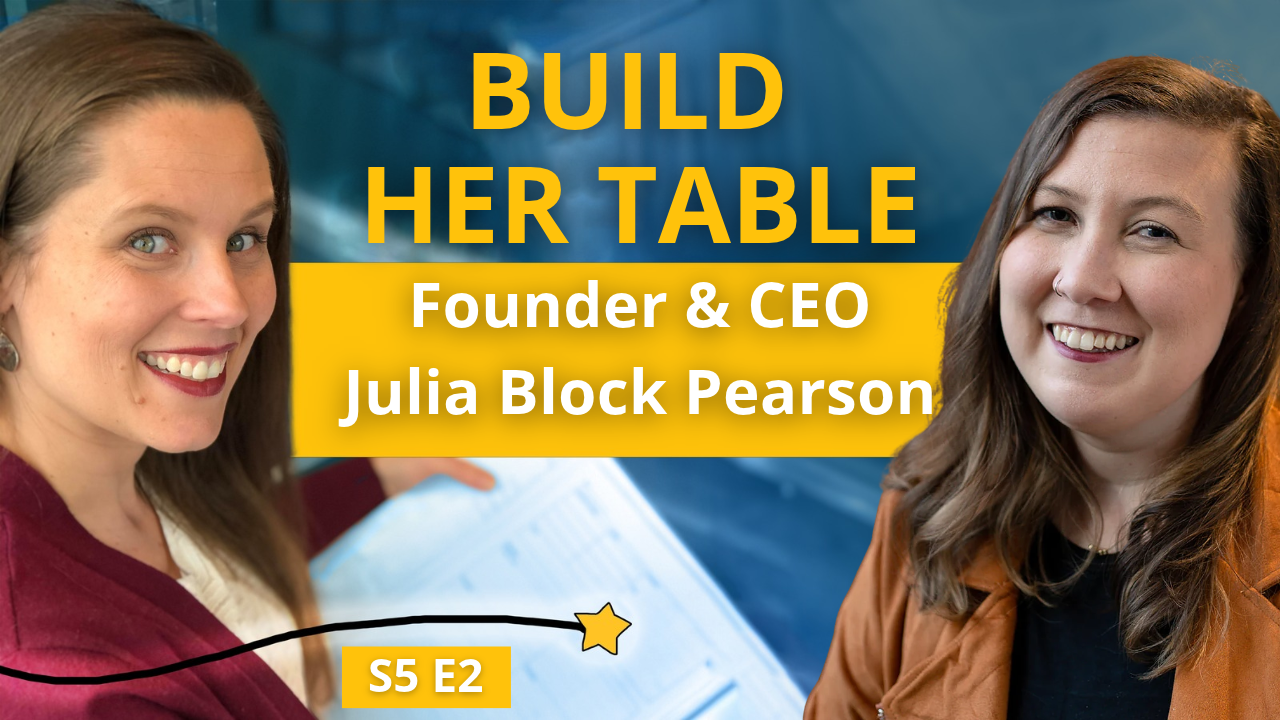


What if the people who understand your business best aren’t in your house?
In this episode of Diary of a Dreamer, I sit down with Julia Block Pearson, founder and CEO of Stratos Creative Marketing, to talk about building a business from scratch, the messy middle of five-figure entrepreneurship, and why you don’t need one best friend to carry everything.
Julia and I have known each other for about twelve years, since we were both doing MLM work. She’s since built a marketing agency that runs content and ads for small business owners, co-owns the Photo Camper with her husband, and is raising two little girls. She’s also the founder of Build Her Table, a community for female founders who are doing it on their own.
We talk about the skills network marketing gave us, the freedom to choose your hard, checking your ego when feedback stings, and what it looks like to build a table of women who fight for their dreams alongside you.
About Julia Block Pearson:
Julia Block Pearson is the founder and CEO of Stratos Creative Marketing, a marketing agency that runs content and ads for small business owners. She started the agency as a single woman in her late twenties after years of MLM work and nonprofit marketing, where she learned to build websites and run social media. Outside of Stratos, Julia and her husband own the Photo Camper, a vintage camper turned photo booth. She is also the founder of Build Her Table, a community for female founders in the five-figure range who are looking for what’s next.
Connect With Julia:
Instagram: @juliablockpearson AND @stratoscreative
Website: https://stratosecreative.com AND https://buildhertable.com
If this episode resonated with you, subscribe to Diary of a Dreamer, leave a review, and share it with a woman who’s chasing a dream and could use a table full of people who get it.
Read Transcript
00:00
Welcome to Diary of a Dreamer, where resilience unlocks your potential. I’m Tasha Eizinger, and each week I’ll bring you powerful stories and practical insights from my own experiences and inspiring guests. Whether you’re facing challenges or chasing dreams, this podcast is your go-to for motivation, building confidence, and practical tips for transforming obstacles into opportunities.
Be sure to check out my website, TashaEizinger.com. Let’s dive into today’s episode and start turning your dreams into reality.
00:32
Today, we are here with Julia Block Pearson. She is the founder and CEO of Stratos Creative Marketing. It’s the marketing agency that I use, endorse, and love. I’m so grateful. She’s built an agency that runs content and ads for small business owners. And outside of Stratos, of course, one business isn’t enough. Julia and her husband run the Photo Camper, which is a vintage camper turned photo booth.
And of course, they have two little girls. I know you said that they think they own it. You and I know they own it.
01:18
They totally do, yes.
01:21
My goodness. I’m so excited to have you here. We could record all day.
01:26
Oh my gosh, right. Like I was texting everybody else—since you’re not part of my Tasha’s text message thread—I was like, “How long do we have? What are we talking about?” And she told me what we were talking about and I was like, “Honestly, I don’t know why I asked that question, because really we could talk all day.” Like, that’s not a problem.
01:45
Yeah, it’s so fun. And you are truly one of my dearest, closest friends. And I have loved watching you evolve into this fierce businesswoman.
02:01
Like I remember when you had this idea to build a business and you said, “I want an agency.” And I was like, “What’s the difference between a marketing agency?” Go for it.
02:15
That’s hilarious. Yeah, for sure. Isn’t that crazy? Like, for context, everybody, Tasha and I have known each other for probably twelve years. We both met while we were doing MLM work, MLM businesses. Totally different. We met at a networking event. I never went back to that networking event, and I think you didn’t either.
02:39
Actually, here’s what’s—oh, why I went to this women’s networking group and I was pregnant and didn’t feel like going, but I went like every time they had it for a while. Because I was new to the area and I thought I needed to make friends too. And in network marketing or MLM, they teach you that networking with people is important, which is a great business skill.
03:03
Yeah, so I kept showing up. And three people that I met that only showed up once have become dear friends of mine, and we do business.
03:12
Okay, well, all right. So revision to that story: I only went once. Tasha and I became friends. When you had your baby, I had this Spanish teaching class business that I tried on for size. Like, Tasha has seen multiple iterations of my life and business. And it is kind of crazy to think about twelve years of change.
03:38
It’s been wild. And you, of course, rocked even the Spanish baby classes, because we still sing the songs you taught us, Julia.
03:48
That’s amazing. And now, crazy circle, like full circle, I have all of the books for my daughters and read them. So it’s pretty wild. Life is crazy, honestly.
03:59
Really is. And it’s kind of funny because when we were both doing MLM network marketing, both with reputable companies, really, and we were in it. Like, we both earned cars in our companies. And they were tough companies to earn a car in.
04:17
Right. Yes. Yes.
04:19
You can’t get it in your first month. I’m like, that—
04:21
No, it took me like a couple—a few years. I know it took you a few years too, but yeah. And it sounds like I’m tooting my own horn slash your horn, but we were kind of towards the top of the masses, like what I would say, like the masses.
04:40
With the titles, yeah.
04:41
Yeah. But like, we both approached it from such a serving angle. And wanting to help other people accomplish their dreams. Ironically, like, neither of us do that anymore. But—
04:58
We do the second part.
05:02
Yes, we don’t use MLM network marketing as the vehicle, but we’re still both in the same purpose. Like, we’re still on the same purpose.
05:12
Yeah. Well, and we’ve talked a lot about how it’s actually helped us in our businesses, some of the soft skills. And it’s so funny when I’ve talked to other maybe small business owners, I’m like, “Yeah, this is what you need to do. You need a BAM fam.” And they’re like, “What’s BAM fam?” I’m like, “Book a meeting from a meeting.” People will forget. So you need to schedule it at the end of the meeting. And like, different things that network marketing has taught us have served us.
So like, what are some things that you’ve benefited from?
And let’s be clear too, not all network marketing companies are good. Not all MLMs are good. There’s snake oil, there’s snakes.
05:50
There’s a lot of predatory practices. Yes. I’ve done a ton—if, to all the listeners, if you’re looking at one and you are like, “Is this good or not?” just DM me on Instagram, because I’ve done far too much research and watched all of the documentaries about how they’re scammy.
So I was literally just talking to an old friend who also was in network marketing. And one of the things that we were taught to do is—the company that I was with called it warm chattering. It’s a terrible name, but it’s basically you go up to strangers and you talk to them. And looking back, I’m like, I cannot believe I did that. That’s so weird. Like, to recruit them to come to a party for the company that I was working with. I’m like, why did we think that that was normal?
It wasn’t normal. But I will say, like, this is what I’m getting at, is that by pushing myself to talk to strangers, I have learned that I can literally talk to anybody. Yeah. And sometimes it’s more painful, like if we’ve got like Monologue Joe talking and he can’t stop talking. But other times it’s just people needing conversation. And I think that that skill goes a long way in networking in general for any kind of business. But then also on sales calls, client calls, all of those things. I am like, “You know what? We have an awkward moment. I can pull a question and we can talk about it.” Like, I’m not afraid to have a conversation with people.
07:42
No, that’s so funny. That’s one of the biggest things it taught me too, is just how to create conversation. We taught form, family, occupation, recreation, motivation.
07:53
That’s good. Yours had way more acronyms than mine did.
07:58
He was my mentor. The best possible mentor I could have ever had in network marketing. Like, truly phenomenal. He would come up with all these little acronyms. Find acronyms.
08:10
That’s awesome. I love that. I’m gonna steal that one.
08:16
Yeah, it’s good because it’s like, okay, so pay attention. Like, let’s say you notice that they’re wearing really nice running shoes or something. You could compliment the shoes because it’s genuine, you like the shoes. And then you could ask them, like, “Are you a runner?” And then it creates a conversation. And so it’s an easy way to create conversation. But you’re right, it teaches you how to get comfortable being uncomfortable.
08:43
Totally, totally. I mean, like, I’d go visit people’s—I just think back to that, I’m like, “I was crazy.” Like, we were crazy. But like, we were crazy and we did what I would call now—I would call them weird things. But like, it was really chasing a dream. And I learned to put so many fears aside to be able to chase that dream that I think it has taught me also a tremendous amount of faith now that things will work out how they’re supposed to work out.
And I closed that door, gosh, like, nine years ago. No, way more than that. Like, ten, eleven years ago. And I took a break from business, but I also knew that I would always be back. I just assumed that it would be later on in life when I had a husband who had insurance, so I didn’t have to pay for my own insurance. And that didn’t work out that way either. But when that door closed, I knew that I wanted the freedom that I had been given the vision for.
10:03
The freedom to work ninety hours a week.
10:06
The freedom to work—find you. Yeah, about that.
10:11
But isn’t that so funny? Like, people who are entrepreneurs, we do fight for that freedom and the possibility someday it won’t be crazy hours.
10:20
Yeah, I agreed, agreed. And I think that as I have ebbed and flowed out of workaholicism, I think I’ve also realized it’s the freedom to choose my—the freedom to choose. I want to say my pain, but it’s not like it’s all painful, but like, to choose my hard. Yeah. Like, to choose my discomfort, to choose my hard. And I would rather choose a hard that allows me to have a flexible schedule.
Does that mean that I work at night a lot? Yes, it also means that I work at night a lot. But like, I would rather choose—I love the freedom to choose the hard that I want to do, because I would rather do that kind of hard than nine to five, which can be kind of hard.
11:14
I agree. No, I completely agree. And I know that there are good bosses out there. I mean, you’re one of them. But there are good bosses out there. But I think of that gratitude I feel to have flexibility. I mean, you still have to put in the—yeah. But like, going on my kids’ field trips or showing up to their stuff, or helping a friend or family member who needs care or taken somewhere. I can do those things.
11:43
Even though we always have ten million things to do, it’s like we can kind of keep playing, like moving the puzzle pieces.
11:50
Right, for sure. Right, for sure. And my husband has like your traditional nine to five. His is like more like seven to six. So like, it’s its own different kind of hard. But we often talk about like, okay, one isn’t necessarily harder than the other. I have to regulate my emotions plus two other little girls’ emotions plus work plus navigating employees plus trying to balance between different businesses. And yes, sometimes I get jealous because he gets to go to work and not have to deal with any of those things. He just works all day and only has to take care of one person. But it’s just a different kind of hard.
And I think that when I first started business, I was like, “Oh, everybody needs to—why wouldn’t everybody do this?” And I had dinner with a couple dear friends when I first started Stratos. And they were like, “Gosh, I would never trade a steady paycheck for what you’re doing.” And I was like, “Wow, not everybody wants to do this.”
13:16
What? Not everybody’s delusional like us?
13:20
Right. And so all that to say, I know that you have a ton of different listeners from all walks of life. Yeah, we’re talking about business here, but also I just feel like there is this pressure sometimes where you’re like, “Okay, you have to be an entrepreneur or else you’re not chasing your dreams.” Like, there’s so many different ways to chase your dreams. And you and I have chosen one path. It is a very rocky path.
And it does take—my favorite shirt that I have right now says, “I will succeed because I’m insane.” And I believe that this takes a level of insanity to choose this rocky path. And sometimes I get jealous of my husband who just loves going to his job and just gets to do the same thing. And so like, I just want to affirm everybody: if you’re feeling like, “Hey, I wanna chase my dreams, but do I really have to be an entrepreneur?” No, you get to chase your dreams in a very different way.
14:35
I think that’s a really important distinction too, because there are people that are like, “Oh, my dream’s not that big or not that important.” And the reality is, if it is something that you want and it’s important to you, go get it. And we’re just choosing to do it this way. I agree. Like, I think of my husband, his work schedule’s all over the place, working retail, but he consistently—I see paychecks going into our bank account consistently. And I’m like, would that be nice to have? And it’s a similar amount every single time. It’s very dependable.
15:12
And I’ve had some friends who have jobs that are very successful and they’re like, “I couldn’t do what you’re doing because of that lack of consistency.” And I’m like, “I get that too.” Because we could put all of this time in. You and I have done that with certain things. And not only do you not make any money, you lose money.
15:35
All those things, I’m like, that was an investment in my education.
15:40
I had a $9,000 one of those recently, so that was awesome.
15:45
So painful.
15:47
Right, for sure. I think, yeah, I agree. And I think that—so I started Stratos. Back up, everybody. So my quick five-second story: I did MLM work, took a break, worked in the nonprofit at Ecosphere.
And then in that, I learned how to build websites and run social media because I was always the youngest person on all of the nonprofit teams. So then at one point I was like, maybe somebody could pay me to do this as a freelancer. And when my nine-to-five job went south, I just took the plunge. I had like three months of savings and so I was like, “All right, let’s do this.” And that’s when I called Tasha and I was like, “So I think I’m gonna do this.” And she was like, “Do it.” And then I found out later that she was like, “I don’t know how she’s gonna do it, but she’ll do it.” Tell me that part.
16:52
Wait, I gotta interrupt, because do you know how I knew you could do it?
16:57
Tell me.
16:57
I don’t know if I’ve ever told you this. Okay. When I knew that you earned a car in an MLM that’s a saturated company in our area, I was like, “She knows how to hustle and get it done.”
17:16
Right.
17:16
MLM is so hard because you’re overcoming objections of integrity, character, intelligence, scams, like so many objections that you have to overcome. I’m like, if she really wants to make this work, she can do it, because she earned a car.
17:33
Yeah, well, thank you. Thank you. Um, yeah, so then I started Stratos. But guys, I started as a single woman. I was 28 at the time. Gosh, math is hard today. And I started at 28, unmarried. I wasn’t even dating at the time, so there were like no prospects on the horizon or anything like that.
And I will say, back to our dreaming, my ability to withstand the roller coaster of paychecks coming in and coming out was very different at that time than it would be if I started something now with two kids and a family. And I think you would say the same thing. Yours has looked different at different times. For a while you had to go back to work at a part-time job because that’s what your family needed. I’ve done the same.
And once again, we’re not built for that. But we do the hard things that we might not be built for temporarily, knowing that that’s what our family and what that situation needs. I have a hundred percent been a W-2 employee in the past eight years. Well, do I tell most people that? No, because I want people to think of me as a business owner who is competent and providing for herself. But you gotta do what you gotta do too.
19:16
Absolutely. And I do appreciate that you said that, because just because somebody has to step back from their business and do work outside of their business or whatever, here again, if it’s a dream, if it’s something that you feel like is worth it long term, short term, sometimes you have to do stuff that you don’t want to do.
19:36
Totally, totally. And I think that sometimes when that happens, it makes us feel like we’re failures, but in reality it’s just a rest stop. Like if we’re on a highway, it’s just a rest stop. We’re just stopping there and then we’re gonna get back. And that’s okay.
19:57
Yeah. You know, the moment—like, I knew that taking my part-time job, which is something I had to do for our family at that time—the very first day, we hadn’t even started officially working, it was the first day. And they were talking about a very simple problem of the snacks, and how the snacks were arranged. So I was like—and I love Tetris—so I’m like, “Okay, well, what if we did it this way?” And I moved over the step stool and I moved, heaven forbid, the Ritz crackers.
20:28
And I got a look from someone and I was like, “Oh, okay, so I’m not even allowed to move the Ritz crackers because my coworker is upset with me.” Can I quit before I start? Wait, no, I have to do this.
20:46
Don’t you think that as entrepreneurs, that’s the number one skill you have to have is problem solving?
20:51
Oh, for sure. And I teach my girls—my girls have no entrepreneurial bone in their body right now. And if it is, my will and mission in life is to get Maddie, my four-year-old, to be into a lemonade stand. Like, that’s just what I want, because I want that so much. I’m gonna push—I’m gonna push my business dreams onto my four-year-old. Just kidding, everybody.
But we talk about problem solving a lot in our home right now, because as a four-year-old, she’s like, “Well, I have this problem.” And I’m like, “It’s not that hard. Let’s figure it out.” And I think that problem solving, next to belief, might be the two most important things that you need to have—skills or feelings. Or maybe even, let’s call them mindsets. You have to be able to have those two things, because the amount of problems that come at you is actually incredibly overwhelming. And I think that sometimes you have to figure it out on your own. Sometimes you get the privilege of asking for help. But if you’re not ready to problem solve on an hourly—possibly minute—basis, this would be really challenging for you.
22:21
So I agree. And it is a good life skill in general.
22:25
Totally. Totally.
22:26
It’s amazing when people will see obstacles and then they give up so easily, or they just think it’s not possible. And it’s like, oh—
22:36
Just imagine—yeah. Sorry, I interrupted you. No, you’re fine. Go ahead.
22:40
What were you gonna say here?
22:41
I just—not to get political, but just imagine if our leadership on all levels—not just government, but national, state, school boards, PTAs, all of the leaders that we see every day—what if they were all committed to being problem solvers? We talk a lot about it in Stratos. You can be a problem creator or you can be a problem solver. And I think that even some quote-unquote problem solvers are actually problem creators. Like, once they sit down because they’re like, “Let’s solve this problem,” instead of actually finding a solution, they bring up all of the objections and all of the reasons that that solution won’t work. And yes, there’s time and space for that, but that, I personally believe, is a problem creator.
23:38
And it’s exactly—
23:39
And we need less of those. We need less of those. And I think that we all flow in and out of problem creating and solving. But there are some people who are stuck in problem creating, and we need to get them unstuck ASAP.
23:56
Yes. Yes. I completely agree. And also thinking of solutions that are not based on your own ego. I think that’s really important. That’s one of the things we talk about in Little Shot when we were doing the books and everything, which are obviously done. So I’m working with different people now on different projects, but specifically that team, it was about the project, not our ego. It’s about creating results and producing something we’re proud of as a team. And that means checking your ego. And it can be hard. And that’s usually one of the first things I think of is, like, okay, is this an ego thing or is it a betterment of the project thing?
24:38
I do that too. Even in my daily life. Like, if I get really offended about something—I’m trying to think of an example, but I can’t think of one. Or—
24:54
If you have a visceral reaction and—
24:55
Yeah, like a visceral reaction, or like I am wanting to pull out my phone and send an angry text back or something like that. Or like my brain gets hijacked by the emotions. I often will try to take a few steps back. I’ve learned that I cannot answer in the moment. If I answer in the moment, I make things worse.
25:18
Reddit.
25:20
Totally. And those are some of the questions that I ask myself, especially when it’s business things. Like, did this feedback offend me because it’s true? Or did it offend me because it’s not true, but it pricked something inside of me? Or did this feedback make me look bad, and is that why I’m upset?
25:50
Am I embarrassed? Yeah.
25:52
Or is it something that I need to kind of decipher and figure out what I can take away from? I feel like that’s something that has been really important to me, is to pause and reflect. Like, why did I have this visceral reaction to that? And what does that say about me? And I don’t do that perfectly every time, everybody. So don’t think that I’m a saint here. But I do think that if you can start doing that, then you can start taking the ego out of it. Because sometimes we do make mistakes, and when people point it out, we might have a visceral reaction because we didn’t mean to make that mistake, but they’re just pointing it out. It wasn’t really meant to be offensive.
26:46
Yeah. No, I agree with you. And I think part of what has helped me is having somebody like you in my life, because I mean, we voice message each other.
26:58
On a daily basis, yeah.
27:00
Yes. And I don’t know what I would do without you, Julia.
27:04
I feel the same way about you.
27:06
Yeah, I really don’t—personally and professionally. Like, you are—if something bad happened in my business, you’re one of the very first people, oftentimes the first person that I’m like, “Julia, I have to tell you this just happened.” And it just helps, because sometimes, you know, you love me enough to be supportive, but also if there is an ounce of truth, I know that you would tell me. And if it’s absolute garbage, you help remind me of that.
27:41
Right. Or if something good happened.
27:43
Really, you’re one of the first people that I’m like, “Julia, listen to this, this is so exciting.” And I think that that is a really important thing, is to have really close friendships. And I’m grateful for you.
27:59
I’m really grateful for you. And I feel the same way about you. I think there’s something to be said about having a friend who knows and believes in you enough that even in your ickiest times, they know this isn’t the full—if you took a slice of one of our voice memos on a very bad day, you’d be like, “Wow, these ladies are unhinged and so awful.” But if you look at the whole scheme of things, you can say, “Wow, that was a really hard day. They vented to each other and they supported each other.” But sometimes if you look at one of our voice memos, you’d be like, “What is going on with those ladies?”
And I think that’s the thing, is that I can tell you, “Wow, I legit despise this person currently and I am so hurt by them.” And you can say, “Julia is not a hateful person. This person hurt her. Let me help her work through that.” And so I think that’s the difference. And I do think that it is rare.
I also wanna jump in with something else I’ve noticed: I feel like as women, we have this anomaly—and maybe men have this too, but I can only speak to our experience—there’s this idea that you have to have a best friend. And I don’t think I totally believe that anymore. I think I did as a kid, as a college student, even up to a few recent years. But I think that the more valuable thing is to have close friends who can see you and still love you. And I don’t think that has to be isolated to one person.
Like, by nature, we all learned good, better, best. If you have best, it should be only one, because you can’t have two best things by the definition of the word. But I think that when I think about my friendships, I have several best friends and they all meet different needs in my life. Like, I have my best friend Katie. She and I go on trips together—or we used to, now we have kids. We go on trips together, we have fun together, we laugh together, we love each other so much and can meet each other in the hard times. But she’s the person who I would—and Katie, if you’re listening, I love you—I would tell her an overview about business, but we don’t get deep necessarily on business, because we live two different career paths.
You, Tasha, are somebody who I can go deep on in business with. And you basically know my business and all of them, really. All of the businesses, through and through, and I know yours. Like, if we have deep dark business secrets, we know them.
31:24
We still relate on personal things, but actually, guys, Tasha and I have not seen each other in real life since I got married five years ago. It makes me so—and we have tried so many times. And frankly, we don’t even talk on the phone that often. But we voice message almost every day.
And so I think that’s where I just want to encourage everybody, especially the women out there: if you are living with this misnomer that you need one best friend to carry everything with you, I think you need to relook at that and say, “Hey, you know what? What are a few close friendships, and how do they serve the different parts of me?” Rather than relying on one single friend.
32:13
A community, really. You do need a community. And I know that that’s something that you’ve been building, and I’m so excited that you’re—and these women are amazing. Like, I feel so fortunate to be a part.
32:29
They’re all kind of awesome, right? So they’re all doing really different things. So, everybody, like you’ve already heard, I have Stratos, which is a marketing agency. If you need social media, websites, email, all of that, ads, come talk to me.
32:47
Stratos creates for me, people—compliments, by the way. I’m not kidding. It’s all—
32:52
Yeah, that’s because Savannah—shout out to Savannah, who is our designer—is actually incredible, and she’s also a gem of a human. And then my husband and I own Photo Camper, which is a vintage camper. So if you’re ever in Utah, hit us up. It’s like a photo booth, like what you would have at the mall, but inside of a camper. It’s super adorable.
33:16
Just adorable and fun.
33:19
Fun. It is so cute. I love it. And why not start a third business, right?
33:26
You don’t have enough to do.
33:29
Right. And so, but actually, this initiative business is called Build Her Table. It came out of a true desire to serve people, especially women, female founders who are in the five-figure mark. So there’s a ton of resources for people who are just starting their businesses, and there are tons of resources for people who are marketed to like, “Scale to six figures, scale to seven figures.” But I feel like there’s this five-figure, messy middle.
So people making five figures—and that obviously could be anywhere from 10 grand to 99 grand. So it’s a big range, and there’s a lot of different people and businesses in that range. But usually those women are doing it on their own. They are not quite ready to hire help. And I was meeting a ton of them through Stratos. We would have sales calls and these women would have phenomenal businesses but couldn’t afford agency prices. But they needed to know what was next. Like, what’s the next step?
They’re powerful women who are willing to put the work in. They just need to know what to do, and they are tired of wasting their time, because their time is precious because most of them have kids, et cetera. So they want to do the things that work. So anyway, before I keep on monologuing about it, we’ve put together a community where we do a “What’s Next” session. We talk through, “Hey, what’s next in your business?” We brainstorm solutions. We have had a couple at this point and they are amazing, because it’s just a literal room of women brainstorming your idea and figuring out, “Hey, what’s next? What should you try next?”
We have a community group where people can submit their ideas, submit their brainstorms, ask questions. We have monthly teachings from an expert that I find. I bring them in. You get my eyes on things—I love giving feedback on things—but I think even more importantly, you get all of these other business women who are also putting their eyes on things. Together, collectively, we are helping female founders feel less lonely as they tackle their dreams.
36:01
No, you really are delivering on that too, because it is very lonely. Most of what I do is by myself.
36:07
Yeah, same.
36:08
And so to have people to bounce ideas off of and get different perspectives. Everybody comes from a slightly different background as well. So everybody’s bringing—this is going to be a pun, I can’t think of another way—everybody’s bringing something different to the table.
36:25
Yeah, for sure. And that’s kind of where the name came from. It’s Build Her Table. Some of these women need advisory tables, or people who—or team tables. Like, basically, let’s build your table and who you want sitting around it, who are the voices in your ears.
I think—bless my husband. Again, also Roger, if you’re listening to this, I love you. Sometimes when I have a problem and I want him to be a problem solver—he’s not a problem creator, but he’s like, “You got it.” I’m like, “Mm, that’s not what I was asking for.”
37:04
If you’re listening, stop saying that.
37:09
Yeah, I appreciate—something up. I appreciate his confidence, but I want somebody to brainstorm. And Tasha, like we’ve said, you are usually that person who I’m voice texting and saying, “Hey, what about this? What do you think about this?”
But I almost wanted to recreate what you and I have on a bigger scale for all of these women who are doing it on their own otherwise. And I’ve had a lot of people over the years send me ideas and they’re like, “I’ll pay you for your time, but also I don’t have money to pay you for your time. Can you just give me an idea?” And so that’s kind of what we’re doing now, is making sure that nobody has to just go to their husband or their significant other or their spouse—whoever is your person who does not understand business. You don’t have to go to them anymore if you don’t want to. Just kidding. You should still keep them in the loop.
38:15 Tasha: You can relieve them of their duties of being—
38:17 Julia: Right. You can relieve them of their brainstorming duties. Because you have a community of women who are fighting for their dreams at the same time that you are.
38:32 Tasha: I love that. So how can people join this community? Because I know you’re not just opening it up to the masses exactly.
38:38 Julia: Yeah. So if you head over to BuildHerTable.com, you can submit your application form. Application form sounds really intimidating. It’s just a few questions, everybody. So you’ll be fine. And then you’ll be welcomed into the community.
We do “What’s Next” sessions, which are kind of like hot seats but less intimidating. We do monthly talks by different leaders. We have people who talk about when to hire a VA, more practical things. But then we also have people talking about how to find your niche or your ideal customer, things like that. And then we have the community. We have work sessions where you can come and hang out with us.
I’m hoping in the new year to build out an accountability partner program that people can get deeper with an accountability partner. But also, if you’re like, “Wow, that sounds like so much and I already have a lot on my plate,” you just come and you show up for what you want to show up for. It’s not like it’s required reading or required homework.
So head over to BuildHerTable.com and fill out your application if you’re interested. If you just wanna lurk and hang out, you can follow me at Julia Block Pearson on Instagram. That’s where I spend most of my time.
40:08 Tasha: Love it. And if people want to work with Stratos, where do they go?
40:12 Julia: Go to StratosCreativeMarketing.com. And Stratos is S-T-R-A-T-O-S. So some people say Stratos, some people say Stratos. There’s no right or wrong way. So do whatever you want. But again, we also have Stratos Creative on Instagram too.
40:32 Tasha: Make sure everything’s tagged in the show notes so people can find you. I think everybody needs to know you. That’s what I—
40:38 Julia: I think everybody needs to know you. Are you kidding me? So just come and know us together, everybody.
40:47 Tasha: Thank you so much, Julia, for being here and for being one of my people. I so—
40:53 Julia: Welcome. I am so happy to be one of your people and I’m grateful for you as well. I can’t believe this time is over. I’m like, can we just keep going?
41:07 Tasha: We never get to—like, we actually are seeing each other’s faces right now.
41:11 Julia: Trying, for sure. As I’m hiding in my basement from my kids.
41:17 Tasha: They did great.
41:19 Julia: They did. Thank you, kids. You did great. So anyway, well, thank you, Tasha.
41:32 Tasha: Thank you for tuning into this episode of Diary of a Dreamer. I hope you found the stories and tips shared today to be a source of motivation and strength. Remember, every challenge you face is a chance to grow and move closer to your dreams. Don’t forget to subscribe, leave a review, and share this podcast with anyone who could use a boost of encouragement. Please check out my website, TashaEizinger.com.