
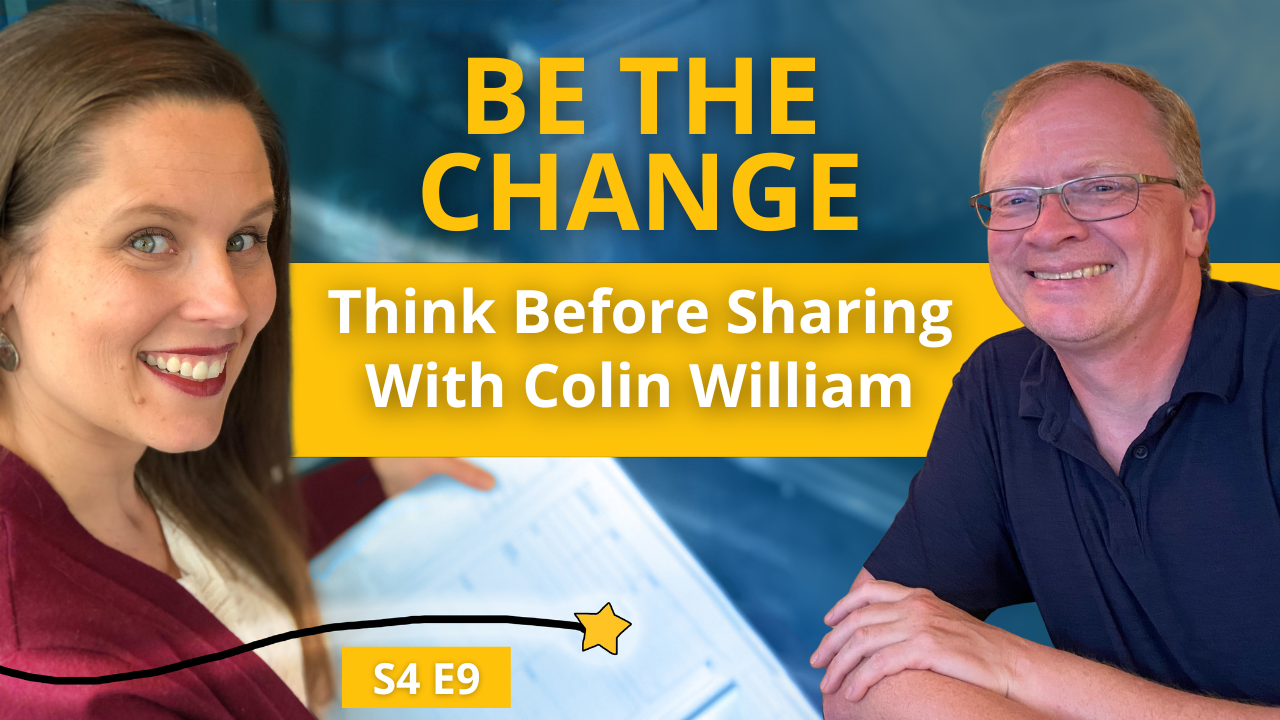


In this episode of Diary of a Dreamer: Be The Change, Tasha Eizinger sits down with Colin William, Teaching Professor in the Department of Psychological Sciences at Purdue University, to explore how we can become more thoughtful consumers of information in a world filled with social media, misinformation, and emotional manipulation.
Colin breaks down how propaganda works, why even highly educated people can fall for misinformation, and how our own brains can make us vulnerable to confirmation bias, cognitive dissonance, and group polarization.
This conversation is not about telling you what to believe. It is about learning how to think.
Together, Tasha and Colin discuss:
- What propaganda actually is and why it is more than simply sharing an opinion
- Why fear, anger, and outrage are powerful tools for manipulation
- How social media algorithms can reinforce our existing beliefs
- Why we are vulnerable to confirmation bias and cognitive dissonance
- How to recognize emotional triggers before reacting or sharing
- Why pausing before reposting is an act of responsibility
- How to evaluate your information sources
- Why critical thinking does not mean questioning everything… it means knowing what deserves deeper examination
- How we can stay informed without living in a constant state of urgency
One of the biggest reminders from this conversation:
You can be an informed citizen without consuming information every moment of every day.
Real change does not come from reacting quickly. It comes from thoughtful people who are willing to stay curious, ask better questions, and engage with others intentionally.
About Colin William:
Colin William is a Teaching Professor in the Department of Psychological Sciences at Purdue University. His work focuses on psychological science, human behavior, and helping students understand how we think, learn, and make decisions.
Read Transcript
00:00
Welcome to a special mini-series of Diary of a Dreamer called Be the Change, where resilience, critical thinking, and everyday courage come together.
I’m Tasha Eizinger, and in this series, we’re exploring how ordinary people can create meaningful change. We’ll talk about how to think clearly, engage responsibly, and take action in ways that truly make a difference.
If you’ve ever wondered how to stay level-headed, raise resilient kids, participate in your community, and be a force for positive change, this series is for you.
You can learn more about my work at TashaEizinger.com.
Let’s dive into today’s conversation and explore how we can be the change.
01:12
Today we are with Colin William. He is a Teaching Professor in the Department of Psychological Sciences at Purdue University, which is my alma mater.
I’m so grateful to have you here, Colin. We met back in our Toastmasters days, and I was beyond impressed with your ability to articulate yourself and communicate so effectively.
I also know your background is really meaningful for this Be the Change series, so thank you for being here.
01:28
Thanks for having me, Tasha.
01:14
We’re going to start with explaining the Psychological Sciences Department. You were telling me about your role at Purdue. Can you explain what you do as a Teaching Professor?
01:28
Yeah. Our department has faculty who are research faculty and faculty who are teaching faculty.
As a Teaching Professor, I primarily teach the very large lecture halls for freshman and sophomore-level classes. I have 450-student classes for Introduction to Psychology, which serves a broad audience, as well as upper-level classes in various areas that are usually in the 250- to 300-seat range.
Our department focuses on psychological science. That’s really our identity. While our graduates may go on to many different professions or graduate programs, our foundation is centered on the science of psychology.
02:19
Interesting. My dream is still to sit in on one of your classes.
02:28
Well, my first class this fall will be Monday morning at 7:30 a.m., so that probably won’t be quite as exciting for my freshmen as it would be for you.
02:39
No, you’re really going to have to up your game to keep them showing up. Do the most ridiculous, absurd things you can think of, and they will probably be there.
02:48
We’ll see if word gets around.
02:51
Wonderful.
Part of this Be the Change series is helping people use their brains, stay grounded, and look at things from different perspectives.
I would like to start with propaganda. Propaganda is all around us, so I would love for you to explain how you define it.
03:16
Propaganda is a pretty loaded word. It’s not simply, “Here’s my opinion.”
It’s specifically oriented toward control. It’s about population-level control or individual-level control through information—or more accurately, incomplete information or deliberate misinformation.
Generally speaking, it has bad-faith intentions behind it.
This is different from two political parties having different opinions on something like tax policy. This is much more insidious. It’s about controlling populations through various mechanisms, primarily through manipulation.
04:12
I feel like it’s also designed to invoke emotion, right?
Even in The Hunger Games, the last movie, they would say, “Let’s shoot a propaganda piece.” If people want to see a simplified version of what that looks like, watching that movie helps explain what you’re describing.
It’s designed to invoke emotion, which can make even highly educated people more susceptible to manipulation.
Why is it that we are all susceptible to it? If we know it exists, why are we still vulnerable?
04:53
That’s a really important question because we’ve now been in the internet era for about 30 years. Propaganda existed long before that, of course, but we’ve also been in the social media era for about 20 years.
Unfortunately, we’re now entering the deepfake era, where information can be more easily fabricated.
I often hear people say, “We need to teach better information literacy in schools.” But as you pointed out, even highly educated people—people with college degrees and graduate degrees—can fall for propaganda.
It’s not necessarily that people lack the tools to recognize it. There’s much more happening psychologically.
The question becomes: if people have the skills, why don’t they use them?
One reason, especially among educated people, can be overconfidence.
You think, “I’m a smart person. I know what I’m looking at. I can tell.”
You think, “I’m too smart to fall for this.”
05:53
But a lot of it starts with the media sources we choose.
Those sources often speak with a high degree of confidence. Simply by giving them your time and attention, you’re psychologically buying into that confidence.
Then, as an educated person, you can become overconfident in the information you’ve received.
06:37
It’s also manipulating you emotionally.
It makes you feel good. It makes you feel right.
Then, as you become more confident in your belief, you can become more confident in clicking that share button and broadcasting it to others.
Now your authority is attached to it as well.
There’s also the issue of motivation. You have to want to check the information you’re hearing.
If that source is telling you, “You’re right, and look how great it is to be right,” you’re less likely to verify whether it’s true.
You may not want to check because there is a risk of discovering you’re wrong—and then you have to deal with feeling bad.
07:26
Fact-checking also takes time.
We’re often seeing this information during an idle moment. Maybe you’ve dropped your child off at story time at the library and now you have 30 minutes to fill, so you decide to scroll.
You’re not necessarily thinking, “That’s interesting. Now I’m going to spend time fact-checking this on my phone.”
That takes effort.
The combination of overconfidence, not wanting to discover you’re wrong, and the authoritative tone of propaganda makes it very difficult for people who are trying to communicate reality.
08:17
I often tell my students when I’m talking about Freud in class—I’m not a fan—that I’m communicating psychological science.
Freud tells a much more interesting story. Science is often more mundane.
It’s fascinating to me, but it may not be fascinating to everyone.
Propaganda works the same way. It tells a much more exciting story. It creates a more engaging narrative, while reality is often more complicated and less dramatic.
It can be difficult for people to step back and recognize what’s happening, even when, once they step back, it becomes obvious.
09:02
You’re right. It is more dramatic and exciting when something is sensationalized and creates those big emotions.
Whether it’s anger, outrage, or even that feeling of, “I knew I was right and everyone else was wrong.”
We almost get caught in a drama loop.
So what are some ways we can check ourselves? Because what I’m hearing is that we have to take personal responsibility.
There are people intentionally creating propaganda, but we also have responsibility for how we respond to it.
What are some questions we can ask ourselves to stay grounded?
09:44
These are the beginnings of building better habits.
Because as you said, we have responsibility. If you take something and immediately reshare it on social media, you’re broadcasting it to an audience, and you owe that audience respect.
Sharing something false with your audience is a profoundly disrespectful thing to do.
You need to develop the habit of checking information.
But developing good habits starts with breaking old ones.
The first habit that’s easy to fall into—and I can feel this myself—is seeing something, immediately becoming angry or self-righteous, and then stopping our thinking process.
The most important thing we can do in that moment is simply pause.
10:51
Pause and let yourself calm down.
One of the biggest tells of propaganda is that it is triggering an emotion—usually outrage, anger, or something intense.
If you can step back and recognize what’s happening, if you can feel it in yourself and say, “Here’s what’s happening. I’m no longer operating as a rational human being,” that is a really good starting point.
That gives you a moment to take a breath.
Because here’s the truth we all need to acknowledge:
Nothing bad will happen if you don’t reshare that thing right now.
11:43
That’s such common-sense advice, but you’re right. It feels urgent.
11:47
Exactly. We feel like, “All of my friends need to know immediately.”
But the reality is, as individual citizens, while we want to be informed, we’re not the ones making every decision. We don’t have to form our final opinion in that exact moment.
Maybe you’re sitting in a waiting room scrolling and feeling that emotion.
Step back and recognize that emotion was intentionally triggered. That’s what the propagandist wanted.
12:21
As an everyday person, you have choices.
You can decide, “This is important to me. I’m going to spend time fact-checking and finding authoritative sources.”
Or you can decide, “I don’t have the time for that right now, and I’m not going to let this become part of my thinking.”
If you don’t have the time to fact-check or seek out authoritative sources, that’s okay. We have lives to lead.
But you also have to recognize the tradeoff: you’re not going to be an authority on that topic yourself.
12:50
Another tell for propaganda is that it often doesn’t provide sources.
It doesn’t give you the ability to check the information.
If you read an article or watch a video and there are no sources provided, that’s a red flag.
Maybe they simply don’t think sources are important.
But often, it’s because they don’t want you looking deeper.
13:31
I frequently have people share things on my social media about “a new psychological study.”
It always sounds suspicious to me because I’m a psychology professor. We generally don’t make sweeping conclusions like that.
When I go back to the original source, I often find much more careful wording than what was presented.
Propaganda works the same way.
If sources aren’t provided, that’s a sign that you need to be cautious.
14:16
Sometimes people can spend hours going down a rabbit hole trying to fact-check something.
But we live in an era where we have endless information and misinformation at our fingertips.
If you can spend two minutes and find a credible source, that can tell you something.
If you can’t find an authoritative source quickly, especially one that isn’t another propaganda source, that’s a reason to be cautious.
15:09
That’s so simple to do.
Pause.
Notice what sensations you’re feeling in your body.
Ask yourself: “Why am I feeling this strongly?”
Then do a quick two-minute source check.
These are things we can all do. It takes less than five minutes.
15:26
And again, if you can’t find something in two minutes, that doesn’t necessarily mean the information is false.
It just means you don’t need to immediately internalize it as something you need to be outraged about or immediately reshare.
15:40
One of my biggest concerns is how fear, anger, and outrage can make people much easier to manipulate.
How does that work in our brains? I understand it in very basic terms—that it can essentially turn off certain parts of our brain—but can you explain how that makes us more vulnerable?
16:15
Yeah, so obviously emotion is a powerful factor, and negative emotions can have a particular power. They connect to our evolutionary defense mechanisms and things like that.
But at a cognitive level, there are some really interesting patterns of cognitive biases. One of them is that humans are often characterized more by loss aversion than by the pursuit of gain.
In other words, in competitive environments, we are often more protective of what we already have and more afraid of losing what we have than we are excited about pursuing something that could be even better.
This is probably one of the things that differentiates the best athletes — the ones who don’t choke under pressure — from others.
Propaganda is often built on that fear and outrage of loss.
“You are going to lose this freedom.”
“You are going to lose your job.”
“You are going to lose your status within society.”
It preys heavily on that loss-aversion bias in human cognition, and that can have a very powerful effect on us.
17:20
We often wonder why we don’t have more positive conversations about politics or society. Part of the reason is that fear of loss is often more powerful than saying, “Look what we can accomplish together,” or “Look how we can build something better.”
Threatening loss is a powerful way to get people’s attention because it makes it personal.
“Here’s how this is going to affect you as an individual.”
But these manipulations are often tribal in nature as well. We are social beings. We exist within social groups and communities.
So often, the message is not just:
“You are going to lose this thing.”
It becomes:
“We are going to lose this thing.”
18:08
Then you get collective anger and collective outrage, and it becomes self-reinforcing.
You’re talking with people on social media who agree with you, who are also scared, angry, and outraged. There’s a concept in social psychology called group polarization.
Group polarization is the idea that when you bring together people who largely agree on something, their positions can become more extreme.
A lot of this has been studied through mock jury situations. If you take 12 people, have them individually evaluate a trial, and they all say, “I think this person is probably guilty,” then bring them together to discuss it, their opinions often intensify.
It moves from:
“I think this person is probably guilty.”
to:
“I know this person is guilty.”
And the sentence they might have considered individually becomes much more extreme after group discussion.
19:05
That same thing happens with collective anger.
“I’m scared about this.”
“I’m scared about this too.”
“We’re scared together.”
That validates each other.
My anger validates your anger. Your anger validates my anger. And suddenly our outrage becomes stronger because we feel justified.
“I’m not alone. I’m not the only one who feels this way.”
Those mechanisms can really magnify loss aversion and drive fear, anger, and outrage.
20:55
So how do we protect ourselves from becoming part of that mob mentality where we’re outraged together and therefore feel completely justified?
21:08
One thing we can do is, to the extent possible in 2026, get ourselves offline a little more.
A lot of where we see group polarization happening is within social media bubbles, especially because of social media algorithms.
There was an interesting study published recently where researchers looked at people using a major social media platform. One group interacted with a chronological feed, while another group interacted with an algorithm-driven feed.
They found that people using the algorithmic feed became more politically hardened over time because the algorithm detects what you engage with and continues feeding you more of the same.
22:19
When I say “get offline,” I don’t mean that we can completely remove ourselves from the online world. That’s not realistic.
But we can become more deliberate about how we consume information and propaganda.
You’re younger than me, but I grew up in an era where media consumption was more intentional. Maybe the radio was playing in the background, but otherwise the news came on at a certain time and the newspaper arrived in the morning.
We weren’t constantly being bombarded.
Now information is coming at us from every direction, and we’re constantly being pulled into outrage.
One of the main delivery mechanisms is social media feeds. Once you begin engaging with certain content, you become immersed in more like-minded opinions because that’s what the algorithms continue to provide.
23:41
Another important thing is that social media tends to elevate the loudest voices.
People who are more thoughtful, nuanced, and careful are often less likely to comment every time something happens.
So the voices we hear most frequently are often the most extreme ones.
And the more we engage with people face-to-face, the more we realize that real conversations usually don’t happen the same way as they do online.
I used to participate in online discussion boards about baseball.
24:15
I bet those got heated.
24:22
Oh, absolutely.
People say things online that they would never say to another human being face-to-face.
If I were standing on the street and someone shared an opinion I disagreed with about my baseball team’s manager, I would never say, “You are the dumbest person in the world for thinking that.”
But online, people say those things because there’s a protective shield — the computer screen.
24:50
It creates distance. It depersonalizes and dehumanizes people.
It also caricatures opinions because you’re often only seeing the most extreme versions of an argument repeated over and over.
Even people you trust may simply be repeating information they received from propaganda sources.
25:17
So what I’m hearing is that we need to have conversations with people — genuine conversations, face-to-face conversations instead of just behind a computer screen.
And I also think it’s important that we learn to question ourselves.
Can you explain cognitive dissonance and confirmation bias so we’re all starting from the same place?
25:48
This idea of questioning ourselves seems obvious when we step outside of ourselves.
If someone asks me, “Of all the opinions you’ve ever held in your life, what percentage do you think were correct?”
I’d have to be the most arrogant person in the world to say, “One hundred percent.”
Maybe 90 percent would still probably not be accurate.
We have all been wrong before, which means we are probably wrong about something we currently believe too.
That requires humility.
Cognitive dissonance goes back to a theory developed in the 1950s. It describes the tension we experience when we recognize that we either hold two conflicting beliefs or that our behaviors conflict with our beliefs.
We don’t like being in that uncomfortable state.
So cognitive dissonance theory says we typically do one of three things:
We change the belief.
We change the behavior.
Or we rationalize away the tension.
27:20
So would an emotion like guilt be an example of cognitive dissonance? For example, I did something that doesn’t align with the person I want to be, and now I feel guilty.
27:33
Yes, exactly.
For example, imagine someone shares something false on social media.
I might be the person who says, “Actually, that isn’t true,” and I provide a source showing why.
If they listen, I’ve now created cognitive dissonance.
They think:
“I’m a good and intelligent person.”
But also:
“I shared something false.”
Those two ideas conflict.
They might feel guilt because of that.
The options are limited. They can admit they were wrong, or they can rationalize.
And what we often see people do is rationalize:
“Well, what does it say about the other side that this could have sounded believable?”
Now the blame shifts away from themselves. They’ve reduced the discomfort and protected their identity.
“I’m still a good person.”
28:57
So you either give up or you dig in.
29:00
Exactly.
That’s cognitive dissonance reduction.
Confirmation bias is another incredibly powerful force.
Confirmation bias is our tendency to seek information that confirms what we already believe rather than risk discovering that what we believe might be wrong.
This has implications everywhere.
For example, in medicine, you want a doctor who not only looks for symptoms that confirm their diagnosis but also actively searches for evidence that might prove the diagnosis wrong.
If a doctor is strongly influenced by confirmation bias, they may miss important symptoms because they’re only looking for information that supports their original conclusion.
Confirmation bias is incredibly powerful in everyday life.
30:19
There’s an interesting question in evolutionary psychology:
Why did humans evolve reason?
Did we evolve reason to solve problems?
Or did we evolve reason to win arguments?
The difference becomes clear when we think about a time we discovered we were wrong.
If reason evolved primarily to solve problems, discovering we were wrong should feel like a victory.
It should be:
“Wow, I had incomplete information before. Now I know more. I’m a better problem solver.”
But that’s usually not how we experience it.
Finding out we were wrong stings because being right has value to us. Our beliefs become connected to our identity.
31:20
Confirmation bias shapes so much of what we see happening today.
People choose media sources that are designed to reinforce what they already believe.
And that happens across the political spectrum.
These sources often exist to keep you inside their information environment because it benefits them.
If you stepped back, you might realize:
“They’re wrong on my side too.”
But finding a more objective source creates the risk that you might discover you’re wrong.
And that’s uncomfortable.
32:23
When we hear information from outside our own beliefs, we often don’t listen to learn.
We listen like defense attorneys protecting our belief system.
We’re preparing our response:
“I object.”
“No, that can’t be right.”
These are incredibly powerful forces, and we’re all vulnerable to them.
Even the person who says, “I’m completely cold and rational. I’m above emotions,” is expressing an emotional investment in that identity.
We are human. This is how we operate.
33:27
I could probably talk with you all day about this, but I want to close by talking about critical thinking skills.
That phrase gets used a lot:
“Oh, I use my critical thinking skills.”
But then I start questioning:
What were your sources?
Are you just finding information that reinforces what you already believe?
Because that’s not critical thinking.
You’ve already mentioned some important things:
Having conversations with people.
Pausing.
Taking a couple minutes to look for sources.
And even looking at sources that may disagree with you.
34:00
Right. So you’ve already hit on having conversations with people, pausing, doing a two-minute search, finding some sources, and probably looking at sources that may even disagree with you. That could actually be healthy.
But what are some ways that we can utilize critical thinking skills in a healthy way to keep ourselves in check and help us regulate our emotions?
34:26
Yeah, critical thinking is an interesting concept when it comes to everyday life because we can’t exist in a perpetual state of skepticism and doubt about everything. At some point, we have to accept some amount of reality and say, “I believe this about the world.”
But critical thinking allows you to recognize those moments when skepticism or questioning is more warranted.
There are countless situations every day where somebody tells us something, and there is no obvious reason why they would be lying to us or trying to manipulate us. We can accept that information and move on with our lives.
The main driver of good critical thinking skills is first and foremost the desire, willingness, and openness to actually use them. It’s that ability to pause and step back.
Critical thinking in the age of the internet, and increasingly with AI-generated content online, is incredibly difficult. The odds that you will immediately find a source online that is obviously true are becoming smaller and smaller.
36:19
They should be getting bigger and better, right?
36:21
I know. We had this promise with the internet and then the iPhone: the entirety of human knowledge in your pocket. That sounds incredible.
Except now all of that information is polluted.
That pollution creates multiple challenges. First, it puts a lot of information out there that is simply false. But second, it creates doubt about information that is actually true.
And that’s part of what propagandists want. They want some people to believe them, but they also want another group of people to simply stop knowing what to believe.
Either way, the propagandists win because people can no longer feel confident that they know what is true.
37:22
And then there is the third challenge, which I’ve already mentioned: fact-checking takes time.
We live in an everyday world where people have kids, jobs, responsibilities, and lives. Where are you going to find the time to thoroughly research every piece of information that comes across your screen?
That’s a lot to ask of people.
But critical thinking does not require that you become a full-time researcher. It can start with simply recognizing the red flags.
If something is triggering a strong emotional response, if there are no sources provided, or if something feels designed to make you react immediately, you can simply say, “I’m not going to accept this at face value.”
That’s a starting point.
38:20
That’s a really good starting point. I think just that alone could solve a lot of problems.
38:26
Yes. And practically speaking, if you want to go beyond that, I think you need to do an honest personal inventory of your information sources.
You may not have time to fact-check every article, video, or post that you see. But if one of your sources is constantly feeding you emotion-based information without citing evidence or sources, that’s a sign that you should reconsider that source.
You may have to do some work to find alternative information sources. And you may even have to admit that some sources you’ve relied on for years were not actually the best sources.
But if you’re willing to honestly evaluate where you’re getting your information, that can be a starting point toward consuming better, more carefully curated information.
39:46
Better journalism.
39:49
Yes, actual journalism.
I know journalism gets a bad reputation, and unfortunately the business model is struggling right now. But there are still outlets that send people out to investigate, gather information, and report back on what is actually happening.
That has value.
Now, there are also propagandistic sources that do that, so you still have to be honest with yourself. Are these sources actually informing me, or are they using emotion to keep me engaged and coming back?
40:29
Yeah, that drama loop.
40:31
Yes.
40:32
That’s my personal term. I don’t think that’s a real term.
40:35
No, but I like the term because it captures a lot of what happens in our current information environment.
I don’t have notifications on my phone from news sources, but people who do are constantly being bombarded with information. They are living in that drama loop.
They’re caught in that dopamine cycle of, “What is the next thing? What is the next piece of information? What is the next emotional reaction?”
Turning off those notifications can be part of how you take control of your information environment and make it less driven by propaganda.
41:22
There are a few sources that I really like and feel confident are not rooted in propaganda. I want everybody to do their own research, but I like 1440 Digest. It’s an email newsletter.
I also like The Flip Side, which shows what both sides of the political spectrum are saying so people can form their own opinions based on actual quotations.
And Jordan Klepper? No, sorry — Jordan is my lawyer. She has a podcast called Unbiased. What’s interesting is that depending on who is in office, she gets accused of supporting the opposite side. When a Republican is in office, people think she’s a Democrat. When a Democrat is in office, people think she’s a Republican.
I think she works hard to present information fairly.
None of these sources are perfect, and people should research them for themselves, but I think they can be good starting points.
I just don’t like the emotional aspect of propaganda because it’s too heavy. It’s too much. It’s not sustainable.
42:27
But if you’ve become hooked on that drama loop, to use your phrase, it can take time to wean yourself off of it.
The sources that are more objective are going to be less emotional. They aren’t going to spend all of their time telling you that you’re right.
And for someone who is going cold turkey from propaganda, they may think, “This is boring. This isn’t stimulating at all.”
That’s actually a feature, not a bug.
The stimulation is the problem.
43:05
So what would be their path to help them get there? Setting a timer on their phone? I don’t know.
43:12
For me, it would be something like: “Okay, I’m going to get my emotional stimulation through sports news.”
I’m going to allow myself to be a fan — a fan of a sports team, an athlete, or even something simple like cat videos.
Try to get your emotions from other sources, especially positive sources. Find things that create emotions like, “This makes me happy. This brings me joy.”
43:42
Okay, I know I said the last question was the last question, but I’m a liar.
Is the fact that anger and negative emotions can feel more addictive because of what you said — loss aversion? Is that why?
44:05
I wouldn’t use the term addictive, but they can be more attention-grabbing.
44:17
Because if healthy emotions were more attention-grabbing, then propaganda would be based on making us feel happy, right?
But people seem drawn toward things that make them angry, scared, or upset. Is that because fear of loss is stronger than the desire for gain?
44:52
I think there’s part of that going on.
It is an interesting question: Why don’t we always choose the things that make us feel good?
Some people do. Some people’s social media feeds are full of funny videos, animals, and positive content.
But there is another piece: feeling right feels good.
Being outraged can actually make people want to return to that source because it tells them what they need to be afraid of while also making them feel justified.
And especially with more conspiratorial forms of propaganda, it’s not just, “I feel right.”
It’s, “I know something other people don’t know.”
That feels special.
46:00
Yes, that’s powerful.
46:00
Exactly. There’s a whole area of research studying how people fall into these conspiracy mindsets. A lot of it connects back to research on groups like cults — where people are given just enough information to start connecting the dots themselves.
That process can feel empowering.
Even when the emotions are negative, there are things that feel positive to the person receiving the propaganda.
They feel like they are on the inside. They feel like they know something others don’t. They feel right compared to someone else who is clearly wrong.
They feel socially superior.
46:52
Well, you certainly are. I mean, that’s all it takes.
So truly, to wrap it up this time, I want you to think about what you want people to hear from this episode.
If they could take away one valuable thing to improve their life, what is it?
47:18
I think the most important thing is simply remembering to pause and not let your emotions control your media consumption.
But beyond that, recognize that a lot of this is just not healthy.
It is not healthy to constantly be bombarded by notifications. It is not healthy to look at other people and hate them because of propaganda you have consumed.
It is not healthy to spend all of your time staring at your phone instead of engaging with the world around you.
None of this is necessary.
You can be an informed person without constantly consuming information.
You can be informed and still delete a social media app from your phone so it’s not tempting you all the time.
You can be informed and learn about something six hours after it happens instead of needing to know the moment it happens.
48:35
We are people living our everyday lives. We have elected leaders who we expect to make decisions, and some will do better jobs than others.
But nothing requires us to live as if we are all 320 million members of Congress.
If we can remove that feeling that everything is urgent all the time, we can slow down.
We can consume information in a more deliberate and controlled way.
We can stop subjecting ourselves to constant drama.
49:27
Being an informed citizen matters. But it does not require spending all 16 hours that we’re awake consuming information.
If we can accept that, become more intentional about how we take in information, and be willing to walk away from sources that are clearly manipulating us — sources that show contempt for us through their behaviors — I think we can live with a little more sanity.
50:11
I agree. And with that sanity, we can actually create real change if we live intentionally.
50:17
Yes. Living with the people around us and engaging with them through real, authentic interaction — rather than the caricatures presented on social media — is incredibly important.
50:38
Thank you so much for being here. I hope that everyone who listens chooses to live more intentionally, take time to reflect, and ask, “How can I be and do better?”
You shared so many insightful tips that anyone can apply, and I hope people choose to put them into practice.
50:56
Thanks so much for having me, Tasha. This was a delightful conversation.
51:00
Thank you for listening to this episode of Be The Change, a mini-series on Diary of a Dreamer.
My hope is that these conversations leave you feeling more informed, more confident in your ability to think critically, and more empowered to contribute positively in your own community.
Real change doesn’t come from reacting quickly. It comes from thoughtful people who are willing to stay curious, ask good questions, and take meaningful action.
If this episode encouraged you, please subscribe, leave a review, and share it with someone who values thoughtful conversations and positive change.
You can learn more about my work and find additional resources at TashaEizinger.com.
Until next time, keep dreaming, keep learning, and remember — each of us has the power to be the change.