
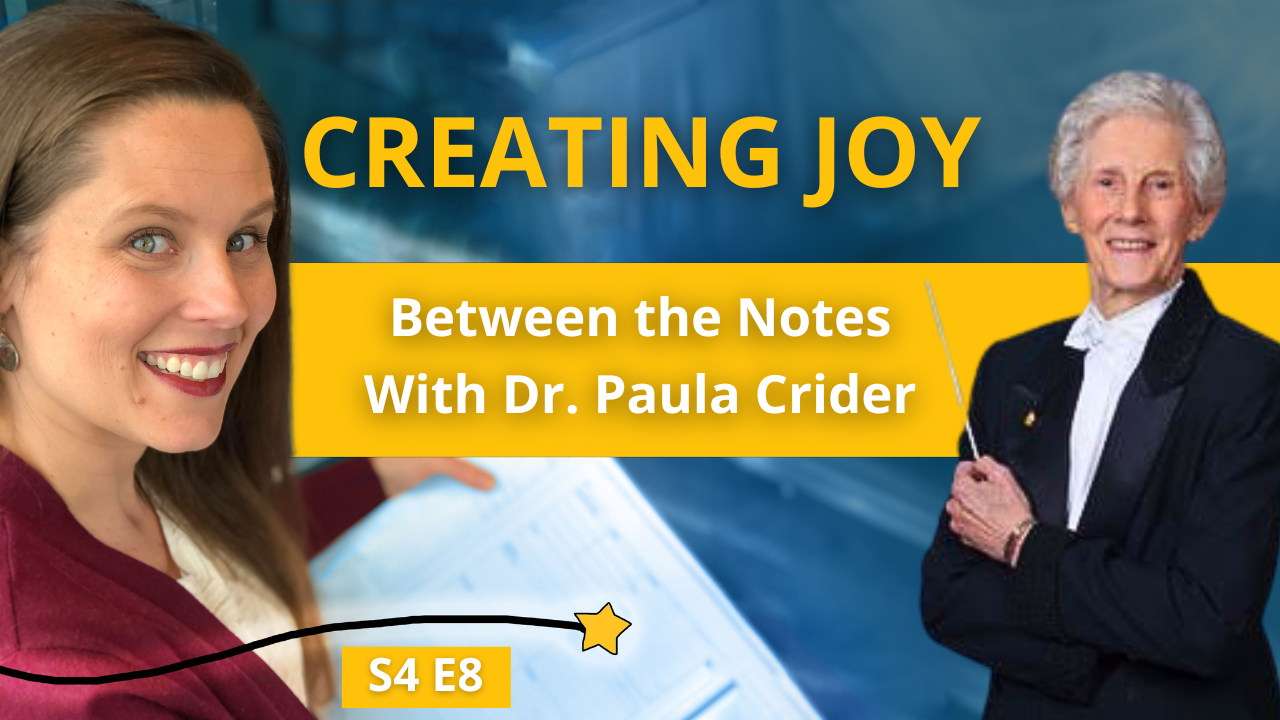


What does it take to break barriers, build confidence, and create a legacy that lasts beyond your accomplishments?
In this inspiring episode of Diary of a Dreamer, Tasha Eizinger sits down with Dr. Paula Crider, internationally recognized conductor, educator, clinician, and Professor Emerita at the University of Texas. Dr. Crider shares the powerful story behind her groundbreaking career, including becoming the first woman to conduct a top classification high school band in Texas.
But this conversation goes far beyond music.
Dr. Crider shares lessons about:
- Building confidence without confusing it with arrogance
- Overcoming limitations and refusing to accept “you can’t”
- The importance of self-reflection and continuous growth
- Why success is not just about achievement, but about doing good
- Encouraging young women to recognize their gifts and potential
- The difference between technical excellence and meaningful impact
- Creating a legacy through mentorship and helping others experience joy
From becoming an unexpected high school band director after only 10 days of student teaching to mentoring generations of musicians, Dr. Crider reminds us that true leadership is about serving others and creating moments that matter.
Her message is simple but powerful:
“Don’t just focus on doing well. Ask yourself: Are you doing good?”
Whether you are an educator, entrepreneur, leader, musician, or someone chasing your own dream, this episode will encourage you to trust yourself, keep learning, and create something meaningful.
🎧 Subscribe to Diary of a Dreamer for more inspiring stories of resilience, courage, leadership, and personal growth.
Read Transcript
00:00
Welcome to Diary of a Dreamer, where resilience unlocks your potential. I’m Tasha Eizinger, and each week I’ll bring you powerful stories and practical insights from my own experiences and inspiring guests.
Whether you’re facing challenges or chasing dreams, this podcast is your go-to for motivation, building confidence, and practical tips for transforming obstacles into opportunities.
Be sure to check out my website, TashaEizinger.com.
Let’s dive into today’s episode and start turning your dreams into reality.
00:36
Today we are with Dr. Paula Crider, Professor Emerita of the University of Texas.
She is internationally recognized as a guest conductor, lecturer, clinician, and educator — which taught me a new word. I did not even know what that word meant until looking you up, Paula.
She is the past president of the National Band Association and the American Bandmasters Association and was the first woman to do so.
I could keep going on and on about all of your accomplishments, but knowing you, even as little as I do, I know you want to get to the meat and potatoes.
01:17
When you get to be my age, time is short.
01:22
Well, I am so humbled that you’re here today.
I have been wanting to learn from you, and selfishly, that’s one of the reasons why I invited you to be on my podcast — because I want to learn from you.
01:33
Well, you’re too kind.
01:36
I met you at the Midwest Clinic.
I work there in that world for only a week out of the year, and one of the benefits of that is I don’t really know who anybody is.
And I kind of like that because I pay attention to people’s behavior and how they treat others.
I’ll tell you what, Paula, when I saw you walk into the room, I knew you were a very confident, strong, go-getter of a woman that I had to know.
So we had breakfast together, and I started asking you questions and found out that you were the first woman in the state of Texas to conduct for the band. Is that correct?
01:59
Correct. It was for what was then a 4A band. Today it would be considered a 6A, but it was the top classification in Texas.
02:22
That’s amazing to me.
Was that your goal when you started out your career — to be the first woman to do that?
02:27
No, I just wanted to be a high school band director, which at the time was considered something that women didn’t have the opportunity to do.
I could have been a middle school band director, which is fine, or teach elementary music.
But being a high school band director — where you get to work with more mature kids on a good day, more challenging music, and so forth — that was what I wanted.
When I went to Texas, there were no females in that role.
I was very fortunate because I had a music supervisor whose wife was one of the best teachers I’d ever met. She taught middle school all of her life and would have been a fantastic high school band director.
But back in the day, that was like a female football coach. It was just unheard of.
Her husband became music supervisor and saw something in me that said, “I’m going to give her a chance that my wife didn’t have.”
I really owe my career to a man named Weldon Covington.
03:42
I absolutely love so many pieces of that story.
I think it’s important for people in positions of power to look for rising stars. That’s what he saw in you. He saw so much potential in you.
I also think it’s interesting because, being part of the Midwest Clinic, I have met a lot of conductors.
One thing I never really thought about — which is obvious when you think about it — is that in a band, there are a lot of people within the band, but there’s only one conductor.
04:14
Yes.
04:15
Highly competitive, isn’t it?
04:17
Exactly.
04:19
So you started conducting, and were you just super confident from the beginning?
04:26
Oh gosh, no.
I never — and to this day, it would be anathema to me — say, “I know everything there is to know about anything,” not to mention music.
When I started, I was a trumpet player, and my goal at that time was to play trumpet for the rest of my life.
I was going to be the next principal trumpet in the Chicago Symphony.
I loved playing. We loved making music.
My college band director encouraged all of us who were going to play professionally to get a music education degree.
A music education degree involves student teaching. You go out for a semester and basically learn more about teaching.
When I went out to do my student teaching, the band director had a heart attack after about 10 days.
05:20
My friends asked me what I did to cause that, but it had nothing to do with me.
Long story short, he decided he was going to retire.
This was a little school in a small town in Mississippi.
The principal called me in and said, “We’re going to have to hire a new band director. But until then, we’ll pay you to be a substitute teacher.”
I thought, “Great! I get paid for student teaching.”
What I didn’t think ahead about was that there was nobody there to guide me.
The band program was so weak that no one even applied for the job.
So I became an instant band director after 10 days of student teaching.
06:15
I worked and worked and worked on this particular passage so that the kids would finally get it.
And they did.
They nailed it.
I stopped and said, “That was fantastic.”
They started high-fiving and smiling, and I thought to myself, “PC, you dope. You’ve been so busy trying to make them better that that’s the first positive thing you said.”
But when I saw the joy on those kids’ faces, that was a paradigm shift for me.
It was like, “This is what I want to do for the rest of my life.”
I want kids to experience that joy and that sense of accomplishment when they’re making music.
After that, I fell into a high school position.
And again, there weren’t any female band directors teaching high school in the state of Mississippi either.
07:06
It’s kind of wild to think about that.
The women I get to talk to at the clinic — we all look up to you so much.
We really do.
Because you didn’t let that stop you.
You didn’t say, “Well, I can’t because it hasn’t been done.”
You were like, “I’m going to do it scared anyway.”
07:49
Yes.
08:26
What do you think has given you the courage to try even though you were afraid?
08:33
I’m not sure I have an answer for that because I’ve really just always been this way.
One of the things music teaches us is that if you’re going to be good at what you do on an instrument, you have to have the discipline to practice.
It can become very competitive, but ultimately the competition is with yourself and not with anyone else.
You compare, but the real question is, “Am I improving?”
And I’ve always been the kind of person that if somebody says, “You can’t do it, especially because you’re a girl,” my response is basically, “Just watch me.”
16:05
I don’t know why that had never clicked for me.
I really thought the conductor was there just keeping everybody on time.
16:11
Well, some conductors, that’s all they do.
Basic conducting is like, “That’s a four-four bar.”
But conducting is something entirely different.
It’s beautiful.
16:29
Oh my goodness. What a great opportunity to have seen that.
I can kind of understand a little bit more of what you’re talking about now.
I wonder who that was because I would love to hear that from you.
16:40
I really should look in the program. I’ll have to look them up and tell them.
It really opened my eyes to what you do.
So going back to when you were talking about the pressure and everything, what have you done to help yourself stay level-headed?
Because I feel like you’re a no-nonsense kind of person, but that doesn’t mean you don’t put pressure on yourself or feel pressure from others.
How do you manage that?
17:09
It’s difficult.
And when I was younger, I didn’t do nearly as good a job as I do now because I developed and matured.
It’s really important to get rid of those voices that say, “What does everybody else think?”
It’s important to listen when someone you admire — someone whose opinion you value — gives you counsel.
Throughout my career, there have obviously been people I’ve admired and sought advice from.
But it’s so easy to get sucked into, “What is so-and-so going to say?” or “What is such-and-such going to think?”
I think it was Louis Armstrong who said, “Man, ain’t nobody’s opinion matters more than your own.”
17:52
Those are true words.
How do you develop that mindset to actually embody it?
Because I think that’s especially important for women.
As I travel around the country, people ask me, “How are you so confident?”
I don’t know how to answer that except to say that every time I step on the podium, I want to be extremely prepared.
But so many women are in situations where someone will look at them and, because of their gender, assume they are not as competent as their male colleagues.
And many times, it couldn’t be further from the truth.
18:34
I completely agree with you.
What would you like to tell women about developing their confidence?
Because I think it’s so important for women not to mistake confidence for arrogance, because they are not the same thing.
How can they develop confidence in themselves?
18:49
The first thing is: never stop learning.
I think that’s important no matter what we do — whether it’s being a great mother or being a CEO.
You never stop learning and looking for ways to grow.
And I don’t think that should only happen within your own profession. Too many people get in a box and stop looking.
I love to travel. I love to read.
Knowledge is empowering.
The second thing I always tell young students, both male and female, is don’t ever let anybody tell you that you can’t be whoever you want to be or do whatever you want to do.
The world is full of naysayers.
But if you want to do something and you set your sights on it, the chances of it happening increase exponentially.
If that little voice in your mind says, “I’m probably not going to try because I probably couldn’t,” then it becomes a self-fulfilling prophecy.
19:48
You’re right.
If you say you can’t, you’re right.
19:52
Exactly.
Your mind believes whatever you tell it to believe.
19:56
Have you always known that?
Because neuroscience supports that now.
Is that just something you’ve always innately known?
20:03
I think I’ve always sensed that.
When I was young, my sister and I were five years apart.
My parents divorced, and we used to joke about the “stepfather du jour” because we had several stepfathers.
I was alone a lot and helped raise my sister, which was actually good for me because it gave me a lot of time to reflect.
I can remember thinking to myself when I was nine years old:
“You can either feel sorry for yourself, or you can get past this.”
20:38
At nine?
20:39
Oh yeah.
20:40
That’s incredible wisdom.
20:42
Well, who knew?
20:46
I’m hearing you say “stepfather du jour” and talking about the divorces, and a lot of people would need therapy for that as an adult — and that’s okay. We all heal differently.
But the fact that at nine years old you were thinking, “All right, this is how it is. So deal with it.”
21:03
Right. Exactly.
And I will say I had extremely supportive grandparents.
My grandmother had five sisters, and they were all college educated at a time when that was not common.
My grandfather was brilliant.
They both nurtured whatever curiosity I had, which was wonderful.
21:31
That’s a beautiful thing — that they encouraged a girl’s curiosity.
That’s incredibly powerful.
21:39
Yeah.
I never heard, “You can’t do this because you’re a girl.”
21:44
I just had a conversation with my daughter last night because one of my cousins had a dad who used to say, “Don’t let society tell you what girls are capable of.”
21:54
Beautiful.
21:55
That’s how you’ve lived your life too.
Your whole life has been about that.
How old is your daughter?
22:00
She’s 11.
22:02
Oh, good for you.
22:03
It was her birthday, so I told her, “I want you to know you have beautiful gifts and talents. Don’t ever let society tell you what you’re capable of.”
22:14
That is so important, Tasha.
So important.
22:21
Because my mother’s whole objective was to go to college and find a husband.
22:27
Which was very common back then.
22:29
Oh gosh.
That should have been my goal too. My mother meant well, but for her, that was success.
It was like, “Mom, that’s not what I want.”
And she would say, “Oh yeah, but you have to find a doctor.”
And I’m thinking, “Oh geez.”
22:46
And you’re like, “How about I just become the doctor?”
22:49
Yeah, right. There you go.
I remember I had a young lady in my flute section when I was teaching high school.
One of the things we would do was ask, “What do you want to be when you grow up?”
We would spend an entire sectional talking about it.
She said, “Well, I want to be a nurse.”
This student was going to be valedictorian of her high school class.
I asked her, “Why not a doctor?”
23:11
And she said, “Oh, I could never do that.”
She was a sophomore.
So I started pushing her. Encouraging her.
She’s a neurosurgeon now.
23:23
I love that.
23:24
I get a card from her every Christmas that says, “Thank you, PC, for letting me see myself as more than a nurse.”
And it’s not that being a nurse isn’t an incredibly important profession.
It absolutely is.
But she had never had anyone tell her, “You can do this. You don’t have to limit yourself.”
23:50
And I think that’s so important.
If someone knows they’re meant to be a nurse, go do it. We need incredible nurses.
But if you feel that tugging on your heart that you’re meant to do something else, then go do it.
24:00
Have you heard the phrase “women supporting women?”
24:04
Yeah.
24:11
One of the things I do is an organization called Women for Women.
Have you heard of it?
24:19
No, I haven’t.
24:20
They support women in places like Nigeria.
They provide scholarships so women can learn a craft or skill because many of these women have children, are not married, and don’t have opportunities.
Their sense of self, as you can imagine, is impacted.
I’ve sponsored four or five women now.
When they graduate, they write you and tell you what they are doing.
It might be something like, “I learned how to weave, and now I’m selling my goods.”
That support is so important.
25:02
I do think when women can support each other and we have male allies who see us and respect us, what greater thing can we do for society?
Because women are community builders.
We are builders of people.
25:19
And strong.
We are.
I’ve had so many wonderful male colleagues, but it’s funny sometimes.
A male colleague will get a sniffle and stay home for three days.
A woman will have walking pneumonia and still show up.
25:37
And go sing opera or something completely absurd.
Like, “What’s your problem?”
Oh my goodness.
But we are very strong, and I think sometimes women forget the strength that we innately have.
25:55
Oh yes.
I’ve never experienced childbirth, but I can’t imagine.
You have to be so strong.
But that’s in the DNA.
We aren’t physically stronger than males, although we are stronger than some of them.
But I think that mental strength and the ability to withstand pain is genetic.
26:19
Our intuition is like our little secret sauce.
26:24
You know, I joke about having a “spidey sense,” but I think that’s true.
I think sometimes we can be better empaths than our male colleagues — although not always, because I have male colleagues who can walk into a room and sense the energy immediately.
That ability is so important for those of us who stand on the podium as teachers.
You have to be able to read people.
26:47
I remember I had a great first-year clarinet player once.
She was always sitting on the edge of her chair.
One day I said, “Let’s go back and do it again,” and I got this feeling that something wasn’t right.
Instead of saying, “You need to pay attention,” I waited.
After band that afternoon, I asked her, “Hey, what’s going on in your life?”
She looked at me and said, “I just saw my boyfriend hugging another girl.”
To a 16-year-old, it’s the end of the world.
27:25
It absolutely is at 16. It’s horrible.
27:27
If I had done what I first wanted to do — which was say, “Get with the program. You’re not paying attention” — it would have been a disaster both for rehearsal and for that child.
That empathy serves us well.
27:57
And it’s a big deal at 35 too.
28:00
Absolutely.
If you could go back and tell your 20-something-year-old self one piece of advice, what would you say?
28:10
That’s a good question.
I think it would be to pay more attention to my own instincts rather than counting on the approval of others.
When I first started teaching, like many young teachers, I’m embarrassed to say this, but it was important for me to win those medals and awards.
For the kids, yes, but also to prove that I knew what I was doing.
28:41
Not long after that, I realized that if you make beautiful music, all the other things happen.
The first year I was teaching, the band I taught had never made straight first divisions.
The rating system went from one to five, and five was not a good thing.
My whole goal was for them to receive that first division rating.
And they did.
The kids worked so hard, and I was so proud of them.
But it was kind of hollow because when they finished, we hadn’t really made much music yet.
It was clean and perfect — well, not perfect — but it was pristine.
29:26
Isn’t that interesting?
I feel like that’s something I would have told myself in my 20s:
Just trust your instincts.
29:35
Yeah.
And we shift our goals too, don’t we?
I think it’s more profound and more all-encompassing.
It’s more “we” instead of “me.”
29:47
And I think when you’re starting out, especially when you’re driven like you are, you’re thinking, “Hey, I know what I’m talking about. These awards prove it.”
29:58
Exactly.
30:16
About what age do you think you started shifting from, “The awards are what prove me,” to “I can just create for the love of creating?”
30:31
It actually happened in my second year of teaching.
30:35
That was quick.
30:36
Well, it was one of those fortunate moments that caused a paradigm shift.
One of the judges at contest was a guy named Frank Erickson, who was a very famous composer at the time.
I didn’t know he was judging.
We went to the state contest, and I looked up on stage and said to the stage manager, “Who’s that old guy?”
He said, “That’s Frank Erickson.”
I was not even 21 yet. He was probably 35, but nonetheless.
31:07
We were playing a piece by Frank Erickson.
My heart was racing.
31:17
I just got really hot thinking about how scary that would be.
31:21
Conductors are supposed to use their left hands.
But when I put my left hand up to conduct, it was shaking so much.
I didn’t want the kids to see it, so I conducted the entire thing with my left hand right here at my chest.
The kids played very well.
I still have the sheet, and I put it up in every office where I have taught.
It said all the things about being well-prepared — in tone, in tune, in time, in style.
And down at the bottom it said:
“…but what about the music?”
31:52
That hit me so hard.
I was spending so much time making sure there was nothing wrong that a judge could deduct points for.
There was no joy.
There was no expression.
And it made me realize:
You have to quit this obsession with just making a one.
Shift to making music.
I’m so fortunate that happened.
Sometimes people never reach that point.
32:27
Well, you’re really great at self-reflection and also considering the feedback you want to take—and probably considering the feedback you want to throw away too, right?
32:39
Right. More of the former than the latter. People who are at the top of our profession are there because they have so much knowledge. And if you listen, you learn.
Again, that’s why being on the Midwest Clinic board was such a big deal for me. I started going to the Midwest Clinic when I was a sophomore in college because my college band director said it was something I needed to do.
33:10
I still have notes from those clinics because the people who come to the Midwest Clinic to give clinics, conduct, or teach are absolutely at the top of their profession.
And no matter how many years I’ve been doing what I do, people will come up to me and say, “PC, you sat through my clinic and said, ‘Heck yeah, I got some really great ideas.'”
And sometimes I’ll think, “Oh, I had forgotten all about that,” or, “What a beautiful way to say that.”
33:43
The Midwest Clinic is a goldmine for things like that.
33:48
So you’re not going to like me saying this, but it’s true. I’m thinking about when you were conducting and you were so nervous because the person who wrote the music was there.
You do realize that people see you now and they’re like, “Oh, it’s Paula Kreider!” They get nervous, excited, and are awestruck.
34:10
I don’t know about awestruck, but it’s funny to me when people come up and say, “Oh, you’re Paula Kreider.”
And I’m like, “It’s just me, kids.”
34:21
But it isn’t. I mean, you see yourself in the mirror every day, right? But what you’ve done for so many women—and men respect you as well because you’re deserving of that respect from everyone.
Other than saying, “It’s just me, kids,” what would you want to tell young people who are looking for mentorship from people like you?
34:49
First of all, you have to ask yourself, “Who do you want to be when you grow up?” That’s important.
And if the answer is, “I want to make all ones at contest,” I’ll say, “Yeah, I was there once too.”
But I think it starts with defining where you want to go. I have notebooks for every year that I taught, and I’ll go back and look and say, “On September 19th, we were here. I want to be here next year.”
Maybe it’s just pushing a little bit further, playing faster scales, or performing a more challenging piece. Whatever it is, you have to keep moving forward.
I have kids come up and ask, “How do you get to conduct an all-state band?”
And I tell them, “You work your anatomy off for about 30 years.”
And they say, “I want to do that.”
Well, you have to earn it.
The other part is that any profession requires a tremendous amount of hard work to become the best you can possibly be.
35:56
A long time too, right? It’s not just, “I tried hard for a couple months.”
36:01
Exactly. It’s rolling up your sleeves and finding people who are more successful than you are.
How do they do this? How did they achieve that? How do they approach things?
It takes hard work.
And I don’t want to be one of those people who says, “Kids nowadays,” because I think kids are incredibly bright, smart, and creative because of all the things they have access to.
I do think their brains are being rewired differently, and we need to figure that out.
But so many young people want everything tomorrow.
36:34
I know. I’ve thought about this a lot—the disservice of kids having access to so many things.
Think about the iPhone. That’s a thousand-dollar phone in their pocket, and they just get it. It’s given to them.
36:51
Right.
36:52
There are so many luxuries today that didn’t exist when you or I were growing up.
37:01
Oh, yeah.
37:02
And it almost creates this unrealistic expectation of what starting out in life should look like.
I remember my first year teaching, I put a blanket over my window to block out the cold so I wouldn’t have to turn the heat up as high.
37:17
For a private school teacher.
37:28
Well, in time, that’s what it takes. When I was teaching, I would get to school when the sun was rising and leave long after the sun went down many times.
But that’s what it takes. It takes that dedication.
And again, it takes self-reflection because you have to spend your time wisely.
37:57
And I also think it’s important because you talked about how you love to travel and you take that trip up the mountain every year.
Sometimes people think dedication means working 20 hours a day, seven days a week. But that’s not what you’re saying.
38:18
No. It’s how you use your time.
One of the hardest things when I first started teaching was learning how to delegate.
It was so easy for me to say, “It’s faster if I just do it myself.”
But when I got the kids involved in becoming leaders and when the band parents became involved, it became a community.
That was a good education for me, the band parents, and the students.
I know people who waste time in rehearsal—rehearse and rehearse and rehearse. I did all-state bands where the schedule was 8 to 12, 1 to 5, and 7 to 10.
The kids can’t do that physically or mentally.
The thought was, “The more time, the better they’re going to be.”
No, no, no. The more constructive time you spend, the better they’re going to be.
So I cut rehearsals almost in half, and it was like, “Wow, they’re playing really well.”
39:25
They can actually still use their brains.
39:28
Exactly. They’re not exhausted.
39:32
I know you don’t want people to think of your name and all the accolades. What do you want people to think when they hear Paula Kreider?
39:43
That if they ever played for me, they experienced joy in making music.
39:51
That’s beautiful. I have a feeling a lot of them did.
39:54
I hope so. Because that’s what matters.
When you see that light—the first time I told you about in that rehearsal—when kids get it, not just intellectually, but they feel it.
That’s the thing about music that we sometimes miss. It’s not just how music sounds that’s important to me. It’s how the music makes you feel.
Those sounds create feelings, not just sounds.
I actually have to leave soon because I’m meeting one of my former students. They’re celebrating their 50-year class reunion.
I haven’t seen her in ages, but those students will come back and say, “Do you remember when we played this?”
When you play something meaningful, it never leaves them.
Probably the greatest compliment anyone can give me as a teacher is when former students say, “I had kids, and they were in band.”
That means it was something so important to them that they wanted their own children to experience it too.
41:13
That is beautiful. I am so grateful I was able to interview you today, learn from you, and spend this time together.
41:22
I always feel like I’m sitting in this chair and someone is going to walk in and say, “Okay, PC, will the real person show up today?”
But what subject did you teach?
41:37
I taught English, and I actually didn’t want to teach English. I wanted to teach science.
But as a new teacher, I was told, “You’re the science teacher, and you get to teach English.”
I was happy to teach literature because I love reading, but it worked out really well.
41:52
Me too. Have you read Theo of Golden?
41:59
I have not.
42:01
It is one of those books where you read a paragraph and think, “I want to read that again.”
It’s so lyrically written.
42:11
Oh, nice.
42:12
I won’t tell you much about it except to say that the main character looks for the good in people.
42:19
I love that. I’m writing it down. I will read that book.
42:23
I read all the time, and of all the books I’ve read lately, that’s the one that really stayed with me.
I’ll probably wait a year and read it again because I thought it was so good.
42:33
I love that. I will definitely read it and let you know what I think when I see you this December.
Oh my goodness. Thank you so much for being here, sharing part of your day, and I definitely cannot wait to see you this December and catch up.
42:52
Tasha, you’re kind to spend your time with me. Have a great day.
43:03
Thank you for tuning into this episode of Diary of a Dreamer. I hope you found the stories and tips shared today to be a source of motivation and strength.
Remember, every challenge you face is a chance to grow and move closer to your dreams.
Don’t forget to subscribe, leave a review, and share this podcast with anyone who could use a boost of encouragement.
Please check out my website, TashaEizinger.com.