
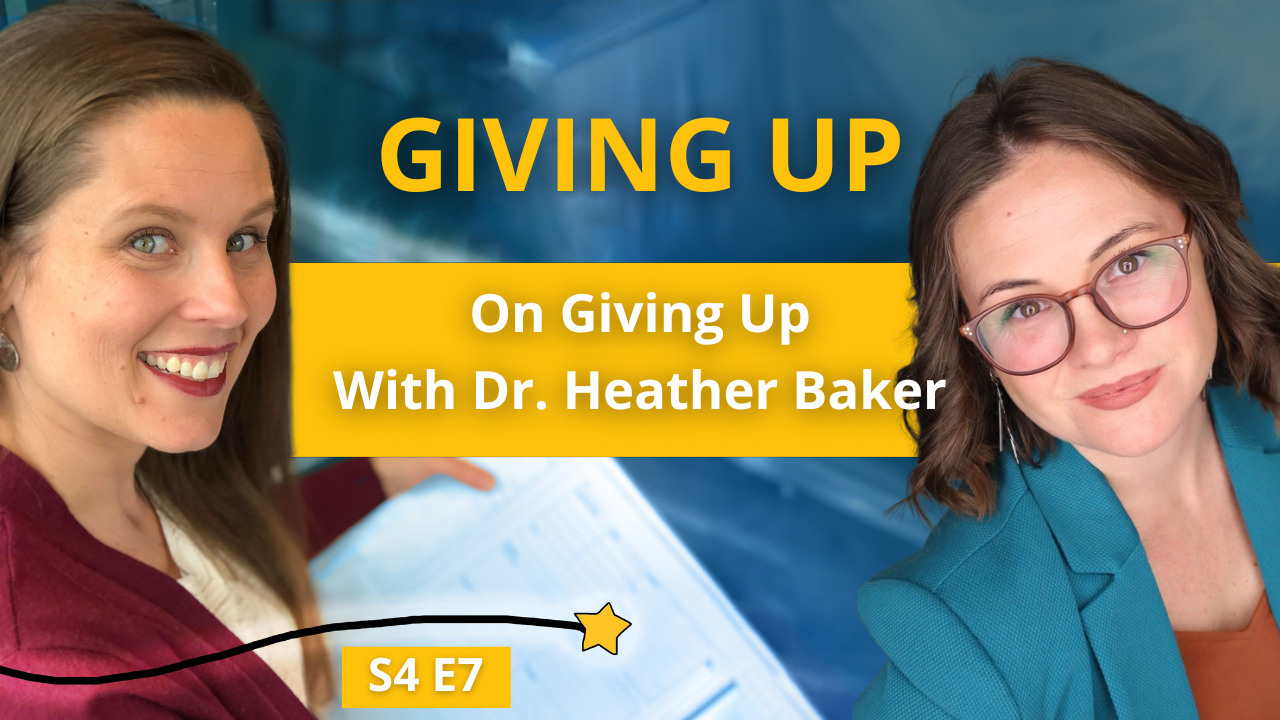


What if giving up isn’t always failure? What if sometimes it’s the first step toward finding the right path?
In this episode of Diary of a Dreamer, Tasha Eizinger sits down with Dr. Heather Baker to explore what resilience really means and how we can develop the skills to navigate challenges, setbacks, and uncertainty.
With research focused on resilience and coping strategies, Dr. Heather Baker shares why people often fall into what she calls the “easy trap” which is quitting too soon instead of evaluating whether they need to adjust their approach, redefine their goal, or take a different path forward.
Together, Tasha and Heather discuss:
✨ Why resilience starts with understanding your self-talk
✨ The difference between quitting and strategically pivoting
✨ How to recognize when a goal needs to change
✨ The five coping strategies people use during difficult situations
✨ Why boundaries are essential for protecting your energy
✨ How surrounding yourself with supportive relationships helps you persevere
✨ How to step outside your comfort zone without becoming overwhelmed
✨ Why affirmations and positive self-talk matter
✨ How parents can help children build resilience through natural consequences and learning from failure
One of the biggest conversations in this episode is about parenting and resilience. Heather explains why children need opportunities to struggle, make mistakes, and experience natural consequences in order to develop confidence and problem-solving skills. Protecting children from every failure may feel loving, but allowing them to learn is part of helping them grow.
Heather also shares a powerful reminder: failure does not define us. Instead, we can use reflection, support, and action to move forward.
Whether you are a parent, educator, entrepreneur, leader, or someone navigating a difficult season, this conversation will help you rethink resilience and give you practical strategies for moving forward.
📚 Heather and Tasha recommend:
Simply More by Cynthia Erivo
Do Hard Things by Steve Magness
Connect with Dr. Heather Baker: heatherbaker3323@gmail.com
Subscribe to Diary of a Dreamer for inspiring stories about resilience, personal growth, entrepreneurship, and turning challenges into opportunities.
Read Transcript
00:00
Welcome to Diary of a Dreamer, where resilience unlocks your potential. I’m Tasha Eizinger, and each week I’ll bring you powerful stories and practical insights from my own experiences and inspiring guests. Whether you’re facing challenges or chasing dreams, this podcast is your go-to source for motivation, building confidence, and practical tips for transforming obstacles into opportunities.
Be sure to visit TashaEizinger.com.
Let’s dive into today’s episode and start turning your dreams into reality.
00:35
Today I’m here with my dear friend, Dr. Heather Baker. Heather has nine years of experience teaching in public schools, served as a graduate teaching assistant at the university level, and recently completed her dissertation on resilience and coping strategies. Her research centers around one powerful idea: giving up on giving up.
I’m so excited to have you here.
01:02
Tell us about resilience and what you’ve been learning and discovering through your dissertation.
01:08
Thank you so much for having me. I’m excited to be here.
01:17
One of my concerns is that I’ve been hearing from so many people about the lack of resilience in both children and adults. You and I both know resilience is critical because life is hard, and we need strategies to navigate it. We can’t simply shut down every time things become difficult.
What have you found in your research that helps people become just a little more resilient?
01:52
One of the biggest things I’ve noticed while working with teachers and university students is the challenge of self-talk.
When we set goals for ourselves, we often ask, Am I good enough? Am I actually going to accomplish this? Those thoughts can lead us into what I call the easy trap—where quitting feels like the easiest option.
Quitting often becomes a premature surrender of our goals.
That doesn’t mean we have to cling to one specific picture of success. Sometimes we need to pivot. Success may not look exactly how we imagined, but it can still be meaningful.
Understanding what we’re feeling—and why we’re feeling it—is important. Our emotions are valid, but we also have to ask ourselves:
- Where do I go from here?
- What does the data tell me?
- What resources do I have?
- How can I be successful with what I have right now?
03:11
Maybe success doesn’t end up looking exactly like the image we originally had in mind…
03:13
…but it can become something else that’s just as beautiful.
03:16
So I’m hearing two major themes: self-awareness and adaptability.
I always like to think about the people listening who might disagree or be thinking, “But you don’t know my situation. Sometimes quitting really is the right choice.”
So when is it okay to quit? What situations aren’t we talking about here?
03:40
There are absolutely times when quitting is the healthiest decision.
One of those is integrity. If what you’re pursuing no longer aligns with your values or with who you are, it’s okay to step away. If your heart isn’t in it, you’re not going to pursue that goal with the same passion.
Quitting can create more time, more energy, and more mental space to pivot toward something that truly matters.
Sometimes we become attached to one picture of success when, in reality, that picture no longer fits.
04:21
I really appreciate that perspective because I don’t think enough people talk about adjusting goals.
Sometimes people believe they have one goal and they have to accomplish it exactly as they first imagined.
What questions should people ask themselves along the way to determine whether they need to adjust the goal, the timeline, or even the strategy?
04:53
The first question is:
What outcome am I actually hoping for?
Once you’re clear about that, take an honest look at the steps required to get there.
Are those steps moving you toward the outcome you truly want?
Part of resilience is removing the things that aren’t serving you—negative thinking, unnecessary baggage, self-doubt, and unproductive habits.
Ask yourself:
- Am I just spinning my wheels?
- Am I trying to force something to become what it isn’t?
Sometimes surrendering to reality is actually the healthiest thing you can do.
If the goal feels overwhelming, break it into smaller, more manageable steps.
And sometimes, through that process, you realize the goal itself has changed.
For example, someone may believe they want to become a classroom teacher, but after breaking the goal down, they discover they really love working one-on-one with students and helping solve problems. They may realize becoming a school counselor is a better fit.
That isn’t failure.
It simply means what they wanted evolved.
06:21
…what I wanted changed.
06:24
Exactly.
Those honest reflections help redirect our energy and give us a clearer vision of what we truly want in the long run.
06:37
Again, I hear that theme of self-awareness—really understanding what you want and why you want it.
I also think who we surround ourselves with plays a huge role.
I feel fortunate to have incredible women in my life who I trust. Sometimes they encourage me to keep going when I can’t see the progress myself. Other times, they’re the ones who help me realize it’s time to adjust.
What role do close relationships play in resilience and perseverance?
07:12
When I analyzed the research, coping strategies fell into five categories.
One category was maladaptive coping—things like believing, “If I just work harder, eventually everything will get easier.”
Another major category was connection.
That includes mentors, trusted relationships, and healthy feedback from others.
For many people—especially educators—feeling disconnected was a significant challenge.
Supportive relationships matter.
We need people we respect, people with integrity, and people whose opinions we value.
Sometimes that support comes from a mentor.
Sometimes it comes from family.
Sometimes it’s simply talking through things with someone who genuinely listens.
Healthy relationships are one of the strongest contributors to resilience.
08:20
What are the other three coping categories?
08:27
The first is mentally making sense of the situation.
People naturally try to understand what’s happening. They tell themselves things like, “I’ll get through this,” or “This experience is making me stronger.”
The second is emotional coping.
That includes self-reflection, setting healthy boundaries, seeking counseling or therapy, and finding emotional support.
The third is problem-focused coping.
Instead of simply worrying about a problem, you actively do something about it.
For example, if funding is limited, you begin writing grants, fundraising, or planning ahead.
So the five categories include:
- Maladaptive coping
- Connection and relationships
- Mental understanding
- Emotional coping
- Problem-focused action
09:59
Let’s go back to maladaptive coping.
Some people might say, “I’m not maladaptive. I can handle a lot.”
What are some warning signs that someone is operating in an unhealthy way?
10:30
For some reason, we’ve convinced ourselves that removing every boundary makes us appear harder working or more deserving.
It creates the illusion that sacrificing ourselves proves our commitment.
One example is relationship boundaries.
If you continually absorb other people’s problems, you’re also carrying their emotional baggage.
There’s only so much emotional capacity we have.
11:11
Seriously?
If you listen to people complain all day, you’re carrying their baggage too?
11:17
Absolutely.
For teachers, that often looked like sitting in the teachers’ lounge listening to constant complaints.
Sometimes we need to be a supportive listener.
But there has to be a boundary.
11:30
I actually avoided the teachers’ lounge most days.
I usually ate lunch by myself—and there was a reason for that.
11:39
There’s something about emotionally investing in another person’s problems.
The more emotional energy we spend carrying someone else’s burdens, the less capacity we have for our own.
Eventually, our own well runs dry.
[11:49] Healthy Support vs. Constant Negativity
Balance is important.
You want to be a supportive, caring friend, but there are also times when someone continually complains without looking for solutions.
Heather explained that complaining isn’t always unhealthy. Sometimes we’re simply trying to make sense of what we’re experiencing.
Often, when we share our struggles, we’re looking for one of two things:
- Validation
- Someone to simply listen
The important question is whether we’re absorbing someone else’s negative energy or helping them process it in a healthy way.
[12:37] Asking for Feedback Without Sounding Entitled
I asked Heather how employees—or teachers working with administrators—can request feedback without coming across as entitled.
Heather suggested using AI as a brainstorming tool if you’re unsure how to start the conversation.
You can explain:
- How you’re feeling
- Your supervisor’s personality
- The type of feedback that helps you learn best
Then ask AI to help you draft a respectful request.
Rather than saying, “I don’t like your feedback,” she recommends approaching it like this:
“I’m really trying to improve. Would you be willing to give me feedback in this way? It helps me learn best and allows me to perform at my highest level.”
Most leaders genuinely want to help their employees succeed.
Heather shared that when she was teaching, she intentionally asked her administrator to observe a lesson and provide feedback in a way that matched her learning style. That simple request became the foundation of a strong professional relationship.
[14:43] Practice Before the Conversation
I loved Heather’s advice, and I added one of my own.
If you’re nervous about having an important conversation, record yourself on your phone.
Listen to it.
Adjust your wording.
Practice until you feel comfortable.
For many people, face-to-face conversations are intimidating. Rehearsing beforehand can build confidence and help the conversation go much more smoothly.
[15:25] Your Comfort Zone Is Your Fort
Heather shared a perspective I’d never heard before.
The word comfort begins with “com” and “fort.”
She described our comfort zone as our fort—the place we retreat to when we feel scared.
Growth requires stepping outside that fort.
That doesn’t mean forcing yourself into overwhelming situations.
It means stretching yourself just enough to continue growing.
[16:04] Growth Requires Discomfort
Nobody is perfect.
Expecting perfection only creates unnecessary pressure.
Building resilience means regularly stepping outside your comfort zone so that when life becomes difficult, you’ve already trained yourself to navigate discomfort.
As moms, we know this all too well.
Life constantly presents unexpected challenges, and every one of them becomes another opportunity to grow.
[17:11] How Do You Grow Your Comfort Zone?
I shared that I’m currently taking improv comedy classes—not because I want to become a comedian, but because I enjoy challenging myself.
I asked Heather what practical steps people can take to expand their comfort zone.
[17:44] Start with Your Strengths
Heather explained that one of the exercises in her resilience workbook begins with two simple lists.
On one page, write down your strengths.
Ask yourself:
- What am I naturally good at?
- What abilities do I already possess?
On a second page, write down two or three current challenges.
Then connect your strengths to those challenges.
Rather than becoming overwhelmed by everything you’re trying to improve, identify the resources you already have that can help you succeed.
[18:20] Reduce the Variables
Heather emphasized that trying to overcome too many challenges at once often leads to what she calls “the easy trap”—quitting because everything feels overwhelming.
Instead, reduce the number of variables.
For example, if asking your supervisor for feedback feels intimidating, begin with something you’re already confident about.
Invite them to observe a lesson you know went well.
Practice requesting feedback in a situation where your confidence is already high.
Then gradually work toward more difficult conversations.
Small wins create bigger confidence.
[19:32] Confidence Comes from Evidence
I wanted to make sure I understood Heather’s process correctly.
She explained that this isn’t about pretending to be confident.
It’s about collecting evidence.
If public speaking feels intimidating, ask yourself:
- Could a friend attend with me?
- Can I watch videos beforehand?
- What experiences do I already have that prepare me for this?
Confidence grows when we recognize the resources we already possess.
[21:15] Proving It to Yourself
One of the biggest takeaways for me was that resilience isn’t built through empty encouragement.
It’s built by proving to yourself that you can handle difficult things.
If identifying your strengths feels difficult, ask the people who know you best.
Sometimes others recognize gifts in us long before we recognize them ourselves.
[21:44] The Role of Self-Talk
I asked Heather whether affirmations actually matter.
She explained that every person carries wounds, disappointments, and difficult experiences into adulthood.
That’s simply part of being human.
Normalizing those struggles is incredibly important.
Therapy is healthy.
Talking about difficult things is healthy.
Seeking support is healthy.
[22:27] Redefining Failure
Heather encouraged us to ask ourselves an important question:
How do I define failure?
Often, we assume one outcome is the only path to success.
Instead, she encourages people to prepare for multiple possibilities.
Not backup plans—but different pathways forward.
She compared it to the story of Thomas Edison.
He didn’t fail hundreds of times.
He simply discovered hundreds of ways that didn’t work before finding the one that did.
[24:00] Daily Affirmations
Heather believes affirmations can be a powerful tool because they help interrupt the negative stories we often tell ourselves.
She keeps a deck of daily affirmation cards in her bathroom as a reminder to pause each day and ask herself:
- Am I making a difference?
- Am I doing meaningful work?
- Am I showing up as the person I want to become?
Sometimes the encouragement we need most is the encouragement we choose to give ourselves.
24:41
That’s so good. I also think our brains believe whatever we repeatedly tell them. If we’re constantly feeding ourselves negativity—criticizing ourselves, focusing on what’s wrong, or surrounding ourselves with complainers—that’s where our minds will naturally go.
That’s why I love the idea of affirmations. Whether it’s daily affirmation cards, writing down your strengths, or reminding yourself of what you’re doing well, you’re giving your brain evidence of what’s true instead of constantly reinforcing what’s wrong.
I also love the idea of writing down your strengths because you’re proving to yourself what you’re capable of.
25:17
I feel like we need to have a tough conversation about parenting.
As parents, we love our kids deeply, but children have to learn how to be resilient. They have to learn how to handle life. I know parents act out of love and a desire to protect their children, but sometimes the greatest lessons come through allowing them to experience natural consequences.
25:34
Absolutely.
The only way we truly learn is by doing.
Educational theory has long supported the idea that learning happens through experience. When we continually step in and prevent children from experiencing failure, we’re actually preventing the lesson from being learned.
For example, my daughter recently had a dance competition. When we arrived, she realized she had forgotten her dance shoes.
I already knew they weren’t in her bag because she had left them at home the night before.
Her coach suggested borrowing a pair from another dancer.
Instead, I said, “No. She has her tights on. She’ll dance without them. Most people probably won’t even notice, and she’ll remember her shoes next time.”
Was it uncomfortable?
Absolutely.
But learning requires what researchers call cognitive dissonance—recognizing there’s a problem that needs to be solved. Without that discomfort, real learning rarely happens.
Sometimes, as parents, we mistakenly believe that protecting our children from every failure is the loving thing to do.
Real love means making sure they’re safe, cared for, and supported while also allowing them to experience age-appropriate consequences that help them grow.
That’s where learning happens.
27:37
I hope everyone rewinds and listens to that again.
One thing I’ve always taught my own children is that they don’t have to be perfect.
For example, if they forget their homework at school, I’ll go back and get it—but only once during the entire school year.
If they choose to use that “one time” early in the year, that’s their choice.
I don’t expect perfection, but I do want them to learn responsibility.
What I also appreciate is that you didn’t yell at your daughter.
You didn’t shame her.
You didn’t make her feel terrible.
You simply allowed a natural consequence to become a teaching moment.
Sometimes parents think allowing consequences is mean.
I don’t see it that way.
I see it as teaching.
28:34
When I was teaching, I always paid attention to how parents responded when their child made a mistake.
Kids are going to make mistakes.
They’re supposed to.
Adults make mistakes too.
If a parent immediately said, “My child would never do that,” even though I’d witnessed it myself, I knew we were probably going to have a difficult partnership.
But if a parent responded with, “What happened? We’ll take care of it,” I knew that child was going to be just fine.
I want parents to know this:
Your child’s mistakes are not a reflection of your worth as a parent.
29:27
Exactly.
Children need advocates, but advocating doesn’t mean automatically taking their side every time.
Advocating means supporting their development.
If they made a mistake, own it, learn from it, and grow.
One of the biggest messages I share is that no child is bad.
Children make poor choices.
Behaviors can be corrected.
Every mistake is an opportunity to learn.
As teachers, we can maintain healthy relationships with students while still allowing consequences to teach important lessons.
That’s one of the foundations of restorative practices.
30:32
I think that’s such an important distinction.
As parents, I constantly ask myself:
“Am I being the kind of mom I would’ve wanted in my classroom?”
Sometimes parents become so focused on protecting their children that they unintentionally remove opportunities for growth.
Other times, they’re afraid their child’s behavior reflects poorly on them.
31:00
I think that’s exactly it.
When parents stop viewing everything their child does as a reflection of themselves, the outcome is often much healthier.
Children are their own people.
They come into the world with unique personalities.
We do our best to guide them, but they’re still learning who they are.
31:35
Teachers are human too.
They have families, personal struggles, and responsibilities outside the classroom.
When parents immediately attack teachers instead of partnering with them, they’re often preventing an important learning opportunity.
Later in life, that same child will have a supervisor, a manager, or a boss.
Learning how to navigate difficult situations respectfully is a life skill.
31:46
Exactly.
Eventually they’ll encounter those situations again.
I’ve even heard stories about parents attending their children’s job interviews.
No.
We can’t do that.
32:09
At the university level, we receive emails from parents all the time.
Because of privacy laws, there are many situations where we’re simply not allowed to discuss a student’s information with anyone except the student.
My response is always the same:
“I’m sorry, but I need to speak directly with your student.”
32:25
We’re all doing the best we can as parents.
Hopefully we’re continuing to learn and grow right alongside our children.
What books would you recommend for people who want to learn more about resilience?
32:37
There actually aren’t many books specifically on this topic yet.
If someone emails me, I’m happy to share my dissertation.
One book I highly recommend is Simply More by Cynthia Erivo.
It’s a beautiful reminder that you are more than your circumstances.
It’s written for anyone who’s ever been told they’re “too much,” or for anyone who’s struggled while pursuing a goal.
It aligns perfectly with everything we’ve talked about today.
33:32
I’ll definitely have to read that.
One book I’d recommend is Do Hard Things by Steve Magness.
It explores resilience from the perspective of athletes and the military, challenging the idea that toughness means suppressing your emotions.
Instead, it teaches that resilience comes from recognizing your emotions, processing them, and continuing to move forward.
34:04
Exactly.
You can’t simply shove emotions aside.
You have to recognize them, understand them, and look at them from a different perspective.
That’s where growth happens.
34:15
For anyone who wants to connect with you, I know you speak on several topics and mentor others.
What’s the best way for people to reach you?
34:31
I’ll leave my contact information with you.
The best way to reach me is through email.
I’m currently interviewing for university positions and expect to continue working at the collegiate level.
I always enjoy connecting with people, so I’d love to hear from anyone who wants to reach out.
34:50
Perfect.
I’ll include your email address in the show notes.
Thank you so much for being here.
34:56
Thank you so much for having me, Tasha.
35:05
Thank you for tuning in to this episode of Diary of a Dreamer. I hope today’s conversation gave you encouragement and practical tools to strengthen your resilience.
Remember, every challenge you face is an opportunity to grow and move one step closer to your dreams.
If you enjoyed this episode, be sure to subscribe, leave a review, and share it with someone who could use a little encouragement today.
For more resources, visit TashaEizinger.com.