
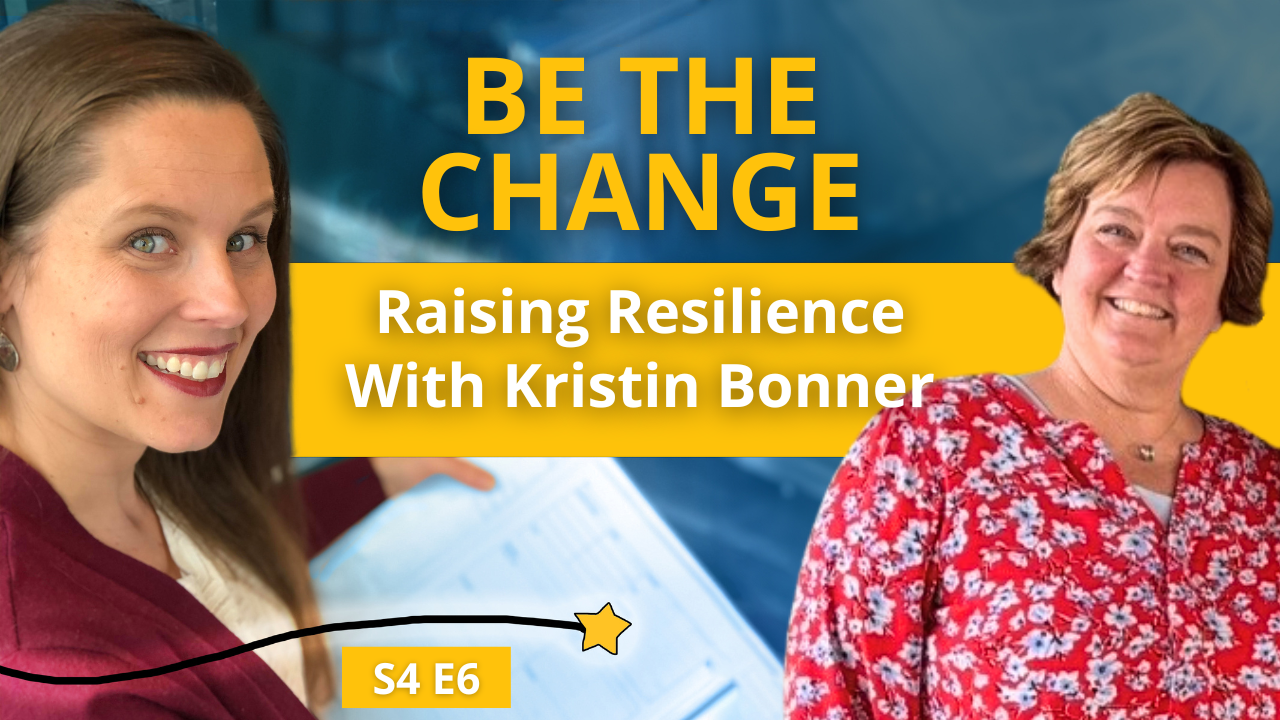


What does it take to raise resilient kids in a world full of distractions, division, and constant noise?
In this episode of Be the Change, I sit down with my former teacher, Kristin Bonner, for a thoughtful and practical conversation about parenting, education, resilience, and how we can teach the next generation to think critically and communicate respectfully.
From technology overload and post-COVID challenges to letting kids fail, teaching independence, and modeling healthy disagreement—this conversation is packed with wisdom for parents, educators, and anyone who cares about raising capable, kind humans.
This isn’t about politics.
It’s about people.
It’s about learning how to listen better, think more clearly, and be the change we want to see.
In this episode, we discuss:
- Why resilience begins at home
- The danger of overprotecting our kids
- How boredom actually builds creativity
- Why kids need opportunities to fail—and recover
- What teachers are seeing post-COVID
- The impact of technology on attention spans and confidence
- How to model respectful disagreement
- Why listening is half of communication
- What healthy debate actually looks like
- How community and teamwork shape stronger humans
Memorable Quote:
“It doesn’t really matter what you believe. It only matters what you can prove.” — Kristin Bonner
Book Referenced:
Read Transcript
Tasha Eizinger:
Welcome to a special mini-series of Diary of a Dreamer called Be the Change, where resilience, critical thinking, and everyday courage come together.
I’m Tasha Eizinger, and in this series we’re exploring how ordinary people can create meaningful change. We’ll talk about how to think clearly, engage responsibly, and take action in ways that truly make a difference.
If you’ve ever wondered how to stay level-headed, raise resilient kids, participate in your community, and be a force for positive change—this series is for you.
You can learn more about my work at TashaEizinger.com.
Let’s dive into today’s conversation and explore how we can be the change.
00:47 | Introducing Kristin
Tasha:
Mrs. Bonner—also known as Kristin—which is kind of awkward to say because you were my teacher many years ago.
Kristin Bonner:
Many years ago! Was I your first-year teacher?
Tasha:
No, I graduated in 2002.
Kristin:
Right—I taught from 1993 to 2002.
Tasha:
That’s right—and then you stayed home with your kids for a while.
Kristin:
About a decade.
Tasha:
And then came back, which means you’ve experienced both pre- and post-COVID teaching—which we definitely need to talk about.
Kristin:
Yes. Teaching through COVID was… an experience.
Tasha:
That could honestly be its own episode.
01:39 | Why this conversation matters
Tasha:
I’m really glad you’re here because you made a Facebook post recently—I tried to find it last night and couldn’t—but it was about having conversations with people you disagree with.
That’s something I’ve wanted to talk about for a long time, but like most people, life gets busy. There’s always something else demanding your attention.
But I believe we’re at a really critical time in our country—and in the world—where we have to start taking healthy action.
Too many things feel like they’re crumbling.
And you’re seeing it firsthand in your classroom.
Kristin:
Absolutely.
Tasha:
So I’m excited for this conversation because maybe, in some small way, we can help people create change.
Kristin:
We need to.
02:58 | It’s not about politics—it’s about people
Tasha:
And to be clear—we’re not here to tell anyone what political beliefs they should hold.
That’s not the point.
Kristin:
No. We can all be good humans.
Tasha:
Exactly.
At the core of this conversation is remembering that most people we know and love are genuinely good human beings.
So how do we get back to having difficult conversations with people we disagree with—and still maintain respect and understanding?
03:21 | It begins at home
Kristin:
I think it begins at home.
Everything begins at home.
If you grew up with siblings, you probably had disagreements. The question is: how were those handled?
Did your parents teach you how to work through conflict?
Sometimes you have to agree to disagree and simply remember that people are human.
But I also think spending time with people who are different from you makes a huge difference.
I intentionally tried to expose my kids to people who lived differently than we did—different cultures, different homes, different perspectives.
Even reading about different places matters.
And one of my favorite things was debriefing afterward—especially in the car.
“What did you learn?”
“What stood out to you?”
“What surprised you?”
Tasha:
We do that too—a little family debrief after experiences.
Kristin:
It matters.
Because even if you hold strong beliefs, you can still explain to your children:
“This is why I believe this—but someone else may have had a different life experience that shaped how they see it.”
That kind of conversation matters.
04:31 | Stop putting people in boxes
Kristin:
One thing I’ve noticed on social media is that people love putting everyone into categories.
That’s dangerous.
Not everyone fits into one box.
Most of us are somewhere in the middle.
And we have to learn how to meet each other there.
Tasha:
I completely agree.
People are constantly labeled—“woke,” “racist,” “liberal,” “conservative”—and yes, there are extremes…
…but most people are not living in those extremes.
Most people are just trying to live their lives.
One of my favorite questions to ask my kids is:
“That’s interesting… what do you think about that?”
Because I want them to process.
If they disagree with someone, I ask:
“Why do you think that person believes that?”
I want them thinking—not just repeating what they heard.
Kristin:
Exactly.
Are they actually thinking?
Or are they simply regurgitating what was said at the dinner table?
That’s the difference.
05:55 | Technology and attention spans
Kristin:
A lot of today’s younger parents grew up with technology.
My generation didn’t.
We learned human interaction before technology.
Now parents are exhausted—they work all day, they come home, and it feels easier to put kids in front of a screen.
And I understand that.
But I don’t think many people realize the long-term impact.
I see it in my students.
They can barely focus for three minutes.
Tasha:
Three minutes?
Your students are teenagers.
Kristin:
Fourteen, fifteen, sixteen.
And their attention spans are incredibly short.
Teachers are constantly trying to change things up—new activity, new method, new strategy—just to keep them engaged.
But honestly, I think we’ve reached the point where there’s not much more teachers can do.
The technology has to be reduced.
If they’re constantly consuming fast-moving content at home, we can’t compete with that.
07:27 | The “Xennial” perspective
Tasha:
I’m technically a Xennial—this tiny generation that grew up in both worlds.
We remember life before smartphones.
We had MapQuest.
Kristin:
Oh my goodness. The car arguments over MapQuest!
Tasha:
Exactly.
You got lost and then realized it didn’t tell you how to recover.
But we learned.
We adapted.
So I understand both sides.
Parents are tired.
Sometimes screens are survival.
But if you’re going to use them, I always tell parents—make it quality content.
Long-form content.
Not endless short clips.
Not constant flashing images.
Because those sweet little brains need protection.
That’s how I frame it with my kids:
“You have good brains. I want to protect them.”
10:27 | Practical ways to build resilience
Tasha:
So what are some very practical things parents can do?
Kristin:
Honestly—teach basic life skills.
I had students this week folding t-shirts.
Teenagers.
And several of them said:
“I’ve never folded a shirt before.”
Tasha:
That hurts my heart.
Kristin:
Mine too.
And it made me realize how many little life skills kids are missing—not because parents don’t care—but because life has changed.
We do grocery pickup now.
Kids don’t walk the aisles.
They don’t compare prices.
They don’t ask questions.
They miss those tiny learning moments.
Take them with you.
Go to the library.
Go to story hour.
Do boring things.
Because boredom creates creativity.
And kids don’t know how to be bored anymore.
13:06 | Boredom is good
Tasha:
When my kids tell me they’re bored, I say:
“Great. You can deep clean the house.”
And somehow they immediately find something else to do.
Kristin:
Exactly.
Even I’d rather invent something than clean.
But that’s the point.
Kids need boredom.
That’s where imagination grows.
14:00 | Teach one life skill at a time
Tasha:
One thing I do with my kids every summer is this:
Each child has to learn how to make one meal really well.
They choose it.
They help buy the ingredients.
Then they learn how to make it.
One dish every year.
That adds up.
Kristin:
I love that.
That’s exactly what we should be doing.
End of Part 1
Reply “continue” and I’ll send Part 2 (failure, confidence, classroom stories, and post-COVID changes).
continue
Here is Cleaned Transcript — Part 2:
Be the Change Mini-Series: Raising Resilient Kids & Having Tough Conversations
Hosted by Tasha Eizinger
Guest: Kristin Bonner
14:36 | What do kids need to know before they leave home?
Kristin:
I read a book once—I think it was called something like 1,000 Things Your Kids Need to Know Before They Leave Home.
It was very practical.
One thing it mentioned was teaching your kids how to go to the doctor and fill out paperwork.
And I remember thinking, Oh my goodness… did I teach that?
Because when your kids are younger, you naturally handle all of that for them.
But eventually they need to know:
What’s an insurance card?
What forms do I fill out?
What questions do I ask?
Those little things matter.
When I was in college, I had to have my appendix removed.
I knew nothing.
I didn’t know where to go. I didn’t know what to do.
There was no Google.
It was terrifying.
Tasha:
Right—and that’s not fear-based parenting.
It’s simply asking: What real-life things will they need to know?
How to buy groceries.
How to budget.
How to ask for help.
Those are life skills.
15:48 | Confidence comes from doing hard things
Kristin:
My middle son just bought his first house at 22.
Signed the papers on his birthday.
And even then, he was saying, “I don’t even know what all this means.”
And that’s okay.
Nobody fully knows until they do it.
But the confidence comes from believing, I can figure this out.
That’s what I worry kids are missing right now.
They don’t believe they can do hard things.
They quit before they even try.
Tasha:
Yes.
I hear kids say “I can’t” all the time.
And my response is always:
“You can’t do it… yet.”
That word matters.
17:18 | Let your kids fail
Kristin:
If I could give one parenting advice, it would be this:
Let your kids fail.
Really.
Let them mess up.
There are consequences to our actions.
If we do something poorly, we learn.
If we make a mistake, we recover.
But if parents constantly rescue their kids, they never build that muscle.
I had a friend tell me once when my kids were toddlers:
“If the ball rolls under the chair—don’t get it for them. Let them get it.”
That sounds small, but it starts there.
And then it grows.
18:03 | A student who couldn’t handle feedback
Kristin:
I directed a musical recently.
A student had a solo.
I simply said, “I’d like you to try it a little differently.”
That was it.
No criticism. No negativity.
Just feedback.
And she dropped to the floor crying.
Crying.
Because she felt like she had failed.
And I remember thinking—
This isn’t failure. This is feedback.
But somewhere along the way, kids have started interpreting correction as personal rejection.
That’s dangerous.
18:53 | Celebrate risk, not just results
Kristin:
My youngest daughter is in college.
Her first year, she called me several times and said:
“I took a risk today.”
“I went somewhere by myself.”
“I introduced myself to someone new.”
And every time, I told her:
“I’m so proud of you.”
Not because the outcome was perfect.
Because she took the risk.
Tasha:
That’s exactly what Dr. Carol Dweck teaches in Mindset.
Praise the process—not the outcome.
Celebrate effort.
Celebrate resilience.
Celebrate persistence.
Not just success.
19:52 | Bringing books back into the classroom
Kristin:
This semester I decided to do something different.
We’re reading To Kill a Mockingbird.
Actual books.
Physical books.
I posted online asking if anyone wanted to donate copies.
I ended up receiving 150 books.
So every student got one.
I told them:
“Write your name in it. This is your book.”
And something incredible happened.
They started talking.
Because there were no laptops.
No phones.
Nothing to hide behind.
Just books and conversation.
For the first time in years, I’ve had to tell students to be quiet.
And honestly?
That made me happy.
21:06 | Teaching students how to learn
Kristin:
Yesterday I gave students three paragraph options and told them:
“You’re going to memorize one.”
They panicked.
Immediately:
“There’s no way.”
“I can’t do that.”
But here’s what I didn’t do—
I didn’t tell them when it was due.
Tasha:
Honestly, even at 42 that gives me anxiety.
Kristin:
(laughing) I know.
But I wanted to teach them how to learn.
So we practiced.
Say it aloud.
Turn around and say it again.
Memorize one line.
Build from there.
A little every day.
That’s the lesson.
Not just memorization.
Learning how to approach something hard.
21:57 | The quiet student who surprised everyone
Kristin:
There’s a student in one of my classes—very quiet.
Front row.
Had barely spoken all semester.
After class yesterday, she came up to me—which is a big deal for a quiet kid.
And she said:
“Mrs. Bonner… I think I almost have it memorized already.”
I was shocked.
She had gone home and practiced.
She told me she’s a dancer, so she understands repetition and muscle memory.
And I realized:
That student never would’ve come talk to me if we hadn’t created that challenge.
That one assignment gave her confidence.
Tasha:
And she will remember that forever.
That’s why people teach.
Those moments.
23:38 | Kids must prove it to themselves
Tasha:
What I love about what you’re doing is that you’re not just giving them a pep talk.
You’re not saying:
“You can do anything!”
You’re letting them prove it to themselves.
That’s different.
That changes the wiring in their brain.
They begin to believe:
“I thought this was impossible… and I did it.”
That becomes part of their identity.
Kristin:
Exactly.
That’s what we’ve lost.
Kids need to do hard things.
Fail.
Try again.
And eventually succeed—or at least learn something valuable.
That’s life.
25:00 | When parents rescue too much
Tasha:
When I was teaching writing, I once gave a student an F.
They were confused.
They said, “But this is a good paper.”
And I said:
“Yes—but your mom wrote it.”
So I graded your mom.
If you write it, I’ll grade you.
Kristin:
And honestly… I’ve done that too as a parent.
Rescued my kids when I shouldn’t have.
Sometimes it’s easier.
Sometimes you’re tired.
Sometimes you’re embarrassed.
But we can’t always do it for them.
26:28 | Kids don’t need to be good at everything
Kristin:
One of my daughters danced for years.
Eventually she realized—
she just wasn’t good at it.
And that was okay.
She didn’t need to keep suffering just because she had started.
Sometimes quitting is healthy.
Parents need to hear that.
Kids should try things.
They should fail.
They should discover what they love.
But they do not need to be exceptional at everything.
27:23 | Think long-term
Kristin:
One of the greatest gifts teaching gave me as a parent was perspective.
I could see what behaviors looked cute at age six—
but would not be cute at sixteen.
That helps you parent differently.
You stop asking:
“What solves today’s problem?”
And you start asking:
“What kind of adult am I raising?”
That changes everything.
End of Part 2
Reply “continue” and I’ll send Part 3 (post-COVID, parenting today, theater kids, accountability, and how to disagree well).
continue
Absolutely—continuing the cleaned, polished transcript with timestamps from where we left off.
Diary of a Dreamer – Be the Change Mini-Series
Episode: Kristin Bonner | Raising Resilient Kids & Having Hard Conversations
Host: Tasha Eizinger
[30:25] COVID, Parenting, and Human Interaction
Tasha:
With sleep deprivation and absolute exhaustion—I mean, it’s so real. We’ve all been there. Sometimes I think about that in the middle of the night. I’m like, the Navy SEALs get to ring the bell when they’re done. Moms don’t get to ring the bell.
Kristin:
I know.
Tasha:
They literally use sleep deprivation to get them to quit—and moms are just expected to keep going.
Kristin:
Exactly. I think I’m going to be a really good grandparent someday because I had good parents, and they rescued me a lot. I think I’ll be able to step in for my kids and say, “You need a break? I’ve got the kids.”
Tasha:
Yes. “Go sleep. Go rest.” Even just once in a while.
Kristin:
Exactly.
[31:16] What Changed After COVID?
Tasha:
What differences are you seeing pre- and post-COVID? I hear teachers say all the time that there’s a huge shift.
Kristin:
That’s a good question. It’s honestly hard to know what’s COVID, what’s technology, what’s parenting—or if it’s just all three together.
Tasha:
Probably a combination.
Kristin:
I think human interaction is the biggest missing piece. During COVID we separated people from people—and kids need people.
When my kids were little, we’d go to McDonald’s Playland—full of germs—and my oldest daughter would come out saying, “I made a friend! Can she come over?”
Kids just don’t do that anymore.
Then we handed them phones, so now they can stare at a screen and feel like they’re interacting—but it’s not the same.
And every kid is different. My son is an introvert—he’s fine at home. My youngest needs people constantly. Parenting is complicated. COVID just added another layer of uncertainty.
[34:05] Hope for the Future
Kristin:
The freshmen I teach now were in second grade during COVID. They were little.
It changed all of us for a while.
But I do believe we’re going to swing back toward valuing human connection again. I have to believe that.
Tasha:
I have to believe that too. We need hope.
[34:52] Why Theater Matters
Kristin:
My theater students are high-functioning in many ways. They memorize lines, sing, dance—do all the things.
Tasha:
And they’re phenomenal. I went to all those productions when I was in high school. They’re not just “kids acting on a stage.” They are true productions.
Kristin:
They really are. And next fall we’re opening a brand-new performing arts center.
Tasha:
That’s amazing.
Kristin:
It’s exciting—and it’s a challenge, which I love.
A lot of my theater students also have involved parents. Not all come from two-parent homes—but many do have strong support systems.
And they’ve learned resilience.
We fail a lot before we get things right.
That’s what builds capable adults.
[37:04] Make Their Lives Harder (In Healthy Ways)
Kristin:
If I’m honest, I wish I had made my kids’ lives a little harder.
We gave them too much. We made things too easy.
But life is not easy.
Tasha:
Exactly.
Their habits and resilience are built young.
I want my kids to leave my home as capable, independent, kind humans.
That means I have to build that now.
Kristin:
And model it.
Tasha:
Yes. Always.
[38:15] When Your Kid Messes Up
Kristin:
One of my kids—who shall remain nameless—cheated in class.
Used an Apple Watch.
And unfortunately for them, the teacher was one of my close friends.
Tasha:
That’s rough.
Kristin:
I told them, “You’ll accept the consequences at school. And at home? I’m taking your Apple Watch—and you’re writing an apology note.”
No excuses.
Tasha:
Exactly.
Not, “My precious angel would never.”
Kids make mistakes.
What matters is how parents respond.
Kristin:
Yes.
And that child learned from it.
That’s what matters.
[41:51] Full Circle: Learning to Disagree Well
Tasha:
Let’s come full circle.
You taught me speech class—which I loved—and part of that was debate.
Today people argue online constantly, but very few actually know how to debate.
What do adults need to remember?
Kristin:
One thing I always told my students:
“It doesn’t matter what you believe. It matters what you can prove.”
They wanted to argue feelings.
I told them: You need evidence.
And you also need to listen.
If you don’t understand the other side, how can you respond thoughtfully?
[44:18] Listening Is Half of Communication
Tasha:
And if you’re emotionally charged, you can’t hear what’s being said.
You have to self-regulate first.
Kristin:
Exactly.
Listening is half of communication.
And we don’t teach that.
Most people are just waiting for their turn to talk.
[45:02] Soundbites & Social Media
Kristin:
One thing I’ve learned over the last decade—especially watching social media—is that half the soundbites people react to aren’t even true.
They’re out of context.
Sometimes the wisest thing is to stay quiet and wait for the truth.
Tasha:
Time reveals truth.
Kristin:
It does.
[46:15] If You Want Change, Create It
Tasha:
That’s exactly why I wanted this series.
If you want change—go create it.
Ranting on Facebook isn’t solving problems.
Actually solving problems solves problems.
Kristin:
Exactly.
A lot of what I post as a teacher isn’t me ranting—it’s me saying:
“This is a problem. How do we fix it?”
Because I care deeply about my students.
[47:29] Stop Putting People in Boxes
Kristin:
People assume so much about each other now.
If you have one opinion, suddenly people think they know everything about you.
That has to stop.
You are not just one thing.
None of us are.
[47:55] What Theater Teaches Us About Humanity
Kristin:
One of the greatest gifts theater gives students is this:
They work intensely together.
Lights. Sound. Costumes. Performers. Crew.
Different personalities. Different strengths.
By the end, they’re a family.
That’s what the real world needs.
We need each other.
We need to stop saying, “My way or the highway.”
We need to recognize the gifts other people bring—and use those gifts for good.
[49:05] Closing Thoughts
Tasha:
That’s the perfect ending.
We need good people working together.
And there are so many good people.
Kristin:
So many.
Tasha:
Thank you for being here.
Kristin:
It was fun. My little speech student grew up.
Tasha:
Now I’m 42.
Kristin:
What does that make me?
Tasha:
Forty-three.
Kristin:
That’s right.
I was very young when I taught you.
Tasha:
A prodigy.
Thank you for being here.
[49:49] Outro
Tasha:
Thank you for listening to this episode of Be the Change, a mini-series on Diary of a Dreamer.
My hope is that these conversations leave you feeling more informed, more confident in your ability to think critically, and more empowered to contribute positively in your own community.
Real change doesn’t come from reacting quickly. It comes from thoughtful people who are willing to stay curious, ask good questions, and take meaningful action.
If this episode encouraged you, please subscribe, leave a review, and share this podcast with someone who values thoughtful conversations and positive change.
You can learn more about my work and find additional resources at TashaEizinger.com.
Until next time—keep dreaming, keep learning, and remember:
each of us has the power to be the change.