
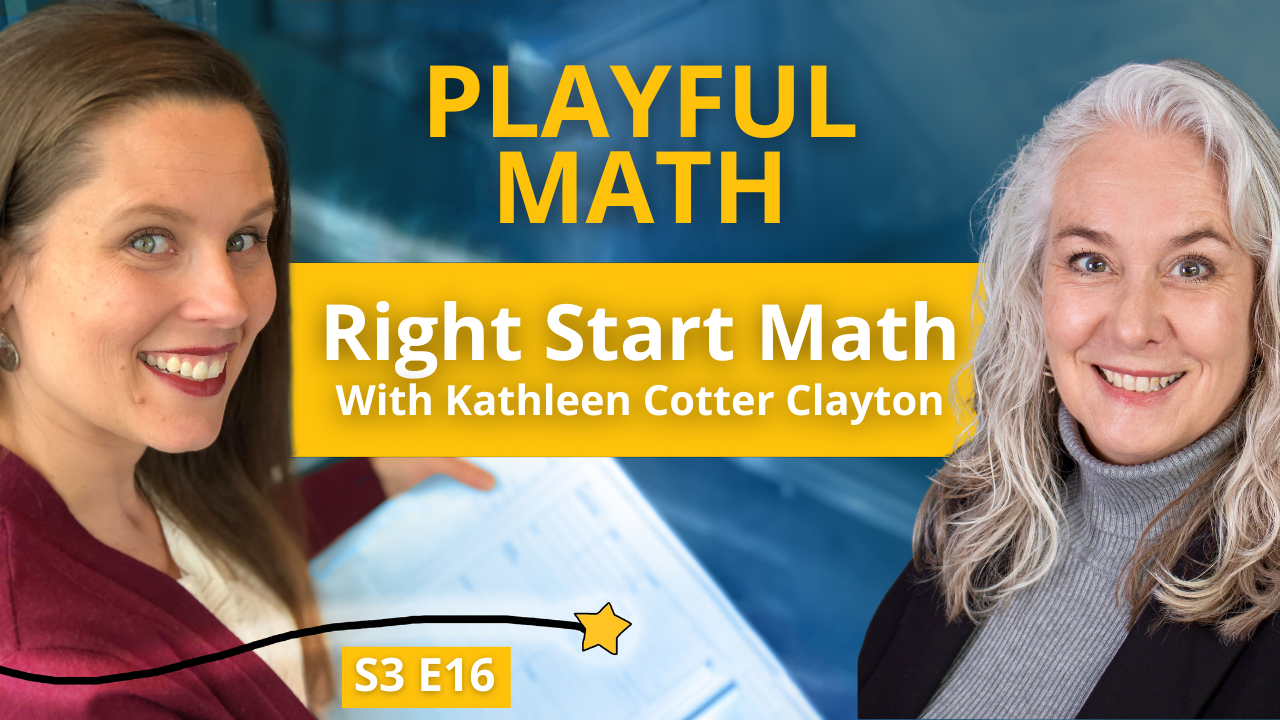


Can kids actually enjoy learning math?
In this episode of Diary of a Dreamer, Tasha Eizinger sits down with Kathleen Cotter Clayton, curriculum developer for RightStart Mathematics, to explore a better way to teach math.
Instead of worksheets and memorization, Kathleen shares how games, visual tools, and hands-on learning help kids truly understand math concepts.
If your child struggles with math (or says they hate it) this conversation will change how you think about teaching numbers.
You’ll learn:
• Why memorizing math facts often fails kids
• How understanding concepts builds real confidence
• Simple math games you can play with a deck of cards
• Why fractions are easier than most people think
• How parents can turn everyday moments into learning opportunities
Kathleen also explains how the RightStart Mathematics program helps children build strong number sense through visual, auditory, and kinesthetic learning.
Whether you’re a parent, teacher, homeschool family, or simply someone who wants kids to enjoy learning, this episode will inspire you to rethink math education.
Resources Mentioned
RightStart Math https://rightstartmath.com
Discount Code (limited time): DREAMER25KC2
Read Transcript
00:00 Welcome to Diary of a Dreamer, where resilience unlocks your potential. I’m Tasha Eizinger, and each week I’ll bring you powerful stories and practical insights from my own experiences and inspiring guests. Whether you’re facing challenges or chasing dreams, this podcast is your go-to for motivation, building confidence, and practical tips for transforming obstacles into opportunities. Be sure to check out my website, TashaEizinger.com. Let’s dive into today’s episode and start turning your dreams into reality.
00:35 Today, we are with Kathleen Cotter Clayton. She is the daughter of Dr. Joan A. Cotter, who is the author and developer of Right Start Mathematics, which I’m very excited as a former teacher to learn more about this way of teaching math. Kathleen is also involved with curriculum development and has written or co-authored 18 different manuals. That’s so much work.
01:01 It’s been a lot. A lot of work.
01:05 Oh my. And of course, Kathleen travels all across the country speaking, travels the world for fun, has six kids and six grandchildren. It is so good to have you here. Kathleen, thank you for joining us today.
01:17 And thank you so much for having me, Tasha. I’m excited.
01:20 You know what’s funny? So in the email today, you said we’re tech sisters. I love that you have like bachelor’s, two master’s degrees. I have a bachelor’s degree. We both are involved in the… tech world in some capacity, right?
01:37 And we could not figure out the intake form either way.
01:42 And when I finally sent my copy, two of them were upside down. Turn my computer. Oh my goodness. This is
01:54 fun. Oh my goodness. I just love it because I tease that technology is kind of out to get me a little bit sometimes. And then I, found out that you have two master’s degrees and i’m like all right then it’s fine i’m still smart i
02:07 can still do this oh my goodness well
02:12 i would love to hear um why like there’s a lot about math out there for people right and yes i only taught math one year thankfully i mostly taught writing Because math is really hard to teach. And part of it is how we were taught. Exactly. How to do it. It’s just like you just learn the formula and you just do it. Right? That’s not really teaching how to do it. So why should we not teach our children? That’s just the way we do it and always have done it.
02:45 Well, you look at how many people today. How many people like math? You know, in a room full of people, like when I’m speaking, I’ll have people raise their hands and, you know, maybe on a good group, I’ll get 40 percent. Most of the time, it’s 20, 30 percent that they say they like math. The rest of them are like, oh, yeah, four letter word. Don’t do that. You know, they just I’m not going to do it. I don’t like math. It’s not good. They don’t. And that’s not where we want our kids. We want our kids loving this. This is math is something that brings order to our chaotic life. Math. It’s not just your multiplication table. There’s actually 200 branches of mathematics. OK, wait a minute. How are there? What do you mean? Because, OK, you got this big whole thing. This is math. But in there, there’s arithmetic. okay we know that you know it’s your addition multiplication uh addition subtraction multiplication division but then there’s also statistics some people are like oh yeah other people are like um there’s algebra there’s geometry there’s fractals there’s there’s actually a branch of math called recreational math and some people are like that’s kind of an oxymoron i don’t think so yes there is you know like when you look at the sudoku yeah that’s math
04:09 Okay. I get what you’re saying. So like, even like my four-year old right now, she was measuring her foot with her finger and she was like, one, two. And she said, look, it’s 10 inches long. And my older child was like, she got out the ruler. She was like, I got to make sure that my little sister understands. I said, no, that’s the beginning of understanding math. Exactly. Measurement and distance.
04:29 And she’s using her thumb.
04:32 Yeah. As a measurement tool. Right. She may be 10. Thumbs, you know, her foot’s 10 thumbs, you know, not 10 inches, but she’s getting the idea of the concepts. There’s so many cool things in math. But what happens is, is people like me, I’m actually not that good in arithmetic. I mean, I don’t know what eight times seven is. I can figure it out. I’m not stupid. But I don’t know what eight times seven is. I have to go back and see.
05:00 So let me make I do it out loud now. Eight times seven. So what I do is I say four times seven. I know that that’s 28 times two. I double it. So now I know my answer is 56. But eight times seven, I truly don’t know. Because to me, eight times seven, you know, eight times six, six times seven, they’re all the same. They’re all, they’re in the 50s, 40s, somewheres. I don’t know. But you get people who think arithmetic is the only math there is. So you can be bad in arithmetic like me and be really, really good in math. Like when I got statistics class, when I was working on my bachelor’s and my master’s. that was like candy i saved that homework to the very end i do all the other icky homework and then i do my statistics homework because i loved it it was i know i’m weird but
05:50 no there’s not that was great you
05:53 know geometry i don’t really like geometry like with all the euclidean geometry with all those dry proofs you know i don’t like that But again, statistics, algebra, I thought algebra had died and gone to heaven. I loved it. I loved the logic of it.
06:08 So there’s different kinds of math. Yeah, I like algebra because it’s like you just
06:11 learn the process and you just keep repeating the process over and over. Right. And what happens is, is that if we teach the same way that you and I were taught, kind of a drill and kill method. If I don’t know what eight times seven is and I have no idea how the numbers are linked together, how am I supposed to know the answer to that? And how am I supposed to know that math is so much more than arithmetic? We’ve got to do something different than the way you and I were taught. And we have the research. We know, not we right start, you know, me and Kathleen, but we, the research community knows that people don’t learn just by sheer memorization. And you can learn some things, but that needs a lot of attention, a lot of review to keep it intact.
07:02 So is it more like understanding the concept, right? Like what you were saying when you took, you know, eight times seven, the concept is it’s, you know. I break eight apart. Right. And you understand the concept of how it’s structured and you know another way to get the answer. Exactly.
07:23 But that really what you’re teaching is more like understanding the mechanics of it versus what we were taught. Memorize.
07:30 Right. Just memorize. Right. Because you think about it. If I have to memorize, if I have an eight and a seven, initially my answer is a one and a five because it’s addition. Right. But then the next year, eight and seven, because I had the plus sign and I got rid of the vertical line. Now I just have this horizontal line.
07:49 We call it subtraction. And now eight and seven is just the one. Yeah, that’s a little weird, but OK, I can memorize that. But then you do eight times seven. You take the plus sign and you move it 45 degrees. Now, all of a sudden, the answer is a five and a six, because I don’t know. And then never mind division. And then you put fractions in there. I mean, it just, I can’t memorize it. There’s 390 math facts to memorize. That’s a lot. It’s a lot. And no wonder why like your 10 year old is starting to melt. I usually say if we don’t kill our kids off in multiplication, we kill them off in fractions.
08:25 Fractions are hard. Traditionally.
08:27 Right. But they’re actually, they’re really not. They’re really, really cool once you understand what they are. So what we do is we teach you what it is, how it goes together. We actually use an abacus to give the children a feel for what eight means and what seven means and what eight is seven times. Ooh, that’s a lot of beads. And so we’ve got different ways of approaching it. So we learn it on the abacus. And then we practice it with card games.
08:58 So you’re really addressing visual, auditory, and kinesthetic learners all at the same time. Yep.
09:04 All at the same time.
09:05 That’s a great idea. Do you want to know the hardest math I ever did? What’s that? So we had to learn at Purdue. I thought, oh, this will be like easy. It’s just like basic math. No, we had to do math. So our system, of course, is in base 10. Yep, in base 10. We had to learn how to do everything, all the arithmetic. uh fractions everything with different bases yes so two base two plus two base three or whatever and you’re like and it showed just how confusing it really is and how you have to use some of those visuals to explain it because i think sometimes As we get older, and yes, eventually we can know most of our facts or whatever, we
09:46 forget the beginnings of how abstract and confusing it is. And that’s why when you see a number like a one and a five, you know, eight plus seven is a one and a five. It’s not a one and a five. It’s a 10 with a five on top of that zero of the 10. Yes. So it’s. not one zero five it’s one zero but then you put the five on top and it becomes one five and
10:13 that’s what the big system changing it i was like i i don’t want to teach math like i really that’s when i knew i was like i this is so complicated based on how it was being taught at that time to then turn around and explain it to these kids right
10:30 Right. Actually, and I was going to say, don’t quote me, but we’re on a podcast. Everybody can
10:38 fact check it and Kathleen, you can be wrong sometimes. Yes,
10:41 I might be wrong, but I believe, I remember hearing that we started to teach the different bases in schools because that kind of came from NASA, not NASA themselves saying we need to do this, but the idea that we needed to get people to the moon. We had that NASA push. And so they said, oh. do this because that’s like what all the smart people are doing no no no no no no no let let them get base 10 down really really good and once i’ve solidly got it then let’s try a different base and just kind of because then you’re taking a concept and you’re expanding it and you’re kind of pushing it
11:19 But don’t do it right away. Good heavens, the kids are still trying to figure out what eight plus seven is.
11:24 Oh, that’s so funny. Because we did it in college just because our teachers said, we want you to understand how hard it is for kids to understand these concepts. You need to be able to explain it to them so that you aren’t just saying five plus five is 10. You need to be able to explain it to them in a way that they can understand. Did it work for you? We’re going to make it hard for you. And sure enough, some of my colleagues, they were like, I cannot wrap my head around this. Right.
11:52 Now, did it, did it help you or did it show you how hard it was?
11:57 It really helped me see, cause I started like doing things that you see younger kids do. Like I started drawing things out to see how it went together. Right. And I was like, okay, so this is how this works. It becomes a 10 because of this base being met and like starting to understand really. the concepts of it of stuff that I could just memorize before right right because I couldn’t memorize all of right so you had to
12:22 find a way to figure it out okay well that made sense but you were also a college student
12:25 exactly yes like it really showed me first of all how hard it is yeah to do how hard it is to teach effectively when we were taught just memorize yeah
12:38 The way that we do it, when I’m in a presentation and talking with, you know, whether it’s homeschool parents or it’s teachers or, you know, whoever I’m talking to, tutors, I like to use the analogy of, let’s use the alphabet. So A is one, B is two, C is three, you know, D is four. Okay. So what’s F plus E?
13:02 That’s good. Cause then you’re like, okay, you have to think it through. You’re right. so five which is 11 but okay
13:10 but but i need i need the alpha you gave me the numeric you you said it was 11. let’s look at you using your fingers hey it’s k yes that’s what it looks like to kids because isn’t that neat If you just memorize it. But now that you know how to do it, we’re going to go pull up flashcards. What’s E plus G? What’s A plus F? What’s I have no idea. I hate this. No wonder why this makes no sense to kids.
13:40 And so when you do that. Yeah. And it was fun to watch. And again, people on the podcast couldn’t see it. But Tasha, use your fingers. A, B, C, D. Trying to figure out what the
13:50 answer was. And I was so proud that I was like, oh,
13:53 it’s five.
13:55 I got the answer. No, I did not. No,
13:57 you did not. You got part of it, but you still had to translate it. And that’s what it looks like to a child. Oh, that is
14:05 fabulous, Kathleen. So how do we then teach math so it’s like alive and joyful so that kids, even if they’re counting on their fingers, like they’re enjoying it?
14:15 We play games.
14:16 Okay, what kind of games? Any kind.
14:19 Card games. So they’re games, they’re activities, they’re things. Instead of it being, okay, Tasha, you just learned how to do F plus E. So we’re going to do a whole worksheet. There’s 50 of them. Let’s go. And I’m going to time you next week on how fast you can do them.
14:34 Listen, I am almost 42. And if you gave me that, well, once this is recorded and aired, I’m 42. Yeah. If you told me, Kathleen, that I had to do that by next week and pass a test, I’d be like. You are out of your mind. Yeah, I’m not doing it.
14:49 That sounds awful. Yes, exactly. But that’s what we do to the kids. So what we do instead is we’re going to play games. Now, a real simple game. Remember the game of Go Fish? Yeah. Where you want the two to match a two, three to match a three. Mommy, do you have a two? No, Go Fish. Let’s do it with pairs that equal 10.
15:09 So if I have a two in my hand, two needs what to make a 10? An eight? Eight. So mommy, do you have an eight? No, go fish. Oh, I like that. Oh, so right. Instead of it just being matchy-matchies, it’s now what makes 10.
15:25 And people have cards at home. Yes.
15:28 Yes. Great. Yes. Yeah, it’s just super easy. Another one far more advanced, but fractions. Remember how to play the game of war? You lay down two cards. Whoever has the higher one takes it. Again, not really rocket science. What if we use fraction cards? I lay down one half. You lay down one fourth. Whose is more? Who takes both cards?
15:49 One half. So you’re the winner. Wait, wait, wait,
15:51 wait, wait. Four is bigger than two.
15:54 Right. So then do you draw a picture to show? So actually what we do in
15:58 that case, so you’re right, one half is bigger. But how many, how often? Yeah, but isn’t that funny though? How kids will look at the four because they’ve had how many years thinking four is bigger than two? So of course four is bigger. No, it’s not. We took one and we broke it into four equal pieces or one broken two equal pieces. Oh yeah, one half is bigger. Super.
16:21 Okay. So then do you draw it out or do you have like cubes? Like what do you do? We
16:26 actually have a fraction chart that you can see that I’ve got one broken into two equal pieces, broken into three equal pieces, four equal pieces, five equal pieces, six, seven, eight, nine, 10, 11, you know, all the way down to 10, not 11, 10. Okay. I
16:40 know when I was teaching, like I said, only taught math one year, I had parents who said, I cannot do the fourth grade math.
16:48 Right.
16:50 I can’t help them at home, you know, and so having it something that parents can actually do. I know this is for homeschooling families, but I also think a lot of this can be supplemental. Absolutely.
17:01 Yes. And we have a lot of schools that will use the Right Start Math program. We have parents who will, you know, they’re teaching whatever in the school system, but then I get the games and I start to practice. So the kids working on fractions, we’re going to go play this game. A quick funny story about my oldest grandson. I think at that point he was in sixth grade and I had gone to visit and he says, oh, Grammy, Grammy, I have to show you, look at me, divide fractions. And he did it,
17:29 you know, he invert and multiplied and did all this stuff and he had the whole thing. And he said, okay, that’s great, Carson. I said, let’s go play Fraction War, just this one. I did it with just the halves, fourths and eights. That kid, it took us an hour. He kept using the chart because he did not know what was bigger, five ace or one half.
17:48 So he knew the formulas, but
17:50 he knew the formula. He had no idea what fractions were even about. He could do the process, but he had no idea what it was about. He didn’t even know which was bigger, which was smaller. He did not understand it.
18:05 Well, good thing he has you.
18:07 Well, yes, I was very pleased that I was able to have him. But I was amazed. And he’s a bright kid. But even after an hour, he still had to use the chart, which made me think that he even needed to go back farther than I took him with what is a fraction and work your way up to even to begin to compare them.
18:28 We like to bake. That’s our way of practicing fractions.
18:32 Yep. Yep. And that’s good. But if you have things like one third plus one half, your measuring cup does not have sixth on it. No. And so, yes, it gives a concept. It lays an initial foundation and that is good, but we have to go beyond it. And that’s what’s so neat about the Right Start program. We have both the full program and then we also have a tutoring program.
18:56 Okay. So it just takes bits
18:59 and pieces. Okay. So Right Start Math is a full program from kindergarten all the way up to high school algebra. So we’ll teach everything you need to learn. Again, whether you’re a homeschooler or you’re a schooler or you’re a tutor or, you know, whatever it is that you’re working on. The Right Start Math program. But what do we do? I’ll pick on your sweet little 10-year-old here. What if your 10-year-old who’s what? Fourth grade? Fifth grade? fifth grade and let’s just say and i’m sure she’s not but let’s just say that she’s over there and she is just struggling to beat the band she cannot figure out addition i can’t take your 10 year old drop her into first grade material and expect her succeed she doesn’t have time we got to get a move on you know we’ve got to fill this gap and we got to get moving to pull her back up to her peers so that’s where we’ve got the right start tutoring program And that is assuming the child’s two years or more behind where they should be.
19:55 And we only deal with like one book only deals with addition and subtraction. Another book only deals with multiplication and division. Another one only deals with fractions. So it’s topical what I need to fix. And then I go fix it.
20:12 I love that too, because like what you were saying at the very beginning, like. Arithmetic, not exactly your thing, right? So just because maybe a child has done well in math doesn’t mean that there’s not going to be something that they’re learning that’s extra hard. Right. And so you can like hone in on what they’re struggling with.
20:32 Right. Exactly. The other thing that’s really neat about the Right Start Tutoring series is because, again, we assume the child is two years or more behind. I’m not going to take your daughter. What is her name, by the way? Tressa. Tressa? Uh-huh. That’s very pretty. So I’m not going to take Tress again, put her back in first grade and go, okay, we have four puppies and three more puppies and make it very first grady. You know, we want something that’s going to be more appropriate for a fifth grade young lady. And so we’re going to have word problems in situations that are more applicable to our age.
21:06 Right. You
21:07 know, so they’re going to be more, they’re going to be bigger problems. They’re going to be getting more age appropriate. The other thing is, is with your Tressa, she’s already, if she’s challenged with, with her math, she’s already been worksheeted to death. She’s treated worksheets in first grade, second grade, third grade, fourth grade. Then she had the extra ones because she was struggling. Then she had the extra, extra ones because she didn’t get those. She has done worksheets. I’m done. Yeah. So what we do in the books for multiplication, division, and we actually call it number sense. That’s the addition, subtraction. The number sense one is there is not one worksheet. Oh, don’t be devastated, but she’ll be fine. What we do instead is we play games, play games. So instead of doing a worksheet on, again, what makes 10, I’m going to play the go fish game.
21:54 i love that and that does work in a classroom setting too that’s what’s so great about this like you can definitely do it you know as a homeschooling parent supplemental you know in the summers i don’t do school stuff too much in the summers i like them to read and play and explore but if they’re playing with math it’s not doing homework exactly
22:14 um quick quick you mentioned in the very beginning i am dr Cotter’s daughter she’s the author of the right start math program i’m i have been kind of doing some more things with that but anyhow she’s my mother So she actually started this when my brother was having, my younger brother was having difficulties in math and he has some dyslexia issues. So she would create a math card game and try it out on my sister and I. And if we did it and she worked out the bugs, then she would try it with him because a lot of dyslexic children, the first way they do something is the way they latch onto it because they get it. And if the game wasn’t right, she didn’t want him to have to struggle and then change the instructions and things like that. So she would try. out with us. Every summer from about my age, I bet probably 12, 11, 12, 13, every summer we’d get up in the morning, we’d have breakfast, we’d play some games, and then we were released for the rest of the day to go ride our horses or go swimming or do whatever it is that we were doing for the day. But every day that was just part of it. You had breakfast, you had games, math games, and then we went out and did our thing.
23:19 Oh, that sounds like a great childhood. So it’s an easy 23:22 way. Oh, I had a wonderful childhood. But it’s so easy to do it that way. It’s just part of what you do. I mean, you would never skip breakfast. Well, we’re not going to skip the games. Even as you’re eating your cereal, you can be playing a game. You can be working with it. And having fun and laughter. I mean, that brings the joy into it. Nobody wants to do a worksheet, but if I have an opportunity to play a game and beat my sister, sign me up. I am all over that. Siblings everywhere. Absolutely.
23:52 I’ve had some times where people say, well, I don’t have extra kids or I don’t have the time to play the games. Tell the kid to play against the dog. See who wins. You are the dog. You know, do right hand versus left hand.
24:03 Right. Yeah.
24:04 Find a way to modify it to fit your family, to fit your child, to fit your needs. Maybe you do it when dad comes home from work.
24:13 And a deck of cards can even, oh, you
24:15 can really see in my back. Here we go. Even a deck
24:17 of cards could fit inside this, right? So you don’t need a big, huge purse. Just slip a deck of cards in and you can play something.
24:26 And you can do it. Yep, exactly.
24:28 So are these games, the instructions and things on your website?
24:34 We have a lot of them on our website. We have a book called, very cleverly, Math Car Games. I know. We didn’t know what else to name it. Anyhow. But that has 300 games. That has addition, subtraction, multiplication, division, fractions, clocks, and money. Okay, I don’t want to read the book or I’m not good at reading instructions. We have a Vimeo account where you can choose. We’ve got an instructional video that shows you how to play all the games and you can sort it by level. you know, or grade, if you want to call it that. You can do it by level. So I just want to do all the kindergarten games or I just want to do all the fourth grade games. But you can also sort it by topic. I want just the addition games. I want just the multiplication games. The cost is $4.99 a month. We’re not, you know, it’s half the price of Netflix, you know, so it’s a small amount because I’m lazy. What I did is I would tell the kids, you know, hey, go watch that game and go play with your brother. I really don’t care if they change the rules. It’s because it’s not the rules. It’s the thing. It’s the, you’re playing the game.
25:36 Yeah. They’re practicing it and having fun. They don’t even realize that they’re practicing it. So this is something I call it at home. I do something called sneaky school.
25:45 Yes. I saw that. I think. Yeah. Yeah. So my daughter on your website, I think. Yeah.
25:50 Yeah. My daughter, one time she said, mom, why don’t you have me do learning books in the summer? Like so-and-so does. And I’m like. okay, well, let’s talk about this. What’d you do yesterday? What did we do yesterday? She said, we went to the park. I said, yes, we did. And this was many years ago. I said, do you remember what you did with the plaque? She said, well, I read the plaque. She was learning how to read, right? What’d you learn? And she told me, and I said, ah, I said, so you learned something, didn’t you? And you practiced your reading and we were out in nature. That’s called sneaky school.
26:20 I love that.
26:23 i think so often kids think that school is just from september to may you know maybe you go to june whatever maybe start in august but you know it’s just it’s just this and we don’t do it in the summer but we adults do You know, everybody does. We need to make learning lifelong. It needs to be something you do all the time. My mom used to say that if she didn’t learn, she had a thing. I remember her talking about this when I was a teenager, that if she didn’t learn something that day, she would actually sit, grab the encyclopedia. This is, you know, 100 years ago. Grab the encyclopedia, open up and start to read until she found something she did not know and she knew it. She’d close it up and then go to bed.
27:05 I love this. My grandma used to say, learn something every day. Yes. Every day. And she did her encyclopedia or look at the globe and always learn something. I absolutely love that. And that’s what we want is kids who are constantly, consistently using their brains to explore the world around them.
27:24 And not just the kids, but also us. I don’t get to be like, I have a double masters. I’m so smart. I can quit now. No. It just means that I have more to learn. I have to decide, do I want to learn this? Do I want to learn that? Do I want to get better in this? Or do I want to start something completely different?
27:41 Well, and let’s be real. I don’t know about you, Kathleen, but I feel like the more I learn, the more I realize the knowledge that I have is so insignificant in
27:52 the spectrum of what’s available
27:53 to learn. I’m like, I know nothing and I’m still learning everything.
27:57 Yes.
27:59 It never ends. you’re not going around saying every single person on the planet this is the only way
28:04 right right yes there is there is there’s always no one’s going to do everything the exact same way i mean my goodness would our life be boring i
28:14 know since
28:15 this isn’t being released till about may i am going to tell you that we have just joined forces with nicole the math lady and I know. And there are now going to be, and again, I’m saying this here in October. So in May, we should have this in place.
28:35 Although we’ll check before it goes live. We should though, we should be having it, but we should have videos teaching the Right Start program. For people who are unable to teach their children or afraid or want some help to teach their children with the Right Start Math program. Super excited. That’s going to be amazing. Yes. Wonderful.
29:00 Yes. So I know that you had shared there’s a special discount that will last for about a month after this goes live. For anybody who wants to get in touch with you, like how can they get connected? What is the discount? all that good stuff, because I’m sure that there’s somebody listening that they need. They want
29:18 this. Yes. The code is going to be DREAMER, D-R-E-A-M-E-R, 25, and then KC2. For Kathleen, Cotter, Clayton. So KC squared. KC too. Yes. And that will get you. Yes. So they get a little math joke there. But that’ll give you a 10% discount if you go to rightstartmath.com. And it doesn’t matter what you want to order. You just want to get the games. You just want to try a few things. You want to go, oh, yes, I totally need this. I want to get the tutoring. See what you need.
29:53 And this is perfect timing for summer supplemental math at home. Make math fun so that your kids don’t lose what they’ve learned
30:00 during the school year. Right. And we can practice and have fun with it and bring the joy. I mean, most people don’t put the word joy in math together, but it should be. Math is so cool. There’s so many neat things to it and so many exciting little corners and tidbits and pockets of information. It’s just. I want your kids to be like, oh, good, we get to do math. And not instead of like, oh, yeah, no, we want the joy in there. And I also want to bring the joy to the parents, to the adults, you know, to the teachers. I want you to see the joy that’s in there.
30:36 And what I love is these people that say they don’t love math. I’m hoping the adults
30:41 learn to find that
30:43 they can love it, too, because they’re connecting with their kids and having fun. Yes.
30:48 Yes.
30:49 This is a great program, Kathleen. And thank you so much for being here and sharing about it. I know we’ll be connecting in the future.
30:58 Yes. Yeah. If you can read upside down, I can send stuff to you upside down. I totally got this.
31:05 Takes real talent, you know? Thank you again. And thank you so much for your time.
31:11 Thank you. I appreciate it, Tasha.
31:20 Thank you for tuning into this episode of Diary of a Dreamer. I hope you found the stories and tips shared today to be a source of motivation and strength. Remember, every challenge you face is a chance to grow and move closer to your dreams. Don’t forget to subscribe, leave a review, and share this podcast with anyone who could use a boost ofencouragement. Please check out my website, TashaEizinger.com.