
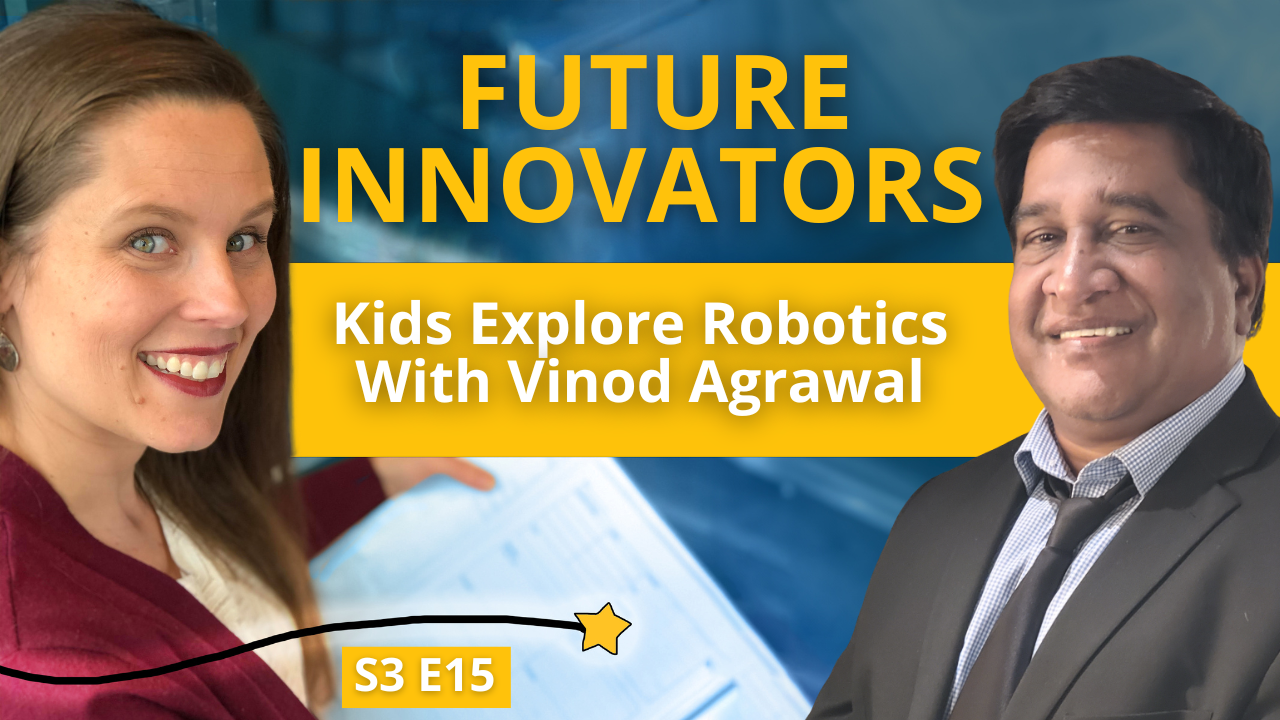


What happens when curiosity meets courage?
In this episode of Diary of a Dreamer, I sit down with Vinod, founder of Kids Explore Robotics, to talk about dreaming big, nurturing curiosity, and empowering the next generation of innovators through hands-on learning.
Vinod shares his journey into robotics education, why fostering creativity and problem-solving in kids matters more than ever, and how parents, educators, and dreamers can help children see themselves as capable builders of the future. This conversation is a reminder that dreams don’t start fully formed — they begin with questions, experimentation, and permission to explore.
If you care about education, entrepreneurship, innovation, creativity, or raising confident kids, this episode will inspire you to think differently about learning and leadership.
Topics we cover:
- How curiosity fuels lifelong learning
- Robotics as a tool for confidence and creativity
- Encouraging kids to dream, build, and problem-solve
- What dreamers of all ages can learn from young innovators
Learn more about Vinod and his work: https://www.kidsexplorerobotics.com
Read Transcript
00:07 Today we are with Vinod, who is an engineer, an educator. I also think an innovator. I’m really excited to learn from Vinod today about his STEM program, which is teaching engineering through robotics. But as you know, as I know, it’s always so much more than just. robotics right this is a very layered business inspired by your son and i’m so excited to dive in and learn more about what you’re doing so thank you for being here today thank
00:39 you thank you so much for having me
00:40 yeah so how did all of this get started obviously being an engineer it makes sense to do something with robotics and stem but it’s also a business so how did you get started with this
00:53 yeah so first of all uh My background is engineering, electrical engineering with master’s degree with 25 plus years of experience. So I’ve done robotics off and on, mostly in industrial settings. And when my son was young in elementary school, he started being in robotics. And he was in robotics ever since then through basically the middle school, high school, not so much because he had some other priorities, but he absolutely loved robotics.
01:19 as part of my hobby i was thinking with robots at home anyways so when he got to the junior high school level uh he said dad i want to do something with my robotics and part of the reason it was kind of like his passion project as he was getting ready to apply for different colleges he wanted to have something really that will distinguish yourself with so he said well i want to do some really cool project and he had some different idea and one of the ideas was robotics i was like okay what do you want to do with robotics he said well I see some problems as I was in my robotics team, and I was like, okay, what was it? I kind of knew about that, but he kind of validated that for me. Basically, he said that, yes, he had a lot of fun being on the robotics team ever since he was in elementary school, but majority of the time, they were given the robotic kits and the instructions. They were basically putting the model together, but they weren’t really learning through behind the scenes of robotics.
02:15 So, for example…
02:16 so can i interrupt what i’m understanding then is they were just following the step-by-step instructions versus trial and error like a true engineer trying to figure it out right exactly exactly now
02:27 some programs were better than others but for most majority of the school programs they’re not trained engineers i mean they do a great job obviously kids really enjoy the programs but as far as the learning aspect that wasn’t quite there it was fun to put the robots together and see them how they move but kids didn’t really understand what kind of purse does it take to build a robot how do those parts work individually how do they work together how do you really put them together how do you create your own different structure So those things were missing.
02:59 They were like following the recipe without having just ingredients in front of them and cooking a meal. They were just following steps. Steps, exactly. It doesn’t sound as exciting either. Yeah.
03:10 And the other thing you mentioned was, well, a lot of the schools do have programming, but the vast majority of the schools, they don’t have anything, particularly for the elementary or middle school. And those they do have, they can only take so many kids. So not all the kids, even if they were interested.
03:28 They didn’t have an opportunity to really be on the program. So he said, you know, Dad, I can do something different. I want to be able to teach. I mean, he had done some tutoring and all this off and on anyways. And I have worked with children ever since I was in high school, quite frankly. So aside from my core engineering job, I was kind of like educator on the side anyways. But so we started thinking about, OK, we don’t want to use any mass produced robotic kits that are out in the market because we’re going to run into the same problem. So we started thinking about, like, why don’t we just design our own robots? Like you said, Dad, you have an engineering background. You’ve done robotics and you have background in it. We can come up with something unique. So we started exchanging ideas. And after many different prototypes here and there, we designed one of our first robots. And it’s this guy right here.
04:18 Can you move it over that way a little bit so I can see it? Oh, that’s so cute. Yeah. wow that looks complicated
04:25 you know actually it’s relatively simple so one of the goals we have in mind is we want to create the robots that kids can actually relate to and we want to give them completely open concept in design meaning we didn’t want to keep anything hidden behind the scenes kids ought to be able to access every single part of the robot they can actually see we can teach them how to do the wiring why you do certain things certain way and all that so we kept the designs of the robot completely open concept and we came up with some of the other creative designs that kids can actually relate to. So for example, this guy does the pull-ups and I’ll just show you, this guy plays the drum. This is an excavator. This is kind of like a three-wheeler that just goes around. This is kind of like an SUV. So variety of different robots we have, kids can something that they can actually relate to. And again, we kept the design relatively simple from custom crafted wooden pieces. Children can do that on their own with some adult help, of course. uh all they have to do is just source some of the parts which we teach them about what kind of parts you need and how you put them together how do they work and not only that once they build the structure we actually teach them how to control the robot the programming of the robot because robots by design they’re just physical machines they don’t do anything on their own until you program them right so we have to teach them how do you really program and we teach even kids as young as six year old in some simple terms they can start making the robots move a little bit and as they actually see the results they get more excited they want to do more of it so they’re really into it and they can learn more so really engaging the kids at early age and getting their attention making it really fun for them while teaching the real world skills and as you know robotics is not an option anymore The robots are here. They’ve been around for a while. They are continuing to grow in usage around the world. And as these kids who are in elementary, middle school, by the time they get into a professional career, they’re going to be surrounded with robots. So having a really good working knowledge of robotics is a must-have skill. So it doesn’t really matter whether they actually pursue an engineering degree or something related to robotics or not. But just having the knowledge of how the robots work, it’s going to serve them a long way, no matter what they end up doing. So what we are trying to do with our program is really attract the kids to the stem programming particularly robotics related because robotics as you mentioned earlier it’s not just pure robotics it has some other chemicals everywhere it’s part of engineering it’s part of math there’s science there’s technology there are all sorts of things that are involved in robotics so when they’re working with the robots they’re learning all those things without them actually even realizing that
07:25 Well, and I love that you’re also, you know, as a former teacher, I love that you’re teaching kids how to use their brains. Absolutely. They’re learning how to figure things out, critical thinking skills, how to ask questions, how to problem solve. They’re learning resilience, growth. I mean, there’s so much that they’re learning. So on the surface, yes, they can understand robots better and the robotics and the computer programming. That’s important, but much. lower or much further below the surface, if you will. They’re learning so many really important skills that will serve them, like you said, no matter what they do.
08:05 Exactly. Like you mentioned, they’re learning to problem solve. Likely when we give them a small design project. we basically give them the requirements and we walk them through some of the main things but they have to try to figure things out so they’re solving problems they’re trying to think critically you know because it requires critical thinking uh they’re boosting their self-confidence because when they see their creation actually work it’s a really feel good exercise that gives them a higher level of confidence yes i can do that i did it i can do it so there are lots of advantages there’s a problem solving creativity critical thinking, teamwork, some of the sessions that we have where we have the kids work in a team of two to four, depending on what the session, what the project is about. They’re learning to work with their peers. So yes, you’re absolutely right. Robotics is not just something technical skills, which you must have now anyways, but they are also building these other skills that will serve them for their entire life, no matter what they end up doing, whether they’re going to engineering, robotics, or… completely something different it’s going to serve them well for sure i
09:14 love this so much so how long does it take like let’s say a sixyear-old doing a very like the simplest program that you have about how long does it take for them to actually see a result yeah
09:27 so one of the simplest program we have is this guy here and i’ll show you in just a little bit but basically it uses two different types of motor but we call it 180 degree motor and 360 motor and basically we teach kids how to put this together relatively simple but then how do you control that so there’s a manual control here let me just show you real quick and
09:50 for people listening it’s spinning yes
09:53 so you’re
09:55 turning it on and it’s spinning
09:56 that’s a 360 motor and when i turn the knob you can see the head moving back and forth yeah This one has a manual control right now, but you can automate that. That means you can program this guy in some really, really simple term. I can teach them how to build this guy and actually program for this one in probably about three to four classes, usually about three classes, three one hour classes. And we actually have this special offer on our website. So yeah, that’s all it takes to do about three classes. to teach them something very basic so they will learn about the different type of motors how do the motors really work how do you really control the motors from programming side so all that takes a little bit and of course they get a really good overview of uh general concepts of robotics also so all this in about three hours they can learn the basics that’s
10:50 tremendous yeah that’s tremendous i feel like this is great too for something to have obviously homeschooling families, public schools, private schools, but also like as a parent, that’s a fun weekend project. Exactly. Over fall break, spring break, you know, whatever, summer break, you know, doing a little bit at a time so that they get excited about it. And I think in terms of attention span, three hours is very reasonable to create something that cool to a kid. They would be excited more.
11:23 Yeah, and they don’t have to necessarily sit in one session. They can break it up in two different sessions, too. So, yeah, I think it’s really, really cool. And as I said, when they build this robot and they can actually make it move, you see the confidence grow and they’ll be even more interested in building a lot more complex robots.
11:40 And we have right now we have about 20 different robots and we’re building more. Our goal to have about 40 to 50 different robots. in variety of different complexity as you know like for example this robot is a little bit more complicated so for a six-year-old this might be it takes a while a little bit they can do it but it will take a little bit time for them but we have different types of robots for different age groups uh and even six-year-old once they start with something simple they can grow into it and you know six seven months later they might be able to build this one with some help so it’s not necessarily so much The age that is important, it’s how much they work with the robotics. And I have had a 20-year-old kid enjoy this guy because they have never done anything robotics. It’s important to give them the basic conceptual understanding of robotics. So we still start them with this simple robot anyway so they can get the basics of it. And then they can move to some other more advanced robot much more quickly than probably a six-year-old. But we basically start them off at the same level.
12:42 i appreciate that you said it doesn’t really matter the age either because i have a four-year-old who is incredibly engineering-minded right oh my goodness the way that she looks at the world it reminds me of my older brother who’s an engineer okay and this is something that i think i want to sit there with her and do it with her because she would be squealing with delight awesome and would be so determined to figure out how does this work why does it work this way what happens if i do this like she loves the process of learning so i agree with you that it doesn’t really matter the age yeah everybody knows their child and their students best of What are their capabilities that I can’t wait to try this at home?
13:29 Right, exactly. So one of our goals is to have a series of video classes recorded for every single robot that we have. So some people, particularly if they’re remote, they’re not able to join us for live classes online because we only offer those live classes at a certain time, certain days, right? So if they wanted to do a home project. they can just basically get the robotic kit and they’ll get access to the video classes once they are done and they can do it their own time you know they don’t have to necessarily join at a particular time so that gives a lot more freedom to to do it at their own pace basically which
14:04 is great as a business model that’s smart for you to set it up that way because it gives you more flexibility but also as a consumer it solves a big problem which everybody’s so quote unquote busy, that it gives more flexibility. Backtracking about your son, I am also a Purdue Boilermaker. Wonderful. I graduated from there many, many years ago. So how did he get started? How old was he when you saw he has an interest in STEM and how were you able to develop that in him?
14:36 Absolutely. So even when he was in like… preschool he was really really good at math and he was always asking questions he was always curious about learning things it’s not like okay this is how it works so we got him enrolled into a variety of different programming me being an engineer mom being an engineer we were always working with on variety of different small projects and he was really intrigued about those things so he got into the robotics team in school uh early elementary now of course during those times this was you know quite a time 10-12 years ago.
15:09 They were not very well established. They had a very basic robotics program, but he still enjoyed it. And as he got into the middle school, he enjoyed it even more because he was a little bit older, he understood a little bit more, and some of the robotic kits were a little bit better at the time. So he started learning about robotics practically when he was six, seven years old, really. so and it wasn’t so much in the school robotics team it’s just something that he was working with me it wasn’t just simply robotic but all aspects of different engineering disciplines so i knew he had a knack for that type of stuff and obviously he was really good in math and all that stuff so naturally this was a good fit for him so he started continuing to do that and and we supported him any way we could
15:58 Just like a good parent, right? You do what you can to support your child and help them develop. Exactly. So what is he studying? I know he’s doing engineering, but what type of engineering at Purdue? mechanical engineering mechanical yeah and i know that the engineering program at purdue is rigorous so i’m sure he’ll be happy when he graduates he
16:20 is he’s pretty good but yes it is tough program man but he’s doing really well so wonderful very well recognized university for engineering just about any type of engineering so i think he do he’ll do very well
16:33 Wonderful. Yeah, my older brother, he’s a mechanical engineer. And I think there’s a misconception about engineers that it’s like one type of engineering. And my older brother has gotten to do so many different types of engineering. Yeah. It really fascinates me all of the possibilities.
16:50 Exactly. Even with a particular discipline like mechanical engineering. mechanical engineering is all sorts of things it’s in aerospace it’s in medical industry it’s in uh automation it’s in just about everything so yeah depending on what his interests are uh obviously he’ll have plenty of different opportunities at this moment he’s actually thinking of continuing his education beyond bachelor’s degree into master’s and phd also whether he’ll actually stick for that i don’t know yet but he’s very very academically focused of course he does lot of other things as well but um maybe he will do his phd and do something much bigger than what i ever done
17:30 well that’s what we want for our children right is for them to do more than we ever thought was possible exactly ourselves that we see them you know progressing so that’s exciting it’ll be fun to follow up
17:42 absolutely absolutely i think it’ll be fine ah one more thing i want to mention before i forget i’ll just as we were talking i just it just kind of triggered my thought so you know a lot of parents are fearful about getting their kids into robotics because they think that they don’t have the knowledge to really guide the students well you don’t have to be engineering parents you don’t have to have any background in technology to get your kids involved in robotics we make it really really easy for them to be able to do that all it takes is a little bit for help from the parents but the way we design our program Kids can practically do most of the things on their own as long as the parents are there to support. So they don’t necessarily need to be having any kind of a technical background or engineering just to get the kids into robotics. So I write blog articles to every once in a while. So one of the articles I wrote is like, hey. You don’t have to be engineers to get your kids involved in something like this. It doesn’t have to be a robot. It could be any part of STEM or engineering. There are a ton of opportunities around the corner just about anywhere in the United States. So I think all it takes for the parents to just a little bit of a work to find those opportunities, whether it’s our program or other program, I really, really highly encourage parents to get their kids particularly into the robotics because, again, as I mentioned. robotics is not an option anymore you know it’s a must-have skills and sooner they engage their kids into this kind of program sooner they will find out if this is something that’s interesting if they are interested then possibly they can make a career out of it if they’re not as interested at least they will have more some of the basic skills that are necessary anyway so getting the kids involved in robotics at any age It’s going to serve them really well, no matter what they end up doing, no matter what their background is. So I highly recommend all the parents to take a little bit of a time from their business schedule and get the kids into robotics or some sort of a technical field.
19:45 Thank you for addressing that, too, because as you were talking, it’s like, oh, mom and dad are engineers. Naturally, your son’s going to. Learn it. So thank you for covering that, that you don’t have to be an engineer to have this in your home. I don’t know how common this is, but you hit on it twice now about how robotic robots are part of our lives now. And I just recognize this really for the first time when we were at Purdue several years ago and we saw these little robots going around on the sidewalks delivering food. Yes, yes. I was like, what is that? I don’t know how common that is on college campuses, but it’s just wild to think we really are entering into just such an interesting way of living. Yes. What kind of predictions do you have just out of curiosity? Because I would have never guessed, you know, robots delivering food. It was always the Jimmy John’s bikers. Yeah.
20:48 So.
20:51 I think we’re going to be surrounded by robots. Robots are literally going to walk amongst us, you know, whether it’s a delivery robot, whether it’s a drone delivery, whether it’s a robot that helps us in our household. There’s a robot vacuum cleaner. Essentially, there’s a robot. There’s going to be many more. There are a lot of companies that are working on, quote unquote, humanoid robots. They look and work pretty much like human. They can practically do everything we human can do. And I think in another 5, 10, 15 years. We will have the robots that will walk amongst us and do pretty much all the chores that we do. And that’s a good thing in a way, you know, if it’s used properly. So, yeah, I think the way the automation, the artificial intelligence, the robotics industry is going, they will be common just like people, you know.
21:41 Go ahead. How does this tie into artificial intelligence? Because that’s another thing I feel like right now. the artificial intelligence that’s available publicly like chat gpt is really just a high-end data processing right like it’s not like true ai it’s like helping me sort information and using predictable formulas right that’s not so how does this tie into like the ai of the future yeah
22:09 so there are lots of different components like there’s an ai there’s a machine learning there’s robotics automation all that right so AI is nothing but something, a very sophisticated algorithm that allows the particular piece of equipment or robot or whatever it is to learn from it, gather a bunch of data, to learn from its environment. And based on the learning, very much like humans do, we learn from our environment. And what we have learned, what’s in our memory, that helps us process the new thoughts, basically, that helps us create new things. artificial intelligence is basically the same thing right it essentially learns from some of the behaviors or the surrounding they have and it comes up with better models essentially so robotics and ai they pretty much go hand in hand so all the smart intelligent robots that we’re talking about that could work practically like human well they’re going to be learning just like a human do And based on their learning environment, they adapt to the environment, they adapt to specific situations. And that’s part of artificial intelligence automation.
23:18 This is fascinating to me. I mean, can you imagine when we were kids, like maybe you imagined this type of a world? I mean, I used to watch the Jetsons on TV, but it’s like we’re kind of living. In that now, you are providing opportunities for children today to thrive now and learn these things now, but it’s going to help them thrive in their future.
23:44 So you won’t believe me, but this is true. When I was in elementary school in my home country, I used to actually think that, hey, yes, we got the cars, but wouldn’t it be really cool if the cars drove on their own? seriously i actually used to visualize in my mind like you know i’ll be just sitting in the back and it’ll be just driving on its own wouldn’t that be cool well 20 30 years later about 30 years later it’s a reality now right i also another thing i used to imagine is wouldn’t it be cool if you had a flying car just like an airplane but it’s more like a car well they’re being built today there are prototypes that are already available so yes i mean it seems silly but I used to actually dream about this kind of things, and some of those things are becoming reality today.
24:35 Is that so wild to see something that you dreamed up as a kid existing in real life?
24:42 It’s pretty wild, but it’s like, man, only if I had the resources at that time. If I had just started at that time, if I had some investors or resources, I would have been all right. But I’m just dreaming as a kid about these kind of things. and i always wanted to be engineer ever since i was in elementary middle school anyway so that was i was always thinking of things and trying to learn how things work and what’s possible you know
25:09 I love that. And I do think it’s important for people like my older daughter isn’t necessarily as engineering minded, but I still want this in my home because she’s going to get the benefits. I think it sounds interesting enough that she would want to build and create and see how this actually works. Even though my younger one would probably want to do every single one of them.
25:35 My older one, it would still serve her well. So I hope people who are listening don’t. think that your child has to be engineering minded or that you have to be engineering minded because this is like really fun and interesting stuff that you are creating for kids so i really appreciate the work you’re doing i think it’s important yeah
25:53 yeah absolutely this is not necessarily just for the kids who want to go in engineering this is for all the kids who are just a little bit curious about how things work and if anything it’s a lot of fun for them and like you mentioned it helps them build some of the other soft skills that are going to be really really valuable no matter what they ended up end up doing in their later careers so uh yeah i mean if you want to i can show you demonstrate some of the robots for if you like
26:20 um could you just do one because i’m thinking most of the people are going to be listening to the podcast if anybody’s listening right now you can definitely view this on youtube um but go ahead if you could just show me one of them that would be great yeah
26:35 let me just show you the drumming robot can you see this okay um
26:38 go ahead and scoot it i’ll keep going like this until i can see it
26:41 oh
26:42 it’s drumming yeah keep going so i can see the drumming there we go oh my goodness So you programmed this into the computer or did you just push a button and it’s doing it?
26:58 No. So it’s already programmed. And typically the way the robots work, once you program it, you have to upload the program into the robot’s memory. So you transfer the program that you hold on a computer typically via USB cable into the memory and the program resides with the robot. So anytime you want to turn it on, there’s usually just a power switch. You turn it on and it starts doing its own thing.
27:19 This is amazing. So can you change the cadence?
27:23 yes yes absolutely and so that’s one of the beautiful thing about this robot this is not this is just something that i program but once the kids can learn i can learn a little bit more about the program they can create their own music they can literally practice programming with this guy for many many months and they can create some really really cool music as a miracle
27:44 oh my goodness you need to have like a little robotic band instruments that would be so fun
27:50 yeah one of the i am thinking of uh developing another robot that’s just going to move around and play xylophone or something like that yeah but that’s something in the future yeah that’s something in the future
28:03 oh my goodness well the possibilities are endless we know that
28:07 yeah exactly yeah and we have some really cool robots just like that we have the robot that does the pull-ups we have the robot that works just like a car we have a three-vealer we have an excavator we have military truck we even have a little bit uh little bit guy that works like a carousel basically this kind of goes around yeah oh
28:28 my goodness i’m excited to check these out um now i know you were at the midwest homeschool expo in 2025. Will you be there in 2026 in Indianapolis?
28:39 Absolutely. Wonderful.
28:42 I’m going to be there as well, so I will definitely see you. I’m so glad that Gene has put together this Homeschool Expo. Absolutely. Yeah, it’s great for homeschooling families, but also anybody who wants to supplement their child’s education. Some of the people I’ve interviewed, whether it’s math, robotics, authors, there’s so many different resources.
29:04 at the expo so will you have it where people can try out absolutely i always hear
29:09 some robots at any of the events that i attend where kids can tinker with them a little bit so absolutely yeah
29:15 wonderful so they can actually see it in real time so anybody that’s even within a two-hour radius at least of indianapolis should definitely check out the midwest homeschool expo you may meet Vinod sorry And meet me as well, right? Yeah, absolutely. So I know that you have a promotional offer for everybody listening. Could you please share a little bit about that? Because it’s such a great deal. I hope people take the opportunity.
29:44 Yes, absolutely. So the promotional offer is for $25. And we ship a simple robotic kit to their house. And they also get to join pre-one-hour live classes. It’s typically once a week for one hour, three weeks consecutively. So what they’re going to learn, the kids are going to learn, they’re going to learn about some of the basic concepts of robotics. They’re going to learn about some of the critical components that you need to build a robot. And they’re going to actually learn about different motors, like for example, 180 degree motor, 360 motor, put this robot together, relatively simple, and then actually learn. what makes this robot work so a little bit of a programming robots are basically programmable machines so you have to write the instructions the program for it so they’ll also learn how to write some simple programs to make this robot work so for example there is a head that just kind of wallows back and forth and then there’s a propeller that spins and you can control the speed you can control the direction for the robotic head you can kind of control how fast it moves back how and how much does it go so there are lots of different aspects of the robot you can learn to control so it’s basically all it takes is three hours three one hour class live classes and it’s only like 25 i mean it basically goes for the cost of the materials and that’s it really the classes are practically free wonderful
31:06 so the program is normally 59 correct if people email you and let you know that you learn that they learned about this on diary of a dreamer they can get this sick you know basically 60 program for 25
31:20 that is correct that is correct and we’ll honor that as long as they continue to mention diary of dreamers yes
31:27 wonderful well thank you so much for being here i cannot wait to meet you at the expo i know we are pretty busy when we’re there so hopefully we can see each other in person um are there any last things that you would like to share with the listeners
31:42 No, I mean, I think we covered most of these things. Once again, I encourage all the parents. It doesn’t really matter whether their child is engineering-minded or not. This program is for just about all kids. It doesn’t really matter the age level or their interest. I think every kid will really enjoy it once you give them the opportunity to just kind of experiment with it. And like you mentioned, with this special promo, it’s not a huge investment. I mean… $25 parents can get them started right from their own home and see how they like it. And if they like it, obviously you have a lot of options. If they don’t, then, you know, they still learn something really cool anyways until it’s $25. So keep in
32:23 mind that’s $25 for a household because I’m going to have both of my kids do this together, right? That’s such a great opportunity. 32:31 Absolutely. Absolutely. Yes.
32:33 Yeah. yeah wonderful well thank you so much i hope people check out your site of course everything will be linked in the show notes so people know where to go to find you um are there any other do you prefer people go to your website to find you yes
32:48 website is probably the best way to reach us obviously there is a contact us form they can send us email through our website uh they can even submit a particular request form and with whatever they’re interested in, we’ll get back to them. There are lots of different ways they can engage with us. And yeah, I mean, we host workshops throughout the central Indiana right now and remotely online occasionally. So there might be an opportunity to get engaged with any of those.
33:17 Wonderful. Well, thank you so much for your time and for the important work you’re doing.
33:22 Thank you so much, Tasha. I really appreciate it. You’re right. Hopefully we’ll be able to meet in person at the next convention. But if you happen to be in Indianapolis area, let me know. We’ll make a special trip to see you over there.
33:37 Oh, that would be great to see you. Take
33:39 care. Thank you. Take care now. Bye-bye